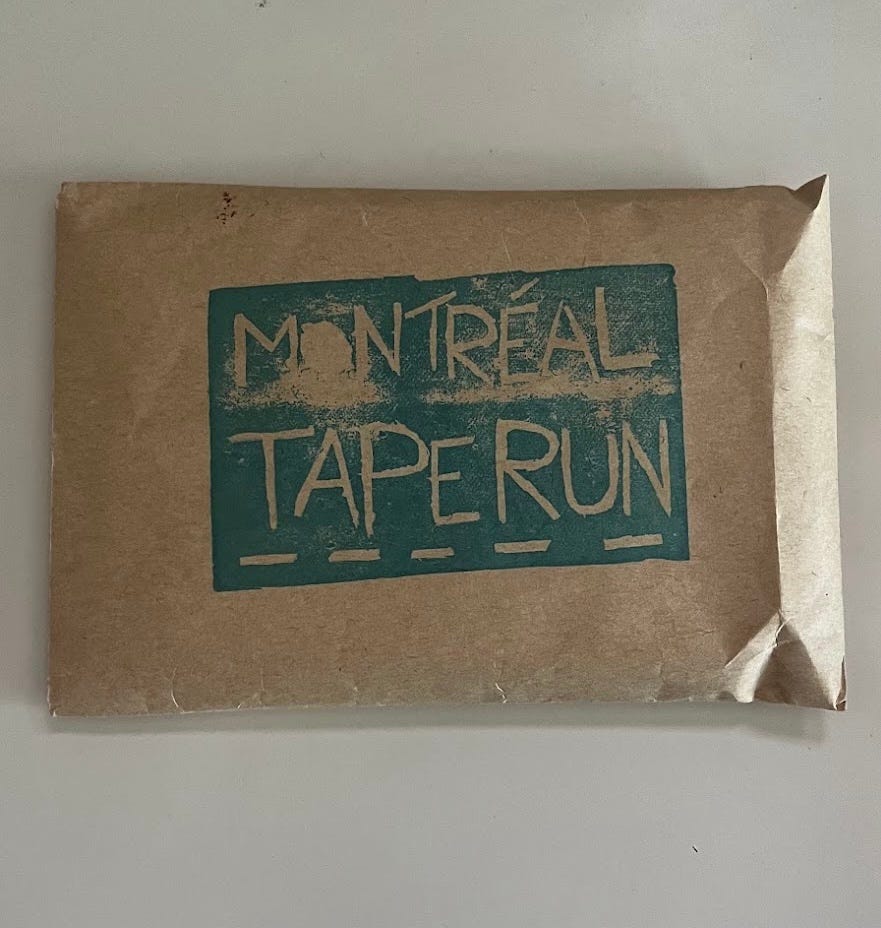
Out of the Box is a monthly series focusing on physical media. It’s an excuse to engage with my collection in a new way, as well as to write about older releases and genres we don’t often cover at ACL.
OUT OF THE BOX #31
Various Artists ~ Montréal Tape Run (2012)
One might object that Montréal Tape Run is just a limited edition cassette, but the medium here is as aligned with its process as Kate Carr’s SD card (OTB #27). A kind of audio exquisite corpse, a tape was passed between ten Montreal artists over ten days in September 2012, a real-life add-and-pass mail art project. Each copy is a facsimile of that original tape, including the awkward pauses, silences, and other imperfections.
The rules were simple. Each runner received the tape, recorded a few minutes of sound, and passed it on to the next. What accumulated over those ten days was forty minutes of sounds—field recordings, electronic tones, tape manipulations, voices, silences—and a document of a city and a scene at a particular moment. But it was also a document of the process itself: the passing of hands, the trust involved, the willingness to add to something without knowing where it would go. It’s less a compilation than a single collaborative work, the result of a process rather than a collection of discrete pieces.
At the time, I was unfamiliar with Anne-F Jacques’ work, but I knew Magali Babin, Martin Tétreault, and Hélène Prévost as artists representative of an influential generation of francophone Québécois experimental musicians, improvisers, and composers. Alain Lefebvre, Andrea-Jane Cornell, and others represented a younger generation, but again, at that time I may not even have recognized their names (though by the end of 2013, I would play with Cornell as part of a quartet telematic performance at Eastern Bloc). The tape is as much a portrait of Montreal’s French-speaking experimental community as it is a collection of sounds.
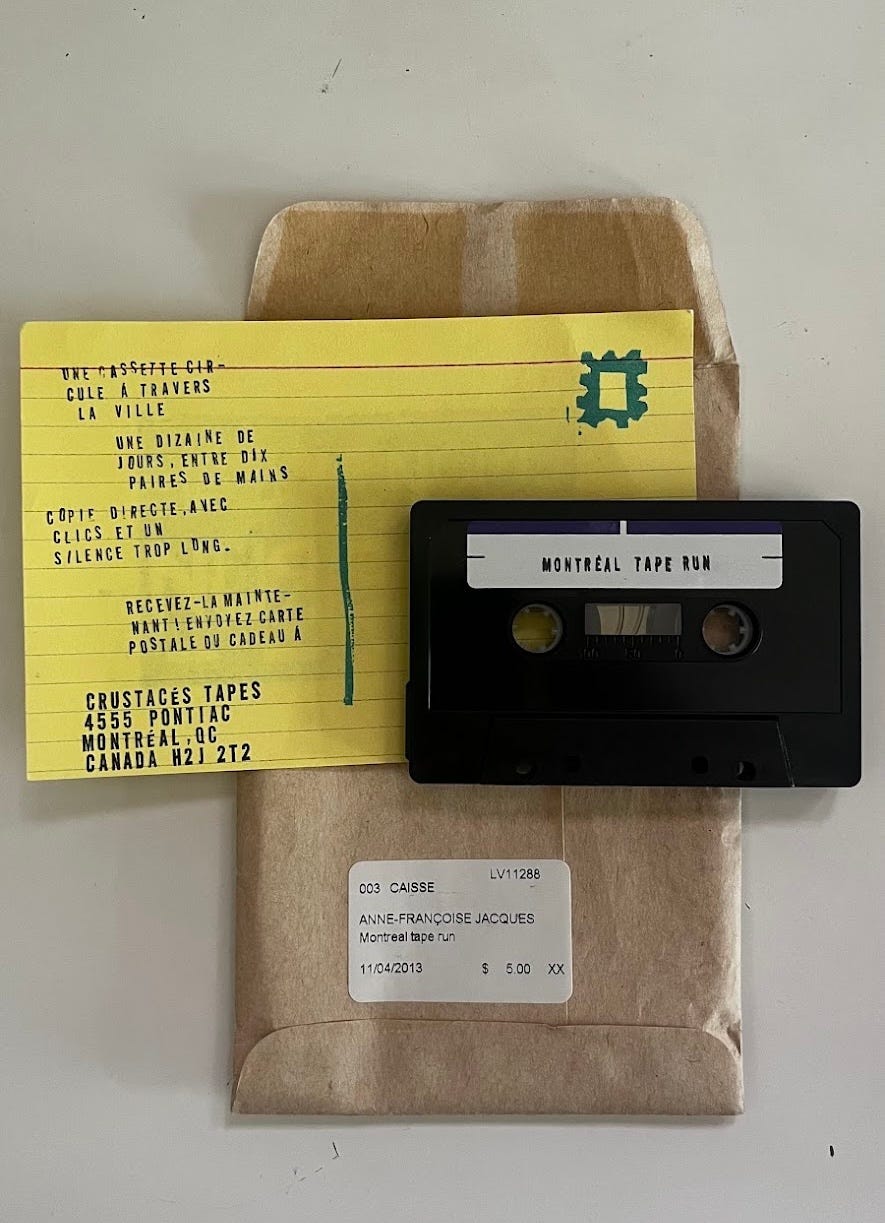
I picked up this tape, not in exchange with Anne-F, but at the bookstore of the Canadian Centre for Architecture (CCA) shortly after its release. I would later spend a good deal of time at the CCA with the archive of Gordon Matta-Clark, and, as is the case with many great museums, I’m an equally big fan of their bookshop. I had also recently written about Martin Tétreault’s Turntable Quartet at Akousma 2012 for eContact. But I think what grabbed me was less any knowledge of the participants than the concept itself. The envelope and the stamped cover, the general DIY quality of the whole project resonated with me, playing off the aesthetic of the postal system and the networks of exchange it represents and makes possible.
I was already interested in cassettes by then—after my grandfather died, I inherited voice recordings he had made, cementing an important connection between DIY recording, archiving, and intimacy—but I had also recently begun researching the mail art network and its connections with cassette culture and the broader DIY subcultures of the pre-internet era. Montréal Tape Run seems to play at the intersection of these histories: the cassette as a medium of personal exchange, the mail art network as a decentralized system of distribution, the postal system as both infrastructure and aesthetic.
The physicality of raw field recordings on tape appeals to me, and in particular the messiness of the recording-as-editing process. Some recordings on this tape have that feeling—the tape player as fly on the wall. But the rules aren’t as strict as my own on Jorge’s Guide to DF. Some contributions are raw field recordings made on tape, while others are studio works, and others still sit somewhere in between. It isn’t necessary to recognize the origin of the sounds—the entire tape has this acousmatic quality. With the tone and style shifting every four minutes or so, and silences sometimes stretching quite long, the tape gives the impression of a journey.
Andrea-Jane Cornell opens the tape with ominous baritone drones, scratching microphonics, and aqueous vocals. Magali Babin’s “Archives 1989-99” layers multiple tape recorders—Realistic, Talkboy Deluxe, General Electric, a Radio Shack answering machine—started one after another. Alain Lefebvre’s contribution is built from tape deck output, pedals, and tape deck input, producing heavily processed pulses that slowly give way to something delicate and feathery. Hélène Prévost’s “Crayon Maçon” documents the demolition of an interior wall, two stonemasons working outside, and Prévost sharpening a pencil, all captured through a live microphone in her studio and layered into something that evolves from invasive hammering into mundane polyrhythm. Anne-F Jacques’ practice is hard to imagine if one has only heard the audio, but having seen Jacques perform a number of times, I can get a better sense of her approach: she tends to set up and manipulate various junk she’s salvaged, turning on light bulbs or moving vacuums in proximity to her microphones. Her contribution here is titled “Bialetti Express,” after a stovetop coffee pot, which helps make sense of the liner notes: “microphone, microcassette, need for coffee.”
Despite his role as a manipulator of vinyl records, Tétreault’s noisy tape transfer of the Golden Voyager LP begins the B-side with the distinct artifacts of tape: wow, flutter, saturation, hiss. The liner notes are increasingly less helpful. “Rainbow banana” tells us little about what Dona Silicon is up to. Seemingly live, unprocessed field recordings—the mic approaching a room full of conversation—are gradually overtaken by tones that loop and stutter to beautiful effect. Silicon is playing with the layers of time and accrual afforded by the tape without being obvious. grkzgl’s “Villeray, Western sauce (take 4), spring box, fuzz, eq, etc” is equally opaque despite including some of the means of production, but seems to document a performance, full of electroacoustic / DIY concrete. In contrast, the gentle hiss of N Tobin’s “Tape Worm” is a welcome relief, the hum of a vacuum with only the occasional punctuation of electronic interruptions. Joshua Bastien’s untitled closing piece leans fully into disorderly and lo-fi acousmatic rustlings. It’s these final additions that resonate most with me: mixtures of field recordings and processing, the clutter and distortion of handheld tape recorders.
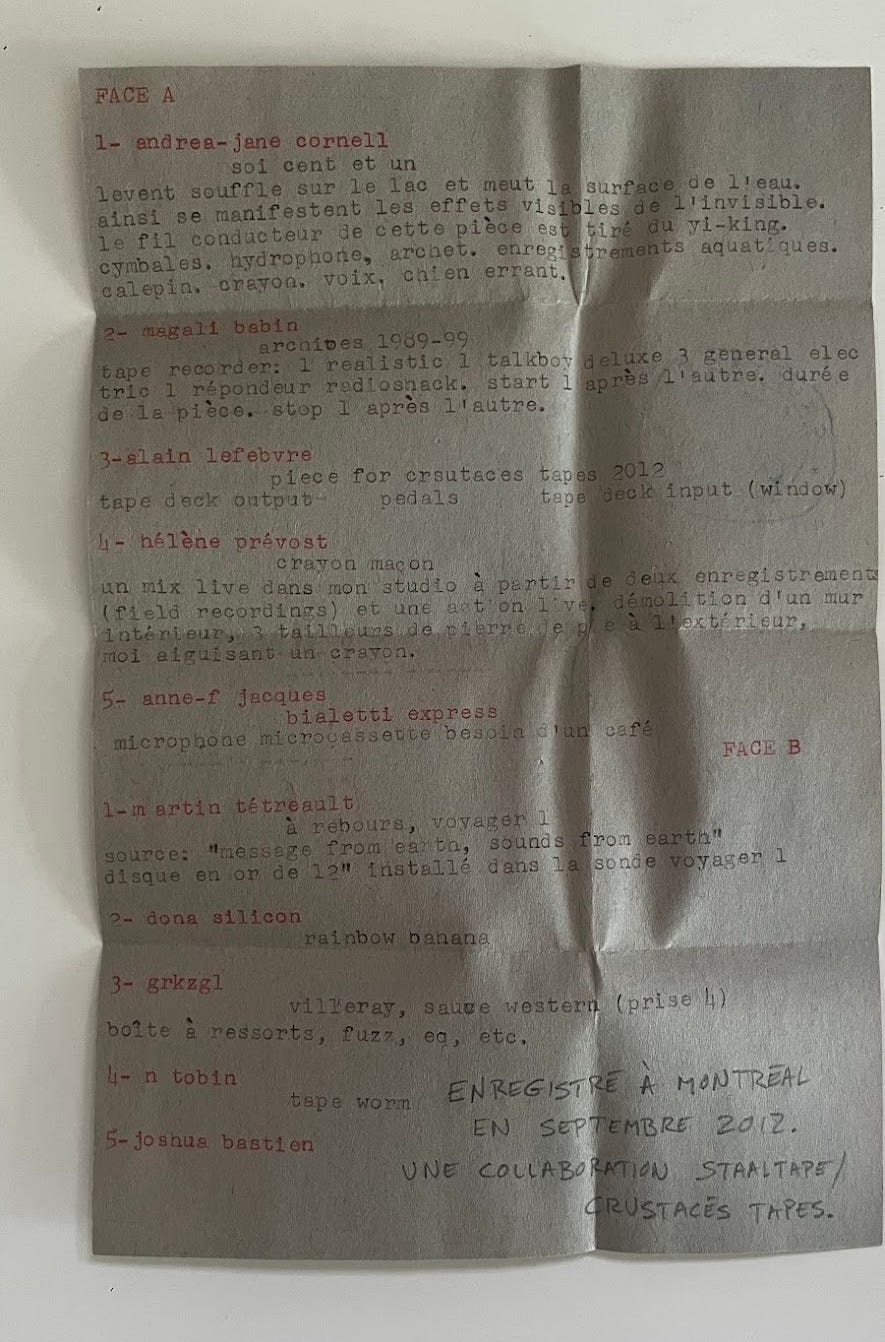
The project’s origins explain some of this looseness. Montréal Tape Run was a joint venture between Staaltape—the cassette arm of Staalplaat—and Anne-F Jacques’ own Crustacés Tapes, released in late 2012. The project was inspired by the Berlin Tape Run (2009) in which a cassette circulated from hand to hand across Berlin. The Montréal version followed the same model. What interests me most about Montréal Tape Run is not just the sounds—which are diverse and often delightful—but the way the object encodes a set of relationships.
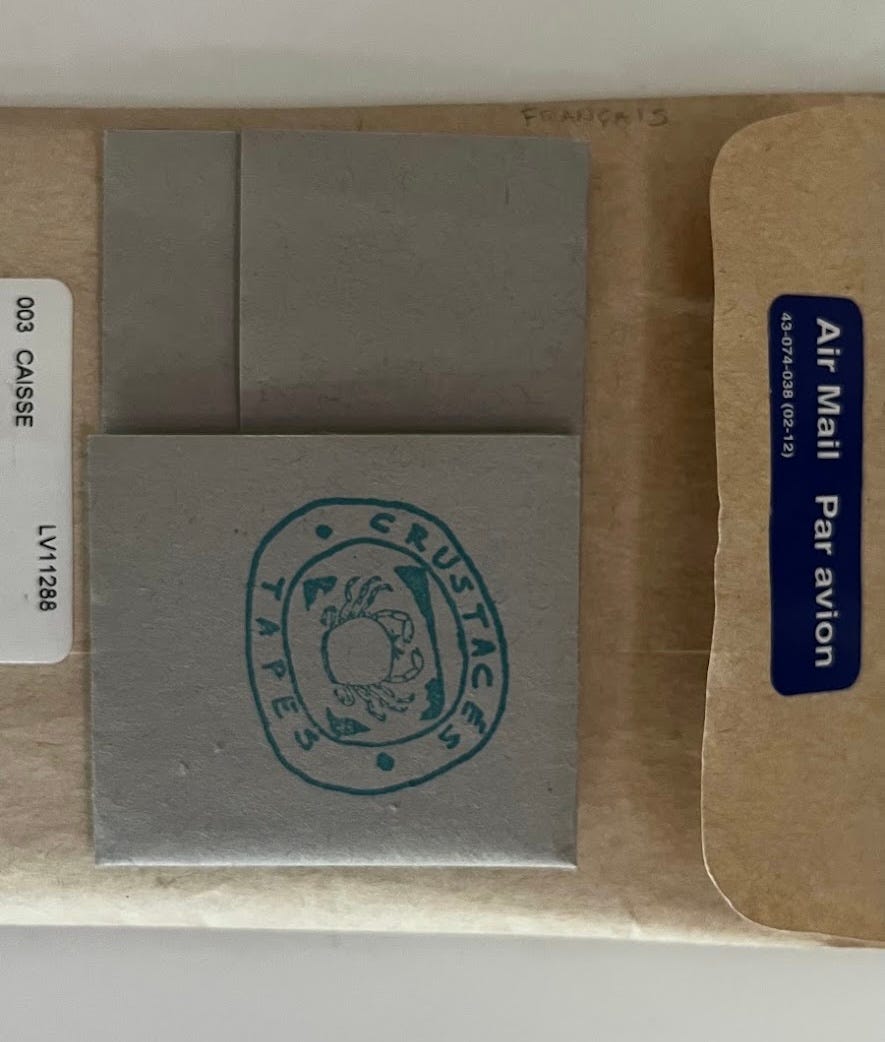
And while I didn’t come to this tape through the mail, I appreciate the symbolism at work. The packaging is suggestive of the tape’s journey, past and future, a continuity of imagery carried through from the stamped envelope to the inserts and the tapes themselves. The packaging isn’t a container for the object so much as part of the object, and for this reason belongs as part of Out of the Box. I don’t keep Montréal Tape Run with most of my tapes; it sits prominently on display alongside the other misfits.
Sending a cassette into the world and expecting one in return—or sending it on to the next person, trusting that they’ll add something and pass it along—requires a certain leap of faith. It’s an exchange outside the usual channels of commerce, a relationship with someone you may never meet, made manifest in physical form. May others make journeys of their own.
In an era when digital distribution has made experimental music more accessible than ever—a development we should all take full advantage of as both listeners and artists—it’s worth remembering the value of exchange that takes time, that asks something of you in return. Montréal Tape Run is one such exchange. It’s a cassette, yes, but it’s also a network, a conversation, a record of trust. I didn’t come to it through the mail, and I haven’t passed it on. But it sits on my shelf as a document of what happens when someone does.