
Out of the Box is a monthly series focusing on physical media. It’s an excuse to engage with my collection in a new way, as well as to write about older releases and genres we don’t often cover at ACL.
OUT OF THE BOX #30
Michael Ridge ~ Padlock Loop (2019)
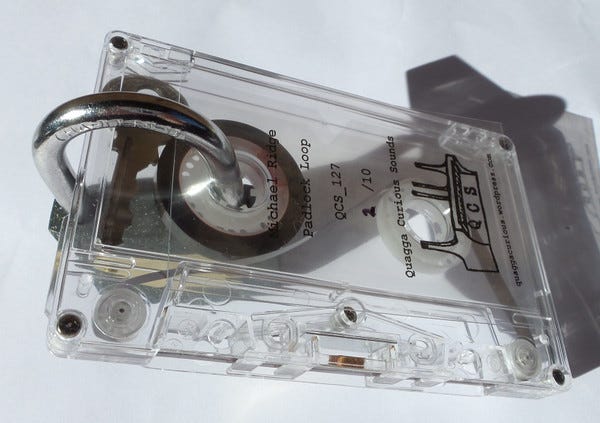
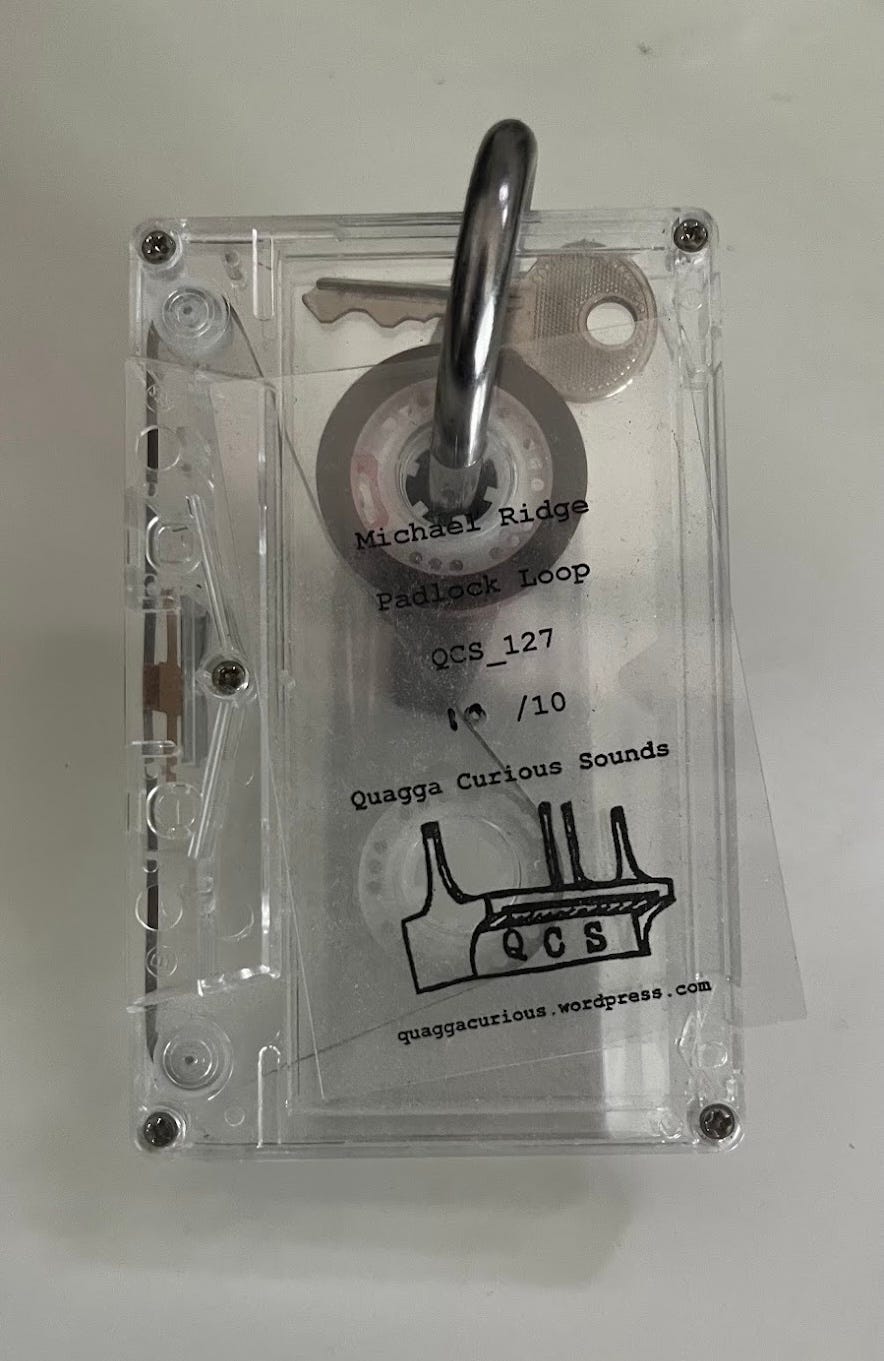
The last few installments have been quite lengthy, and while this installment is relatively svelte in comparison, it’s no less compelling of an object: a padlocked cassette tape with the key inside. Released in 2019 by Quagga Curious Sounds in an edition of only 10, Michael Ridge’s Padlock Loop is very much in the same spirit as Auris Apothecary’s “anti-releases” (as detailed in OTB#28). Like Deep Magic’s microcassette, Ridge’s offering demands to be dismantled before it can be heard, but unlike the patient enforced waiting—the improvised ritual of burning the candle to free the tape—Padlock Loop requires a bit more finesse.
I must admit, I always liked the object as an object. For years it sat on my shelf—sometimes alongside the other cassettes inside my collection, sometimes as a knick-knack on the book shelf, and most recently alongside a sculpture by Maria Chavez as part of a display of mute sound objects—as a curiosity I'd occasionally pick up and examine, never quite compelled to open it. The padlock, the key wedged inside the translucent shell, the sheer absurdity of it, this was all enough. The object’s concept is so strong that the sounds themselves seemed almost beside the point.
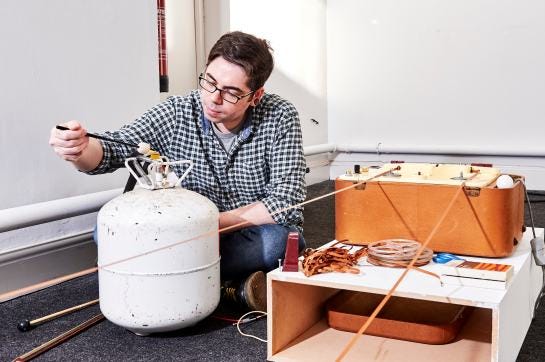
Based in the English city of Norwich, northeast of London, Ridge’s work spans sound, video, photography, performance, and collage. Their sprawling practice orbits around sound reproduction and audio cultures—how we record, preserve, and listen—while engaging with questions of memory, selfhood, temporality, and the role of chance in creative work. Under several aliases, most notably Zebra Mu, Ridge records experimental noise music and runs the DIY label Quagga Curious Sounds. Zebra Mu’s work is characterized by circuit-bent electronics, contact microphones, tape loops, and field recordings, often repurposing unwanted consumer goods. Ridge has exhibited and performed widely, and from 2008 to 2015 was a member of the Norwich-based artist collective other/other/other. They also build experimental sound boxes and upcycled microphones—I’m fairly certain documentation of these objects on their Instagram is how their work first crossed my radar. And perhaps for this reason I’ve long regarded them more as an artist than a musician, and was content to appreciate Padlock Loop for its concept rather than its sounds.
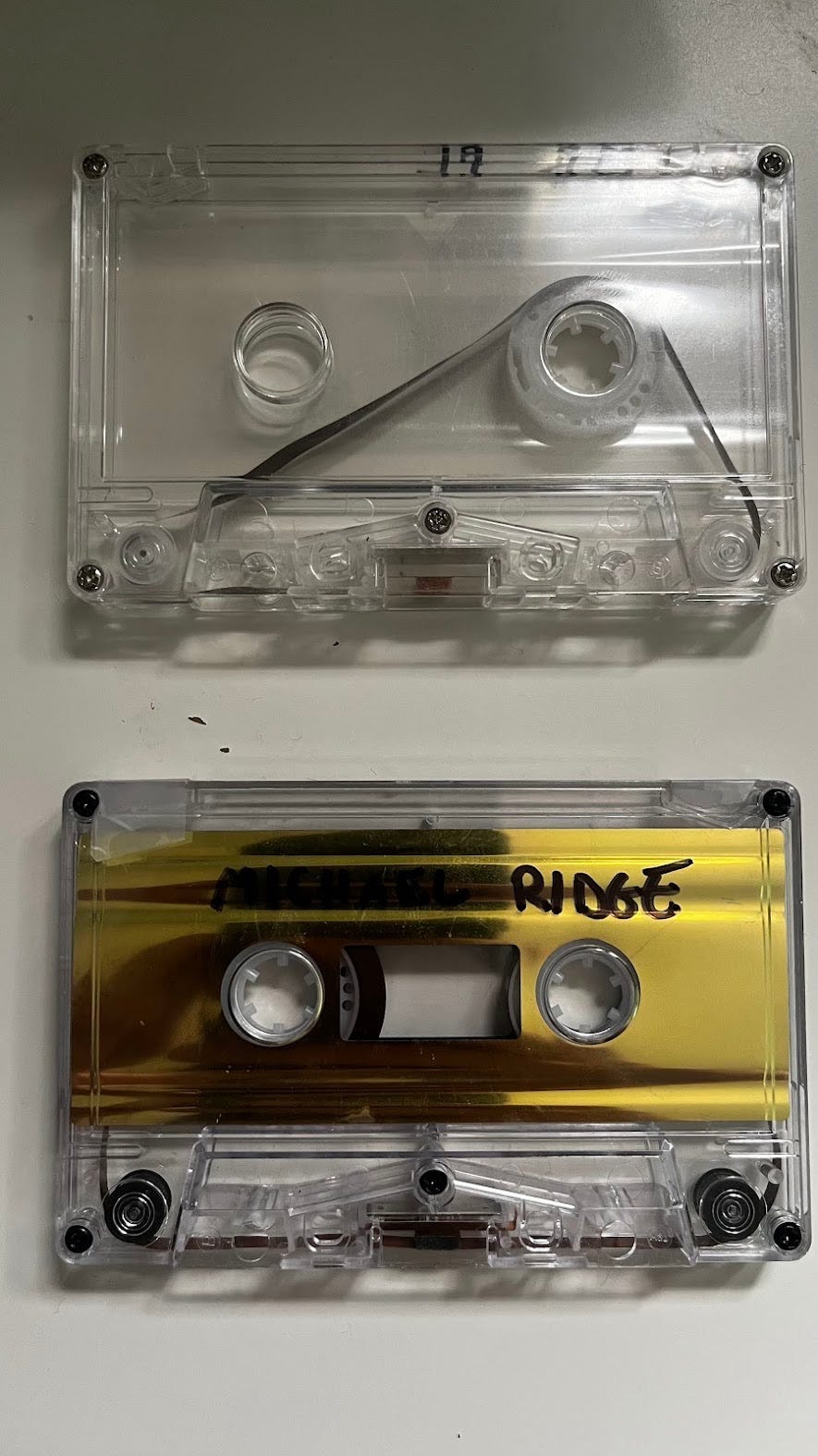
But writing this feature finally inspired me to actually do what the release asked. The tape includes a five-second tape loop as well as a C18 reel of tape, against which the key was wedged. I fetched a small screwdriver from my drawer, unscrewed the cassette shell, freed the key, and unlocked the padlock. I found a spare tape shell from my own stash of blanks and tape loops, configuring the loop itself in the original shell while moving the spool to the new tape, struggling to find a take-up reel and then again to get it running. But run it did, releasing abstract sounds that I suspected must surely be the sound of the lock itself.
In 2024, Ridge would produce another padlock work for the Teeny Tiny Art Show, mounting a hand-cut transparent 0.75” lathe cut record on a small luggage lock, with each side containing six seconds of the amplified vibrations of the key turning and the lock mechanism locking and unlocking, captured through a contact microphone. This confirms for me what I hear on the Padlock Loop is indeed the mechanism of its own arrest: the five-second loop and the longer reel are essentially documentation of the very object that prevents playback. The key to unlocking the tape is, quite literally, the key to unlocking the tape. It’s a closed loop in more ways than one.
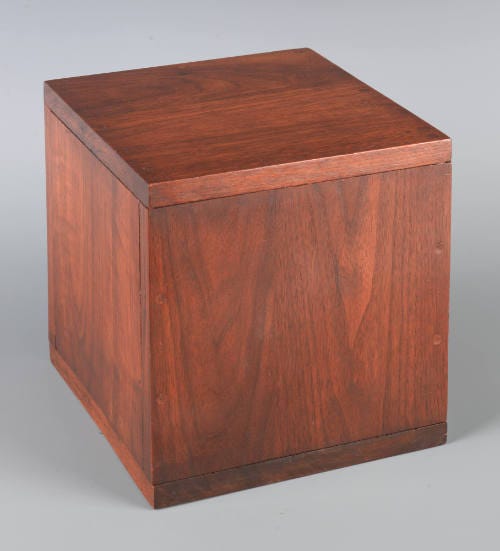
This fact recalls Robert Morris’ foundational work, Box with the Sound of Its Own Making (1961), in which the pioneering conceptual artist recorded the sounds of constructing the box and played them back within it. Ridge’s Padlock Loop operates on a similar principle, but with an added layer of obstruction. Morris’s box contained its own origin story; its sounds reveal the labour that happens without an audience. Ridge’s tape, in contrast, contains the sound of its own impediment. To hear it is to undo the very thing that makes it what it is.
Ridge’s work has long engaged these kinds of conceptual loops. But Morris was a sculptor using sound as a conceptual tool, not a musician, and he certainly didn’t intend for the box sounds to be heard out of context. Ridge’s practice is squarely situated in music and audio culture—even as it frustrates the very act of listening. Still, the self-referential obstruction of Padlock Loop isn’t entirely without precedent in the world of music, even if Ridge’s approach is more literally locked. Its short, anti-musical loops remind me of Ron Lessard’s Lock Grooves records released by the legendary Lowell, Massachusetts label.
Since the 1980s, RRRecords has built an incomparable reputation as a prime distributor of American, European, and Japanese noise and experimental music. The Lock Groove series began with the RRR-100 7” in 1993, expanded to a remarkable 500 participants on the RRR-500 12” LP, and reached its logical (?) extreme with RRR-1000, where 20 artists contributed 50 nano-compositions each. Those 1.8-second grooves exploited the unique physical quirks of vinyl, rendering each record nearly impossible to navigate and each cover hand-assembled into a unique work of art. Though much more singular, Ridge’s Padlock Loop operates in a similar spirit—perhaps raw material for further work, or simple curiosities, but above all, conceptually interesting art objects.
What does it mean to release music that actively resists being played? This of course has been my fascination with Auris Apothecary’s anti-releases. Lessard’s lock grooves were technically playable, but the listener had to work to find them, to drop the needle in precisely the right place, which in practice means embracing chance and happenstance. Ridge goes further: to play the loop, listeners are required to unscrew the cassette shell, remove the key, then reassemble the cassette loop and C18 spool.
Since the padlock dominates the object, traditional packaging is impossible. This also further elevates the object as an art object (rather than a musical one), but some information is still necessary. As such all information is printed onto a small transparent acetate sheet, fixed to the tape via the lock. If you don’t wish to take your copy apart, Ridge offered to send the tracks digitally.
But of course, that defeats the purpose, and for that reason I never took them up on this. The digital files would be identical in content, but they wouldn’t be this, and more than usual the medium does seem to be the message. For years, I was content to allow the mute object to speak. But having finally done so, there is a certain satisfaction of solving the puzzle, a tactile pleasure in unscrewing the shell, freeing the key, clicking open the padlock, and properly refitting the loop, a quiet thrill of reassembling the cassette and pressing play, hearing the very sounds of the lock, now defeated.
The edition is only 10 hand-numbered copies. This is not a mass-market object, not even a niche-market object. It’s an artwork disguised as a tape, a puzzle disguised as a release, a meditation on access disguised as a physical format. Ridge isn’t chasing retro charm or vinyl nostalgia; on the contrary, they may very well be doing the opposite, frustrating those very desires, locking them in place. If anything, that may be the real reason I waited nearly seven years to free these sounds from their prison. In doing so, I feel as though I’ve fully embraced the object itself.
Padlock Loop cultivates a different kind of listening, even if the results are rather unwaveringly repetitive and non-musical. Unlike Morris’ famous box, there’s no revelation here. I listen less to the sounds themselves and more to myself in the act of listening. Some of the previous objects featured in this column this year represent roads not taken, but the padlock was never going to launch a trend or become a broader paradigm—it’s too particular. But it did make listening physical, not to preserve the past, but to inhabit the present more fully.
The listener temporarily becomes the maker in order to become the listener.
ridge's IG was a highlight for me, when i was still there