Out of the Box is a monthly series focusing on physical media. It’s an excuse to engage with my collection in a new way, as well as to write about older releases and genres we don’t often cover at ACL.
OUT OF THE BOX #29
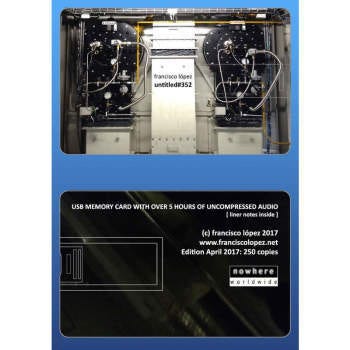
Francisco López ~ untitled#352 (2017)
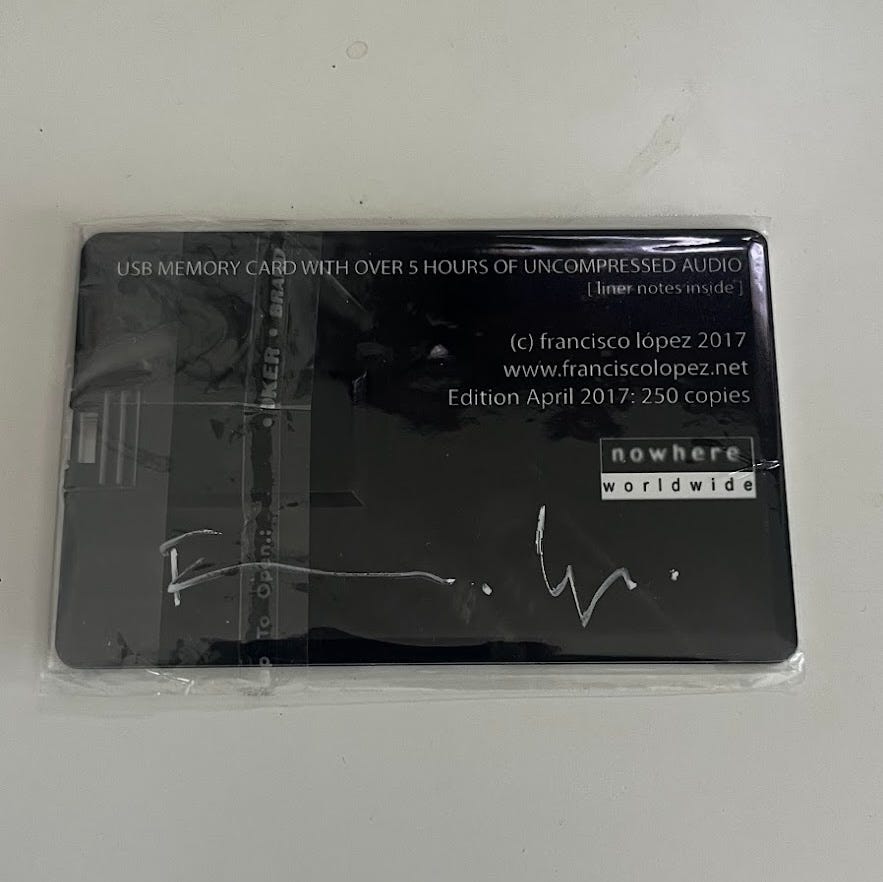
In OTB #26, we examined Jeremy Bible’s USB drive within a black box, sealed with two screws. In OTB #27, Kate Carr’s SD card conjured the releases own origins in travel field recordings. Last month, in OTB #28, what remained of Deep Magic’s aromatherapy candle, burned down to a wax-stained cardstock relic on my Shrine. This month it’s another USB memory card, but one quite different in spirit from Bible’s: Francisco López’s untitled#352, released on the UK label Nowhere in an edition of 250 signed copies. Where Bible’s card necessitated work to access its contents, López’s demands almost nothing of the body at all; you plug it in, and then the real work of active listening begins.
For those unfamiliar—though regular ACL readers will know the name well by now—López has spent four decades building one of the most uncompromising bodies of work in sound art and field recording, almost always released simply as “untitled,” numbered sequentially, resisting the kind of narrative or place-based framing that, say, a Kate Carr title invites. López holds a PhD in ecosystems biology, and that training surfaces less as subject matter than as method: an insistence on treating “natural” and “man-made” sound sources without hierarchy, hearing sound-in-itself rather than sound-as-document. Something of that taxonomic detachment carries into the music, if not the field’s penchant for categorization: no titles to bias the ear, no photographs of the source, no liner notes (Nowhere’s digital insert notwithstanding), often no acknowledgment of source at all.
Indeed, a refusal of the visual runs through everything he does; López has long insisted on blindfolded listening at his live performances (a practice Seth Kim-Cohen has critiqued as quasi-fascist). When I interviewed López in 2012, he described his practice as strictly site- and system-specific, building each show around a particular room and speaker array rather than repeating fixed pieces. Submit to that blindfolded listening and, as I wrote at the time, you’re swept into something close to transcendence; resist it and the experience can turn “quite traumatic.”
untitled#352 both continues and complicates that project, and while the source of the recordings is made clear, López’s typical austerity continues to shroud the work. Contained on a memory card USB are five hours of recordings made at a district heating plant—a Régie de Chauffage Urbain—in Fontenay-sous-Bois, outside Paris, broken into ten half-hour “MANTRAcks,” plus a twenty-minute closing piece.
Why a USB card and not, say, a triple CD or a box of cassettes? The Nowhere edition includes the entirety of the boiler plant sessions uncompressed, something no other consumer format could hold gracefully. In his contemporary review at A Closer Listen, Richard Allen frames the format decision plainly: were this a multi-disc box set the scale might feel like overload, but as a USB card, he writes, “it works.” I’ll go further: the format isn’t just a practical solution but part of the work itself. López is asking how much we actually want to hear, and a drive that holds all five hours without flinching puts that question to the listener directly, materially, before a single MANTRAck even plays.
Here’s what I wrote for our Top Ten Field Recordings of 2017:
López has always been an uncompromising artist, but untitled#352 deserves recognition for its sheer stubborn ambition. López presents five hours of uncompressed raw field-recordings made in a boiler plant near Paris, letting the listener find mantric rhythms buried in the drone of machines that we rarely think about yet play a central role in urban life. The final 20 minute composition, produced for Anne Collod’s choreographic project Exposure, draws upon and mutates that raw material in a way that requires the dedicated listening familiar to fans of López’s work. Yet the preceding five hours doesn’t just grant some small window into Lopez’s process but primes the listener to listen with greater virtuosity.
I was picking up a similar thread from Richard’s review, describing how the drone in each MANTRAck conceals rhythms that only reveal themselves with patience, at one point comparing what’s buried in the static to an IDM track hidden inside the plant’s machinery. That’s the trick of the whole card: nothing here is static in the pejorative sense, even when it sounds, on first pass, like exactly that. Rather than present “untitled#352 - Soundtrack Exposure” first and then the raw material, like a magician revealing how he did his trick, he instead primes the listener in how to listen.
There’s also a direct sonic lineage to some of López’s most notable recordings worth flagging. López’s Trilogy of the Americas paired La Selva’s rainforest recordings with Buildings, built from the hums of air conditioners, boilers, and computers inside a New York high-rise, and Wind, recorded in the not-so-quiet barrenness of Patagonia. untitled#352 is, in a sense, Buildings scaled up, and distilled: the boiler plant isolated and expanded from one texture among many into the entire five-hour environment. Where Buildings treated machine-hum as just another ecosystem alongside animal and plant life of his Trilogy, untitled#352 goes further and refuses to leave the machine at all, forcing its mantric patterns out of pure mechanical repetition rather than finding them embedded in a mixed environment. But López is also a thinker of systems, and zooming in on the granular detail of one particular aspect necessarily leads to contemplating the wider systems supported by this very infrastructure which often goes, by design, unnoticed.
What strikes me, filing untitled#352 away next to the other objects on my shelf, is how differently each artist has answered the same underlying question: what does this format let me do that no other format could? Bible’s USB drive granted access to four hours of HD audio no CD or LP could accommodate, and the screws made you work for that access. Otherwise, the material is locked away. Carr’s SD card mirrored the very device she used to record it, drawing attention to her own process. Auris Apothecary’s candle turned listening into a multi-sensory ritual requiring literal destruction. López’s card does something closer to Bible’s gesture—scale as the justification—but the content of that scale is the point in a way it wasn’t for Music for Black Holes. Five hours isn’t just more efficiently stored on a USB drive; five hours is the point. A shorter version of untitled#352—perhaps ten tidy six-minute mantras and the closer, as Richard imagines in his review—would have been a lesser work. As with much noise music, the excess is the thesis.
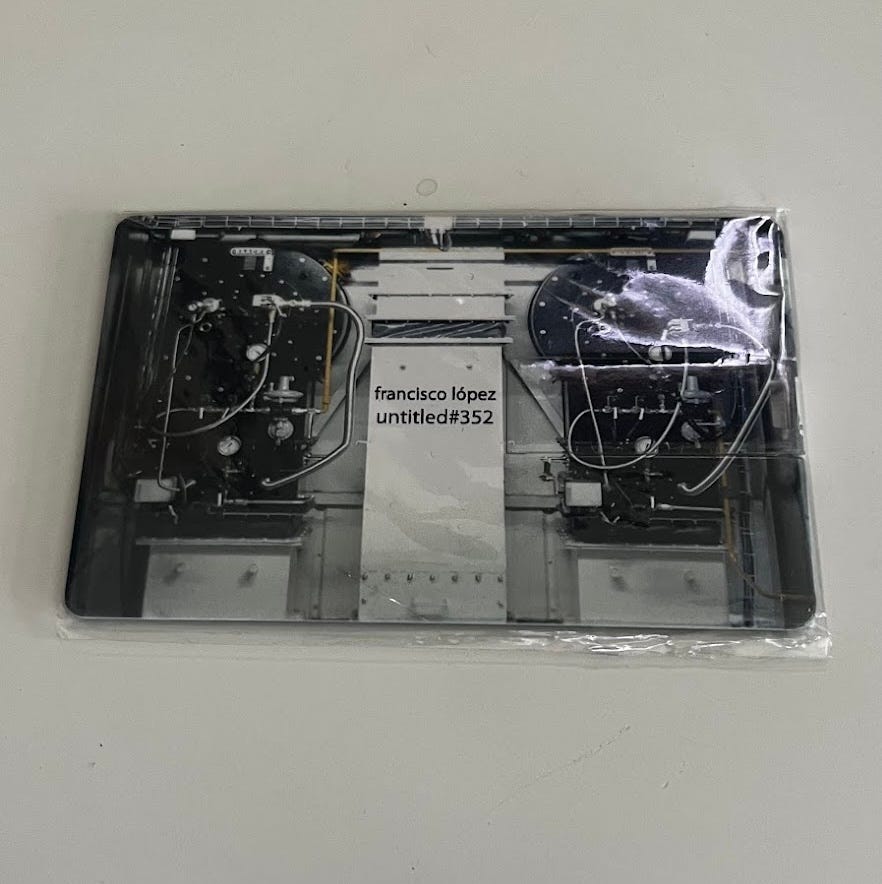
There’s also something worth noting about anonymity and source here, in contrast to the last three installments of the relaunched OTB. Bible named his intentions but not a place; Carr’s whole practice is about naming and complicating a place; Deep Magic named nothing beyond mood and ritual. López names the place with unusual specificity and then asks you to un-hear it as documentary and re-hear it as sonic sculpture. The “intentional clipping” mentioned in the liner notes doesn’t apply to the beginnings and ends of tracks, which are allowed to rise and fall into silence; instead it operates somewhere inside the sustained tones themselves, a compositional decision as much as a recording one.
Störung’s liner notes for untitled#281 carry nearly identical language, describing any digital clipping as “an aesthetic decision” that “is explicitly intentional,” its extent varying with the listener’s own speakers or headphones. It’s a small thing, closer to legal boilerplate than manifesto, but its recurrence across labels and years starts to function as something like a signature: López pre-empting the instinct to hear distortion as accident or failure, insisting that even the harshest, most punishing moments in his catalog were composed, not stumbled into. In fact, don’t worry about the intention or meaning at all, just open your ears (and mind) and listen.
So, why do we do this? Not just hoard physical media, which has been the ostensible question undergirding all of these investigations, but specifically hoard five hours of a Parisian boiler plant on a piece of plastic the size of a credit card. Because, I think, untitled#352 is less interested in giving you an experience than in giving you the conditions to build one yourself, over an unreasonable span of time, the same way Bible’s card asked for four hours of stillness and Carr’s asked you to accept you were only ever overhearing. The USB drive here isn’t nostalgic, isn’t a fetish object, it’s simply the only vessel patient enough to hold what López is actually offering, which is not a piece of music so much as a temporal commitment to listening. Plug it in. Don’t skip ahead. See how long it takes for the plant to start sounding like something else.