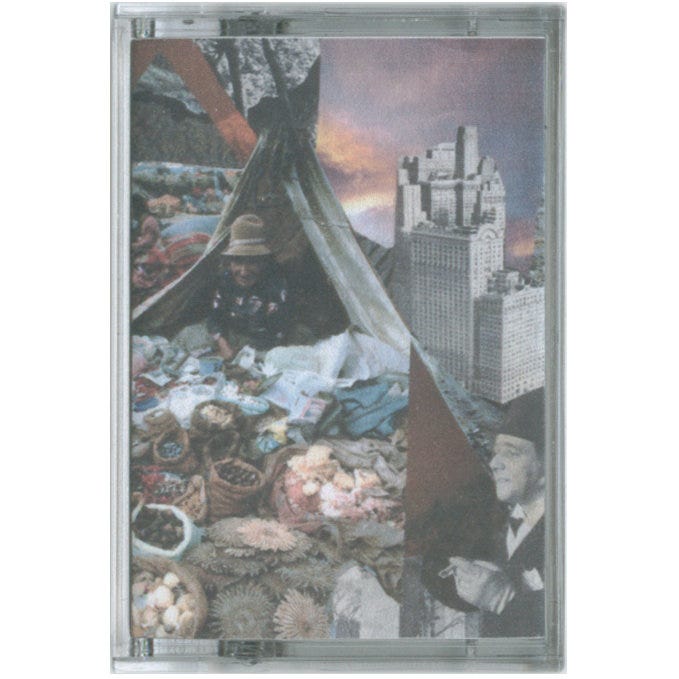
Out of the Box is a monthly series focusing on physical media. It’s an excuse to engage with my collection in a new way, as well as to write about older releases and genres we don’t often cover at ACL.
OUT OF THE BOX #28
Deep Magic ~ Illuminated Offerings (2010)
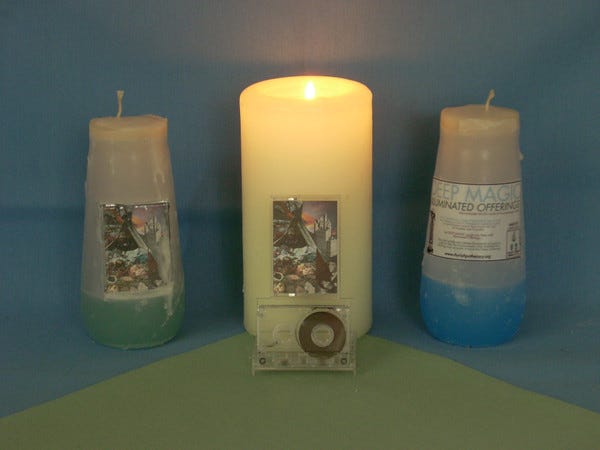
A warm, hazy descending melody unfurls like smoke from a freshly lit wick. Deep Magic, indeed. I was hooked from the opening seconds of Illuminated Offerings, this core refrain establishing itself with ritualistic patience. The fact that this music came on a microcassette embedded in an aromatherapy candle is not incidental: the music was designed for the format. And not just the tape’s low-fidelity grain, but the very vibes that emanate from the object itself—functional yet aesthetic; mundane and mystical—setting the tone for how one is to listen and receive these illuminated offerings.
Illuminated Offerings was released by Auris Apothecary, a label based in Bloomington, Indiana founded in 2008. Simply one of the most interesting labels doing it, AA specializes in physical objects that defy easy categorization. Many of their releases (or, often, “anti-releases”) are obscure or non-playable formats: CDs full of spice, tapes packed with glitter, 3.5” floppy disks, unspooled reel-to-reel tape, a crucified CDr, locked groove lathe cuts, a lathe cut sawblade, recycled VHS tapes, cassettes housed inside NES cartridges, resin-cast records, and even a record made exclusively for a vintage Fisher Price turntable!
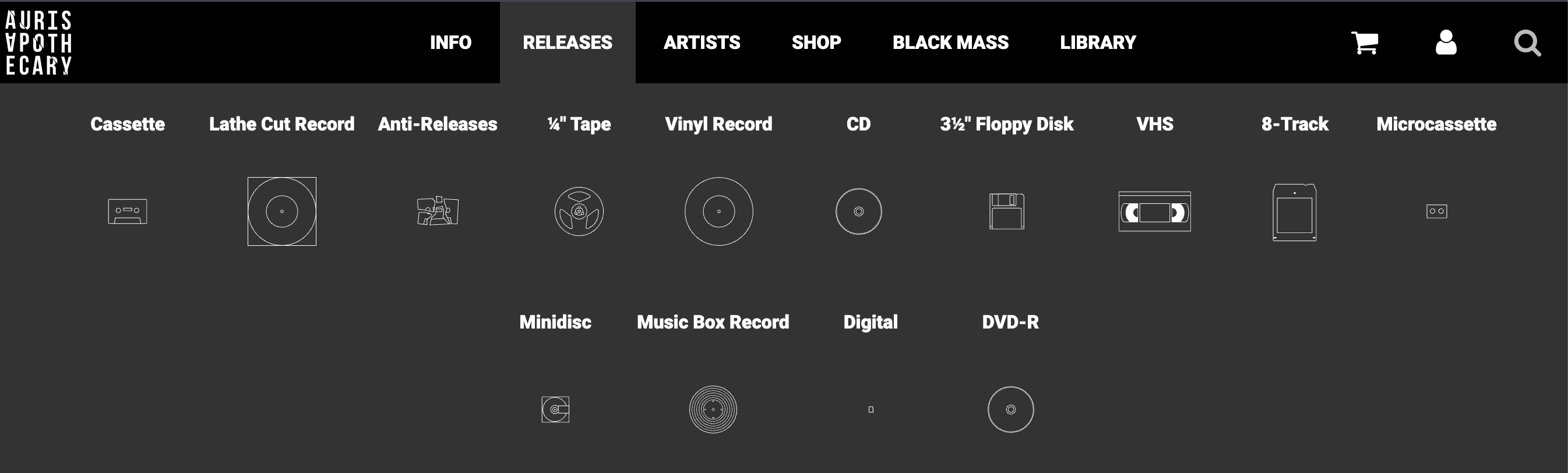
As per my parenthetical interjection above, many of these are “anti-releases”—which is to say, conceptual objects that are inadvisable or impossible to play. But even their traditional releases tend to be on exceedingly obscure formats. I have the utmost respect for these as art objects, even pleasantly hateful art objects, but that shouldn’t overshadow the fact that the label does indeed release sounds that are meant to be heard. In terms of genre, much of the label’s catalogue is electronic, avant-garde, noise, metal, or punk, but Illuminated Offerings is one of the rare ambient-drone releases that is relatively accessible, almost new age, an association the aromatherapy candle somewhat invites. Each release is assigned an “accessibility level”—zero being the least accessible (the anti-releases), nine the most. Illuminated Offerings sits at Level 9, with Zachary Walter’s Drinking Flowers (2023) as its only company.
Accessible, then, but sometimes even accessibility has to be earned. At least, if you’re one of the 25 people who managed to obtain this microcassette MC60 inside aromatherapy candle. I associate microcassettes with answering machines and dictaphones. What kind of music could suit that format? Even the most tranquil vibes and tones in the Auris Apothecary discography requires destruction; in this case, in the form of the consumption of the candle itself.
The label's description says it all:
A lo-fi adventure in tranquil meditation blends with the relaxing aroma of therapeutic scents to create an environment where time stands still and all troubles are forgotten. Let DEEP MAGIC guide you there with Illuminated Offerings, an abstract release containing 3 movements of deep atmospheres on the minimal fidelity of microcassettes, housed within a soothing aromatherapy candle. Burn the candle and release the powers of scent in order to free the microcassette, only available for listening once aromatic nirvana has been achieved.
The packaging itself is a work of art:
Hand-dyed/poured/scented 5” tall candle with either light blue or light green bottom and viewing window cut into side to display cover artwork. Multiple panel, full-color inkjet-printed artwork in clear hardshell case, with flame art on clear label for hand-stamped serial numbering. Transparent microcassette shell with 3-color inkjet printing on white labels. Title/label info printed on white cardstock dipped in wax; serial number stamped in teal. Auris wax branding on bottom.
Every detail is considered, intentional, and thematically appropriate, like the waxy cardstock which maintains the connection long after the candle has been exhausted.
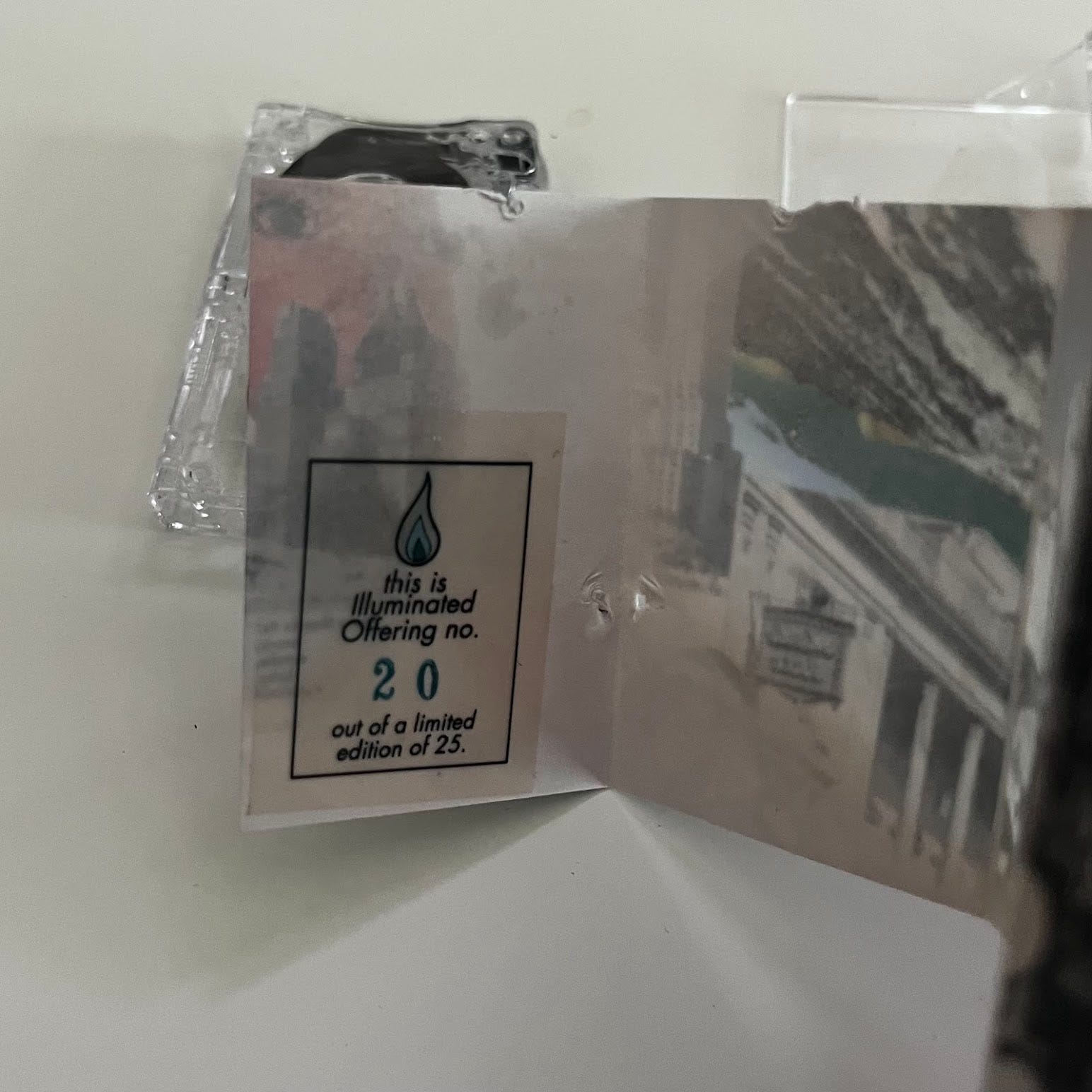
I discovered Deep Magic at a time when I was deep into exploring the fringes of physical media, no longer just digging for cheap vinyl but wading into the thriving, active tape scene of the early 2010s. After encountering Deep Magic and fellow travellers through mp3 blogs like Microphones in the Trees and uaxuctum (just for example; I can’t recall the actual circumstances of my first encounter with Alex’s music, but maybe it was this post on Auxiliary Out), I began playing the pirated mp3s over and over again; when I was reading, writing, meditating, sleeping. Eventually I managed to track down a physical copy of my own. It felt wrong to never burn it—I hate unopened vinyl or toys still in their original packaging; I’ve never been that sort of collector—to refuse its ritual function, but I decided I needed to wait for the right moment.
I don’t remember exactly when I acquired this tape—in 2011 or 2012, certainly after I’d already become obsessed with the music—but I do remember exactly when I burned it: my thirtieth birthday in May 2014. It felt like an appropriately momentous occasion, the uneven proportions of the tape’s three movements symbolically conforming to my temporal experience of the three decades of my rapidly accelerating life. Side one is a side-long piece, while side two is split into two compositions; all three remain untitled. The final movement begins nearly fourteen minutes into the second side. A high register guitar riff is looped against a swelling drone. There’s not much more to it technically speaking, but again Illuminated Offerings is about simple gestures and soothing vibes, not virtuosity or spectacle.
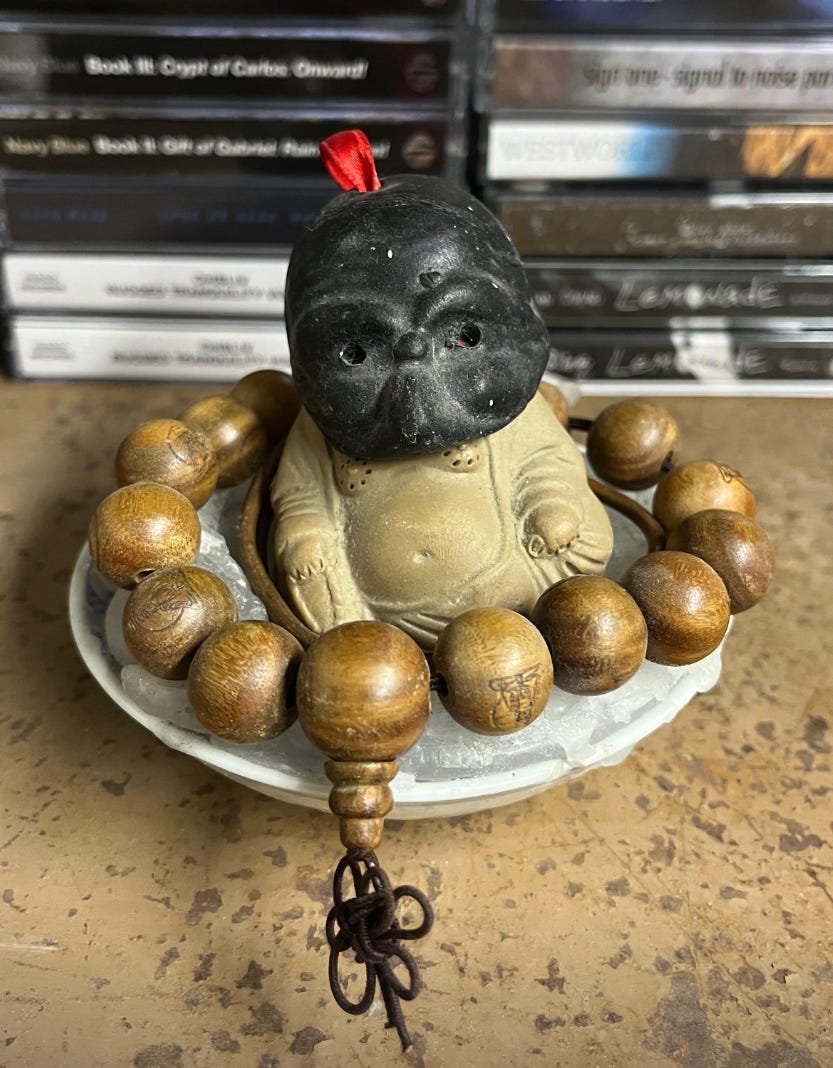
The ritual of burning the candle on my birthday—waiting for the wax to melt enough to free the cassette, the scent filling the room—transformed listening from a passive act into a ceremony. I burned the candle entirely that evening, but the microcassette remains, a relic of a moment when music and object were inseparable, the waxy opacity of the cover art continuing to serve as a reminder. Along with five other objects of personal significance (a tiny ceramic mask from Venice, a Budai from China, sandalwood prayer beads from India, a piece of copper I used to wear around my wrist, and a tea saucer), the remnants of that aromatherapy candle endure as part of an assemblage I later titled Shrine.
The artist behind Deep Magic is Alexander Grawoig (formerly known as Alex Gray), one of my favourite artists. Probably best known for his work as d/p/i (aka DJ Purple Image), other projects include Heat Wave, Chance Images, Genesis Hull, DJ Tribal Shitshow, and Dreamcolour (with Rob Magill), as well as a long tenure in Cameron Stallones’ Sun Araw band. Alex’s work been featured on this site several times over the years, from the very beginning. In 2012 he put together one of my favorite installments in our mix series, setting the bar very high early on, while 2013’s Reflections Of Most Forgotten Love is a record I return to regularly.
Deep Magic featured Alex at his most ambient and relaxed, and he built an impressively lengthy body of work in a relatively short period of time. You’d be doing yourself a service by zoning out to any of these blissful gems. His work as Deep Magic, which tended more towards longform acoustic ambience, remains a standout from the tape label era, but that was always merely one arrow in Alex’s quiver. His concurrent work as Heat Wave was a rhythmic take on sound collage, often reworking R&B and soul samples, a vernacular that morphed into Purple Image. As D/P/I, Alex was one of the most singular voices in the LA beat scene, pursuing mindfucked abstraction as far as he could while often still sampling and referencing pop music in his own twisted way. [See She Was No Tame Thing, a collaboration with Ahnnu that radically reimagines a Drake album, or his flips or “IMAGEREVISIONS” of Gucci Mane, Soulja Boy and Lana Del Rey.]
[Fuck KKR and the Boiler Room of today, but bless the BR of day’s past for putting on sets like the above, or this classic.]
D/P/I conjures a total manic frenzy in contrast to the meditative vibes of Deep Magic. With the self-released “Ad Hocc,” an up to 6-channel work on USB card reimagining field recordings and processing from 2015, and “Composer,” a work of dense rhythmic fragmentation released on Shelter Press in 2016, Gray seemed to have taken D/P/I as far as he could go, and soon after retreated from public view, now living in Mexico, where he turned his attention to painting, a move that makes sense given his long history as a graphic designer and his interest in abstraction and collage. (But don’t confuse him with the acid-kitsch of the other Alex Grey.) He remerged during the pandemic, but not long after removed his Bandcamp page entirely. In 2023 we hosted the video premiere of “So Little Remains,” and he’s recently told me we can expect more guitar and bass centric records in the future.
Alex created the artwork for many of his tape releases, often physical collages, running the art-centric label Deep Tapes to put out limited releases of works by himself and his friends. The laptop still wasn’t quite accepted as an instrument for performance at the time, and bands dominated over solo projects. For fringe psych/noise/shoegaze/experimental groups, the affordability of interfaces and DAWs accelerated the freedom unleashed by the four track, leading to a proliferation of solo projects. The affordability and size of tapes made them an appealing option as archives for their solo work and as tour support and promo. Illuminated Offerings arrived at this interesting moment in underground music.

Today we hear about internet micro-genres and scenes (vaporwave, slushwave, signalwave, etc) but much of the music I gravitated to—then and now—preferred to revel in the ambiguity of genre; all-genre or no-genre. Contemporary labels like Astral Spirits, Constellation Tatsu, LEAVING, Hausua Mountain, Orange Milk, and Umor Rex are carrying on this legacy today. Still, whatever you want to call it, the influences are there. As Alex describes it, “Deep Magic is mystical music. Inspired by minimalism, spirits, love, primitive music/culture & aural meditation/healing.” Alex started the project in his hometown in northern California and into a brief stint in Oakland, but it was really in Los Angeles that Deep Magic found fertile soil.
It began in 2009 with Crystal Visions and Balance, before a host of tapes in 2010 building on this pathway, including Planetary Roots, Soul Vibration, Celestial Communion, and Levitation. The titles and artwork convey the mood well. These cassettes are mostly side-long untitled compositions, or more likely deep improvisations or channelings, often captured direct to tape with little or no computer editing or processing. Lucid Thought (2011) and Reflections Of Most Forgotten Love (2013), both for the Preservation label, are probably the most fully formed Deep Magic projects, with discreet tracks and song titles. Solar Mediations (2010), released by Not Not Fun, and CLOSED EYES (2012), released by Debactle, are in the same vein, but feel closer to those straight to tape experiments. Even still, the former consists of seven movements of “Minds In Lucidity,” while the latter flows as smoothly as any of the tapes. Deep Magic zones out on subtleties the way that only minimalism can, making him a prime candidate to devise a work like Illuminated Offerings.
It’s always a revelation when you discover a scene of like-minded individuals, and I was instantly blown away by the diverse and prolific tape scene of that era. It’s hard not to be when confronted with music this sincere and powerful. The early 2010s saw a flourishing of cassette labels, each with its own aesthetic and community. This isn’t the space for a primer on that scene (such that is was), but let me briefly try to cover the main labels, particularly those Alex worked with.
A few of those labels continue carrying that torch. LA’s Not Not Fun Records, who released their first cassette in 2004 and are still active today, deserve special mention, with a catalogue that includes tapes by Magic Lantern, Sun Araw, Charalambides, Skullflower, U.S. Girls, Gnod, and Mai Mai Mai, cementing important connections with Canada, the UK, and Europe. Portland, Oregon’s Moon Glyph, active since 2009, issues a wild grab bag of psychedelia and ambient, some notables being Lee Noble, PC Worship, Food Pyramid, IE, Ice Blink, and Cole Pulice. Sun Ark, Cameron Stallones’ label, began in 2010 and has released work by Sun Araw, Magic Lantern, Drainolith, High Wolf, and Rob Magill. Magill’s own Weird Cry Records has been active since 2013, mostly releasing his solo works and collaborations as well as a healthy number of tapes by fellow travelers (Dreamcolour, Eugene Chadbourne, Marshall Trammer, Patrick Shiroishi, Shane Parish).
But most labels didn’t last a decade, with many only active for a couple years. Akron, Ohio’s DNT Records (2006-2015) documented Tad, Yellow Swans, and early work by Sean McCann. Fort Wayne, Indiana’s Sacred Phrases (2010-2018) focused on synth and drone-based compositions from the likes of Ekin Fil, Mohave Triangles, M. Geddes Gengras, Sylvia Monnier, Hobo Cubes, Kara-Lis Coverdale, Jesse Osborne-Lanthier/Noir, LXV, Sundrips, and Pulse Emitter. The UK’s Colour Ride (2008-2011) was busy with Gnod, Lanterns, and Jon Collin. Chicago’s Goldtimers Tapes (2011–2013) featured Greg Davis, Derek Rogers, Hobo Cubes, Noir, and Venn Rain. Prairie Fire, a Canadian cassette label active between 2010 and 2013, released Worker, White Dog, Greenhouse, and Celer.
Of course I’ve left out many labels and artists, but this is more than enough to paint a picture of the tape scene that Deep Magic was embedded in, a rich network of collaborators many of whom have since risen in prominence. Many of the major players were outside the main cosmopolitan hubs, the low-investment of tape allowing for a genuine flourishing of DIY production. The late ‘00s and early ‘10s were a moment when the cassette format was being reclaimed not out of nostalgia, but out of necessity and creativity—a way to release music that felt tangible, collectible, and community-driven.
Auris Apothecary took that ethos to its furthest extreme. Founded in 2008 in Bloomington, Indiana, by Dante Augustus Scarlatti (an alias), the label began as “a kind of esoteric spoof” with “the dadaist, absurdist notion was to publicize and release albums you couldn’t hear.” To date, Scarlatti has presided over nearly 200 releases, most often raw textural experimentation in meticulously crafted packaging. The label’s objects require genuine, hands-on effort from the listener, producing reactions that range from sheer bewilderment to pure delight. Scarlatti’s “very real desire to destroy everything” was already there in 2010, but that destructive impulse took a more subdued shape—meditative tones trapped inside an aromatherapy candle.
Gray’s own Deep Tapes, founded in 2009 and operational through 2012, was mostly an archive for his own work (Deep Magic, Heat Wave, Purple/Image) as well as fellow travellers (Earthsurfers, Rob Magill, Lee Noble, Hobo Cubes, Derek Rogers). With DJ Purple Image / DPI and other later projects, Gray often turned to self-releasing CDr or other less conventional formats (more on that in the future) while still releasing major works on vinyl and digital with established labels (Preservation, Shelter Press, etc). From 2015 until 2021, Gray used Zona Music(a) to publish a number of CDs and a USB card, and even a handful of cassettes, but most of the later releases were digital only.
I briefly met Alex in Montreal circa 2012, when he was on tour with Sun Araw, and hung out with him and Cam when they were in Mexico City the next year. As I mentioned, we’ve featured his work on the blog since the beginning, and we’ve kept in occasional touch in the years since. So while I was finishing this piece, I spoke with him to get some useful context and background information. Auris emailed him out of the blue, unexpectedly as Deep Magic’s highest profile release at that time was the recently released tape for Not Not Fun. He remembers Illuminated Offerings as the “weirdest coolest thing” he’s released, with d/p/i’s “ad hocc” a close second. So the idea for the candle and microcassette came from the label, and the music was made very much with that format in mind. He’d recently arrived in Oakland, and his set-up was extremely lo-fi: guitar, a limited set of pedals (including some kind of Boss ME multi-effects pedal), and a tape recorder. To set the vibe, Alex waited until evening, lit some candles, and spread out on the bedroom floor to record some longform channeling direct to tape.
In OTB #26, I noted that Jeremy Bible’s USB drive “made the digital physical, not to preserve the past, but to inhabit the present more fully.” In OTB #27, Kate Carr’s SD card drew attention to, and complicated, the work’s own process of creation. Illuminated Offerings does something else entirely. It’s not about making the digital physical, nor about documenting a place. It’s about transforming the act of listening into a multi-sensory ritual—sight, scent, touch, and finally sound. You can’t just pop it in. You have to commit. You have to wait. You have to participate.
In 2010, a microcassette inside a candle was certainly a rarity, perhaps entirely unique; today it feels almost unthinkable. Let’s return again to Sounds of the Underground (2016), where Stephen Graham argues that prohibitive costs —the logistics that worked against small labels and distributors as costs continued to rise—eventually caught up with many of these operations. Auris Apothecary persists, but the landscape has shifted. Gray himself has continued to evolve, embracing more traditional instrumentation and styles, experimenting with new ways of distributing his work.
But Illuminated Offerings remains a testament to a particular moment when the cassette tape wasn’t a retro fetish object but a living format, when a candle could be a vessel for music, when a limited edition of 25 copies felt like a secret worth guarding. The music itself, three movements of deep atmospheres on the minimal fidelity of microcassettes, rewards the effort. It’s meditative, enveloping, and utterly sincere. It cleanses, massages, and warms from within as it lights from without.
So, Why Do We Do This? Because the act of burning that candle, of freeing the cassette, of committing to an hour of drift amounts to something other than nostalgia. It’s a deliberate pace, chosen in full awareness that now is now. The microcassette candle was never meant to establish a trend or start a series. It’s one of many experimentations in format devised by the mad genius at Auris Apothecary. But it did something even more rare: it made listening physical, not to preserve the past, but to inhabit the present more fully.