Out of the Box is a monthly series focusing on physical media. It’s an excuse to engage with my collection in a new way, as well as to write about older releases and genres we don’t often cover at ACL.
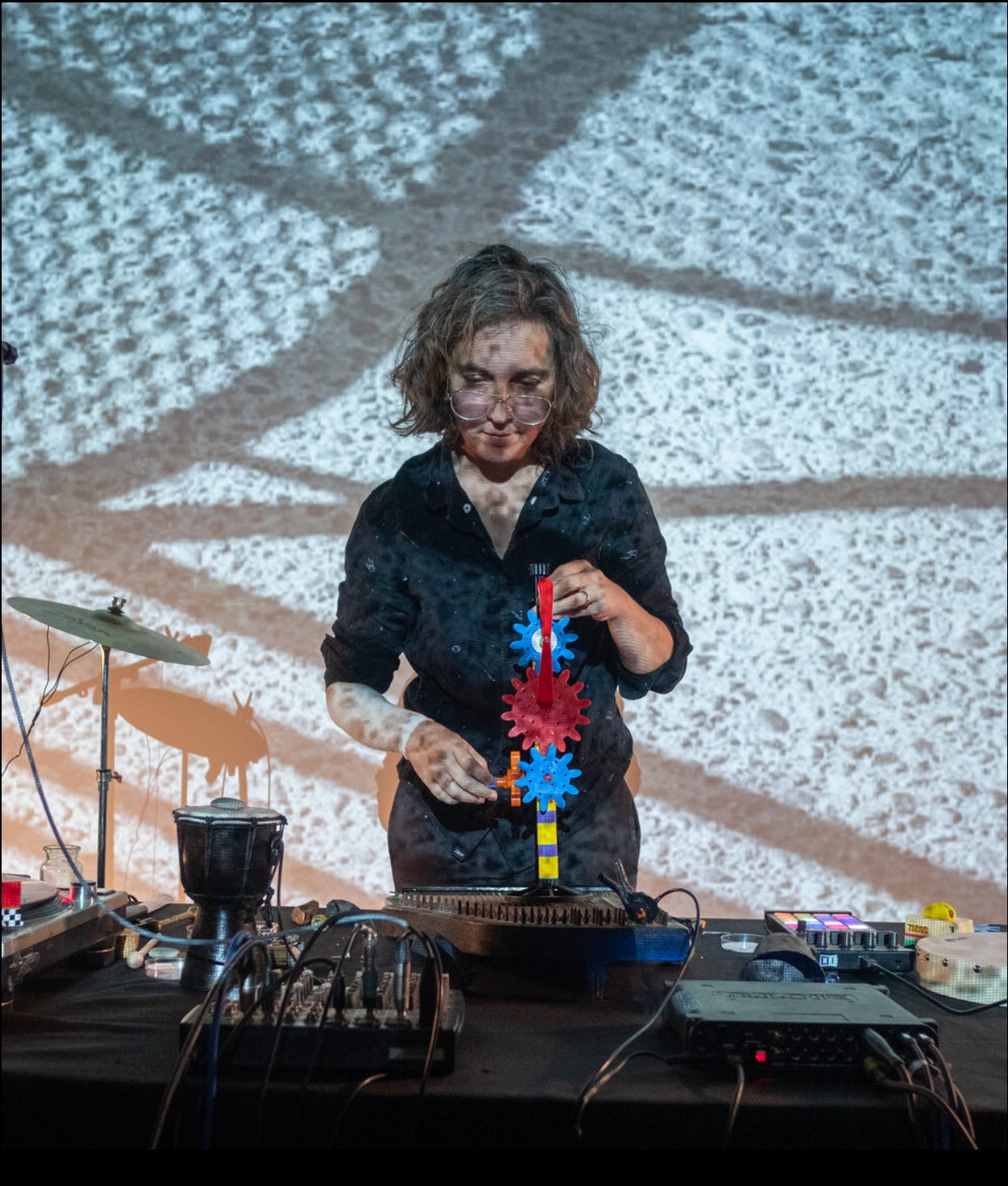
Kate Carr’s work is rooted in the emotional resonances and the potentialities of sound. Her compositions play on these resonances through interactions with environmentalism, urbanism, and technology, with her frequent travel often serving as a starting point for new projects. While work like Doi Saket (2014), Fabulations (2014), I Had Myself A Nuclear Spring (2015), and The Story Surrounds Us (2017) were grounded in field recordings made during the globetrotting Australian’s travels, since I Ended Out Moving To Brixton (2018), Carr’s compositions have increasingly documented her adopted home of London.
Heatwave (2019) was made during a particularly hot weekend in the city, while Midsummer, London (2024) finds Carr tracing the Thames on the longest day of the year. Her latest, Vertical London (New Year’s Day), is something of an inversion, tracing instead a vertical trajectory, moving 20 meters below sea level to 240 meters above on one of the coldest and shortest of days.
Carr’s work is often rooted in a particular time and place, but she’s always been fascinated by the imagination that animates active listening. Carr found her voice as an artist with the founding of her label Flaming Pines in 2011. This coincided with a new focus on composing with field recordings and environmental sounds, as exemplified by that year’s Summer Floods, themes that still animate her work. Rather than (re)present these places (be it London or wherever she happens to find herself) as objective, she relies on the subjective experience of listening (both her own and that of her audience) to harness the interaction of sound and place in ways that are nothing short of fantastic. This tendency in her work has been made most explicit on recent works including Fake Creek (2022) and A Field Guide To Phantasmic Birds (2023).
Surprisingly for an artist known for her field recordings, Carr performs often, with notable concerts as The Barbican, Tate Modern, Whitechapel Gallery, Cafe OTO, and Kraftwerk Berlin. Understandably, then, she has cultivated a distinct practice of live performance, increasingly focused on manipulation of various objects (see her duo Rubbish Music with Iain Chambers, or last year’s solo Rubber Band Music). All of this primer is to demonstrate that regardless of sound source, Carr’s soundscapes are deeply compelling, conceptually clever, and, most importantly, full of sonic intrigue.
In 2015, I published a long conversation with Kate Carr as part of my Sound Propositions series—before it became a podcast—and it’s been interesting to re-read it and look back at her career a decade later. The year prior, Carr had released Lost in Doi Saket/Overheard in Doi Saket, a sound map and limited edition SD card, voted ACL’s number two album of the year in addition to being recognized for the Year’s Best Packaging and Best Field Recordings.
OUT OF THE BOX #27
Kate Carr ~ Overheard in Doi Saket (2014)
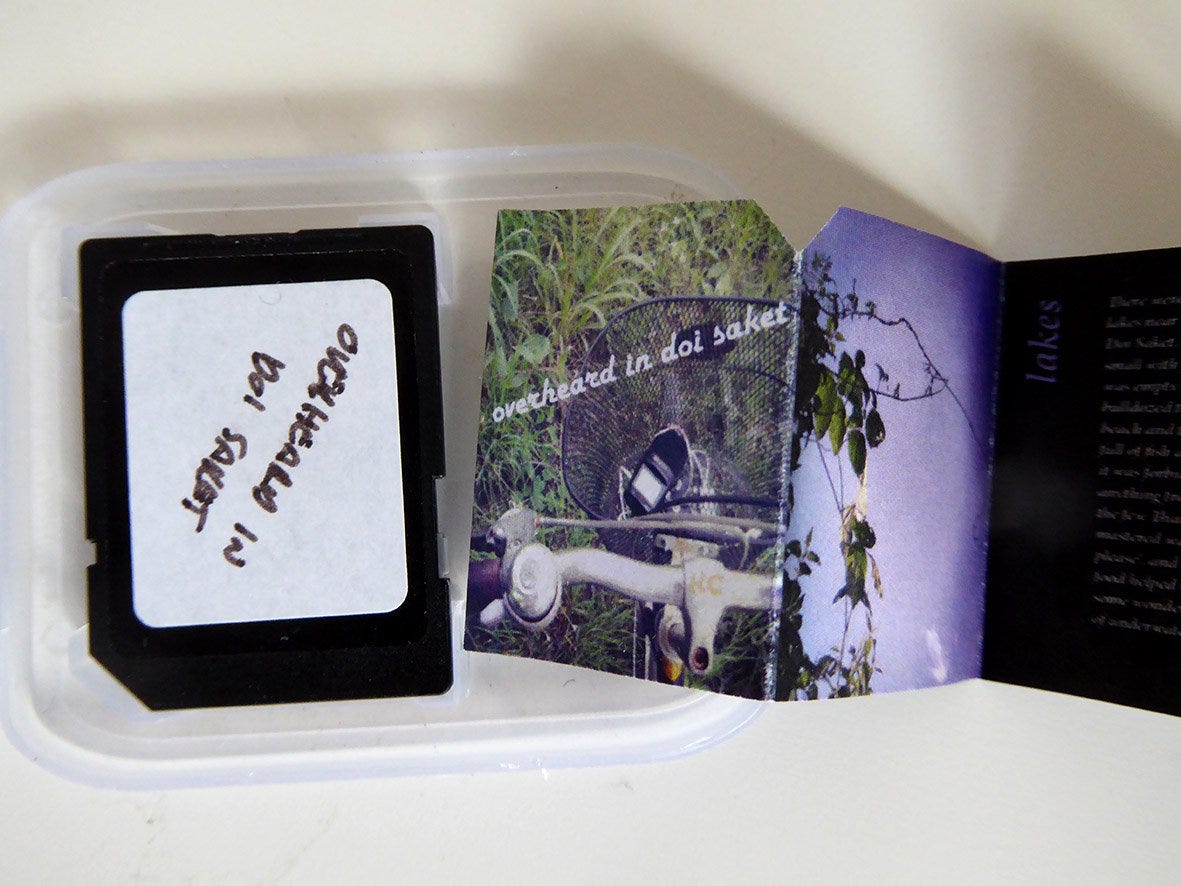
So, what does it mean to hold a field recording? When I decided to bring back this series, I knew that one of the first objects I wanted to write about would be the SD card from Kate Carr’s Overheard in Doi Saket. I reached up to grab it from the top shelf where I keep for “non-standard formats,” which also holds a few business card sized USB drives, a minicassette, some 3.5-inch floppy disks, and Music for Black Holes. In OTB #26, I described that drive within a box “shut tight with two screws,” a physical object that made the digital tactile through deliberate obstruction. This SD card does the opposite, in a way. It offers little resistance. It is contained in the same plastic box as any other SD card, and indeed, it is an SD card like any other, like, in fact, Carr herself used to record the very sounds contained within. Not wanting to reformat the card, I popped it into my laptop card reader rather than my own portable recorder, sacrificing some verisimilitude. I play the files, and I’m transported to Doi Saket, Thailand, 2014. Or rather: I’m listening in on Kate Carr’s Doi Saket, which is not the same thing.

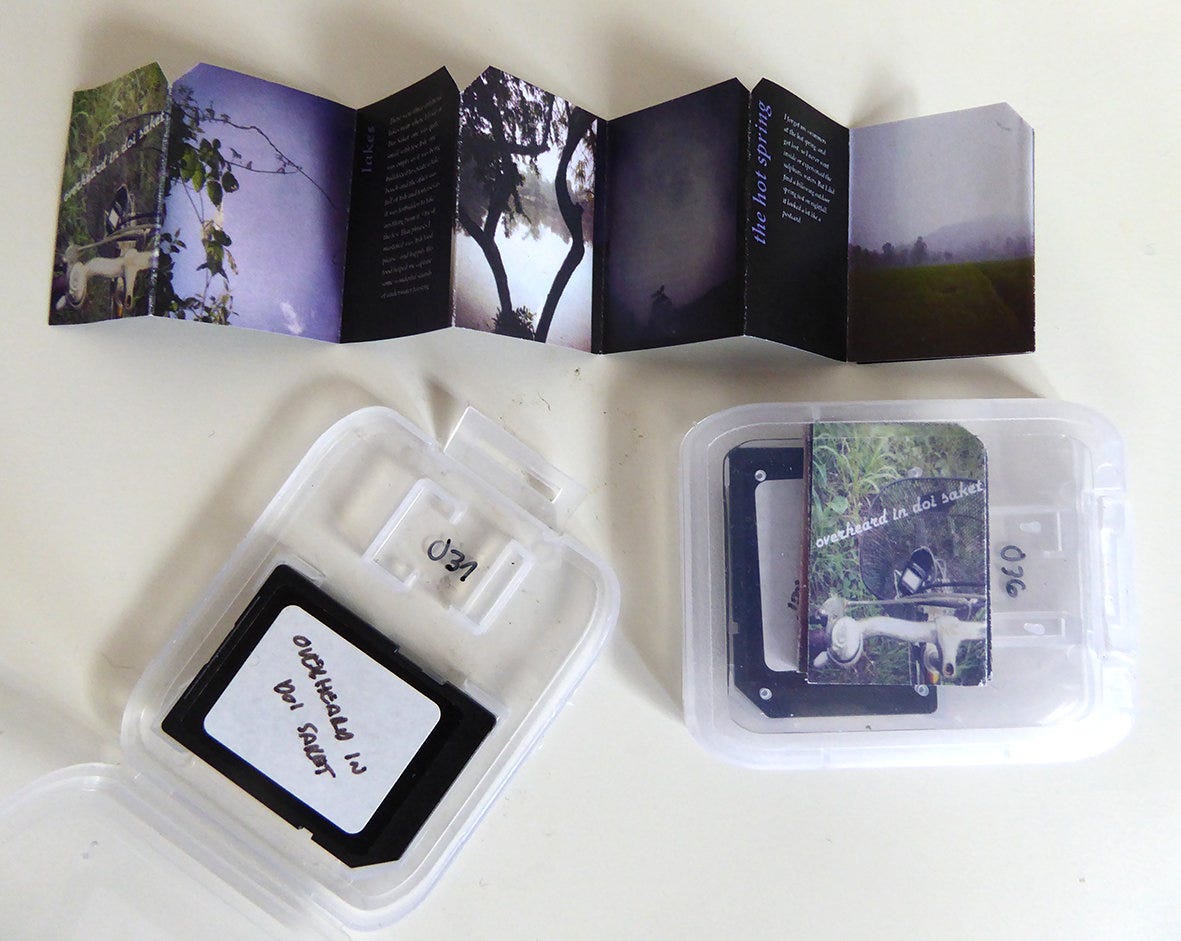
Compared with an LP, a CD, or even a tape, the SD card is diminutive in size. 3leaves, the Japanese label that released Overheard in Doi Saket, repurposed the standard SD card case, retrofitting a tiny accordioned-booklet containing a series of photographs to accompany the eleven recordings on the card. Yet, is there a correlation between sound and image? These aren’t postcard images, but abstractions, fragments, and perhaps this is a key to how one should listen to the sounds as well. This is not a release that wants to hang on your wall. It wants to hide in your bag, your drawer, your digital archive. It is a souvenir smuggled across the border, its very form reminding us of the impossibility of representing a place in sound.
Carr has never believed in the fantasy of field recording as teleportation. “I don’t think necessarily the listener is transported to a place which in any way resembles the recording site,” she told me back in 2015. When she listens to her own work, she remembers exactly how it felt to sit with her gear, listening in the heat of a month-long residency in northern Thailand. But that relationship, she insists, “is not in any way transferable.” What is transferable is something stranger: an invitation to listen as an outsider, to accept that you are overhearing rather than participating. The title is a description, a mission statement, perhaps even a confession. Most of the sounds Carr recorded— the engines roaring, the scooters wheezing about, the distant or not so distant music—she experienced as a temporary traveller. The SD card turns that limitation into an artistic principle, an invitation to lean in and ease drop.
Carr cites Salomé Voegelin’s idea that the listener creates the piece anew through listening, that sound art doesn’t generate new knowledge so much as a sense of knowing about oneself in relation to the material. Another key influence comes from Hildegard Westerkamp, from whom she learned “the need to ‘exaggerate’ aspects of a recording to draw the listener into a passionate experience of listening.” Listening to Overheard in Doi Saket in my apartment, more than a decade later, I didn’t feel transported to Thailand. I felt the weight of my own limitations, my own outsideness, my own inability to fully enter any soundscape not my own. That’s not a failure of the recording. It’s the point. I could appreciate the musicality of Carr’s presentation, feel her hand in the process. Less idealized postcard, let alone objective documentation, Overheard in Doi Saket is instead a scrapbook, with all the subjectivity that entails.
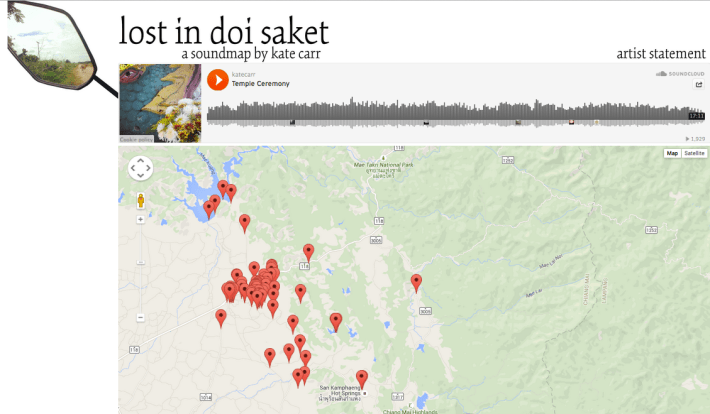
Overheard in Doi Saket begins with “Snatches,” opening with the sound of a motor, while the eleventh and final track, “I Ran Up And Down The Stairs of The Dam,” concludes with a wooden thud. We know from the opening second, in other words, that we are not in “nature.” Carr isn’t working to exclude the sound of human activity or culture; on the contrary, it is these events that structure the development of the album. Before the physical souvenir, this project began as a sound map Lost in Doi Saket—which you can still click through online—offering a different listening experience: non-linear, exploratory, informative, and seemingly endless. The SD card (even the Bandcamp version) is the opposite: fixed, curated, finite. You don’t wander through Overheard, only listen to what Carr chose to present. That decision, that move from an infinite map to a finite object, is its own artistic gesture.
In OTB #26, I noted that Jeremy Bible’s USB drive “made the digital physical, not to preserve the past, but to inhabit the present more fully.” Carr’s SD card does something similar, but also something different. It doesn’t try to preserve Thailand, but a relationship to Thailand, one mediated by microphones, headphones, and SD cards. Whereas Bible’s format emphasized his intentions for audition—audiophile quality digital files—Carr’s SD card draws attention to, and complicates, the work’s own process of creation. I had myself a nuclear spring (2015) would also be given an unusual—slightly less conceptually resonant—physical release, this time as a thumb drive in a metal box.
Carr never intended the Doi Saket recordings to be a “document which attempted to convey something essential about Thailand the country, or the people of Thailand.” But the rich soundscape drew her in
with its cacophonous mix of sounds: buskers, Thai pop blasting from various houses, the incredible noise trucks which drove by almost daily I think campaigning for elections or making announcements, the frogs, the scooters, the everyday hustle and bustle of the Doi Saket residents.
She leaned into her position as a tourist, overhearing. Carr would revisit themes of distance and intimacy more explicitly with a trilogy of works made before, at the beginning, and during the pandemic; Contact (2019), a meditation on sonic connection through radio, morse code, and digital technology; Where to Begin (2020), a study of love letter writing, which Carr says has profound similarities with field recording; and For Some Odd Reason (2020), an exploration of the kinds of noise we came to miss during social distancing and the mediated ways we’ve tried to add it back. The former two were given limited CD releases, and while I’ll eventually have something to say about the varieties of CDs and their packaging, nothing quite tops the conceptual poetry of a brilliant field recording album release on an SD card.