
Out of the Box is a monthly series focusing on physical media. It’s an excuse to engage with my collection in a new way, as well as to write about older releases and genres we don’t often cover at ACL.

After a 6-month hiatus, OUT OF THE BOX is back in new form, so please excuse this somewhat lengthy preamble to relaunch the series. OTB began as a monthly series focusing on seven inch records. The first installment is prefaced by an essay reflecting on being a collector, and stakes out a defense of physical media. I began with Minor Threat, while the most recent edition featured The Books, with many genres and eras represented in between, including screamo, Italo-Disco, soul, and hip hop.
My introductory essay to #1 concluded with an ode the seven inch as an “underappreciated format that Out of the Box will be devoted, at least for a while. My collection of 7”s and 45s isn’t particularly impressive: three short boxes of records. But that’s more than enough to keep this column going for a long while.” A long while turned out to be 25 installments, from November 2023 until October 2025. After two years, I decided to take a break, and I knew that when the series returned it would be a good time to shake up the format, by switching formats. I may still cover seven inches in the future, but for now I’m going to explore physical releases that experiment with format, packaging, and presentation.
As with seven inches, my focus on unconventional formats was spurred by their very physicality and the attendant questions raised by living as an amateur archivist (or “hoarder,” depending who you ask). That first post wrestled with the central question posed to collectors, one intensified by quarantine: Why Do We Do This?
Sometime during the pandemic, my friend Stefan moved into a new apartment, sparking a conversation between us about physical media. Why do we do this to ourselves, we both wondered, why keep lugging boxes of records, tapes, and CDs around, when we hardly ever listen to a tenth of them? What’s the use?
There is no use, I argued, citing my own conclusion from “On the Pedagogical Organization of Record Collections”: Record collecting is about meaning, not function. The impracticality is not a rational decision. The functionless accumulation, the great (literal) weight of storage. This has become part of the fetish. After accepting the pathology, I ask how best, then, to organize one’s collection?
You can read that first installment for more of my thoughts on being a collector, but to get to the point, I recently found myself once again reorganizing my collections. I’ve found many old tape storage drawers in used record stores, moving my cassettes and freeing up space for CDs. Later I acquired two additional vinyl shelves (cheap mass furniture brand accidentally double shipped), letting my overstuffed records spread out and reunite with those who had been relegated to boxes in the closet. This additional storage capacity left plenty of room for formats and packaging styles that don’t conform to the standardization.
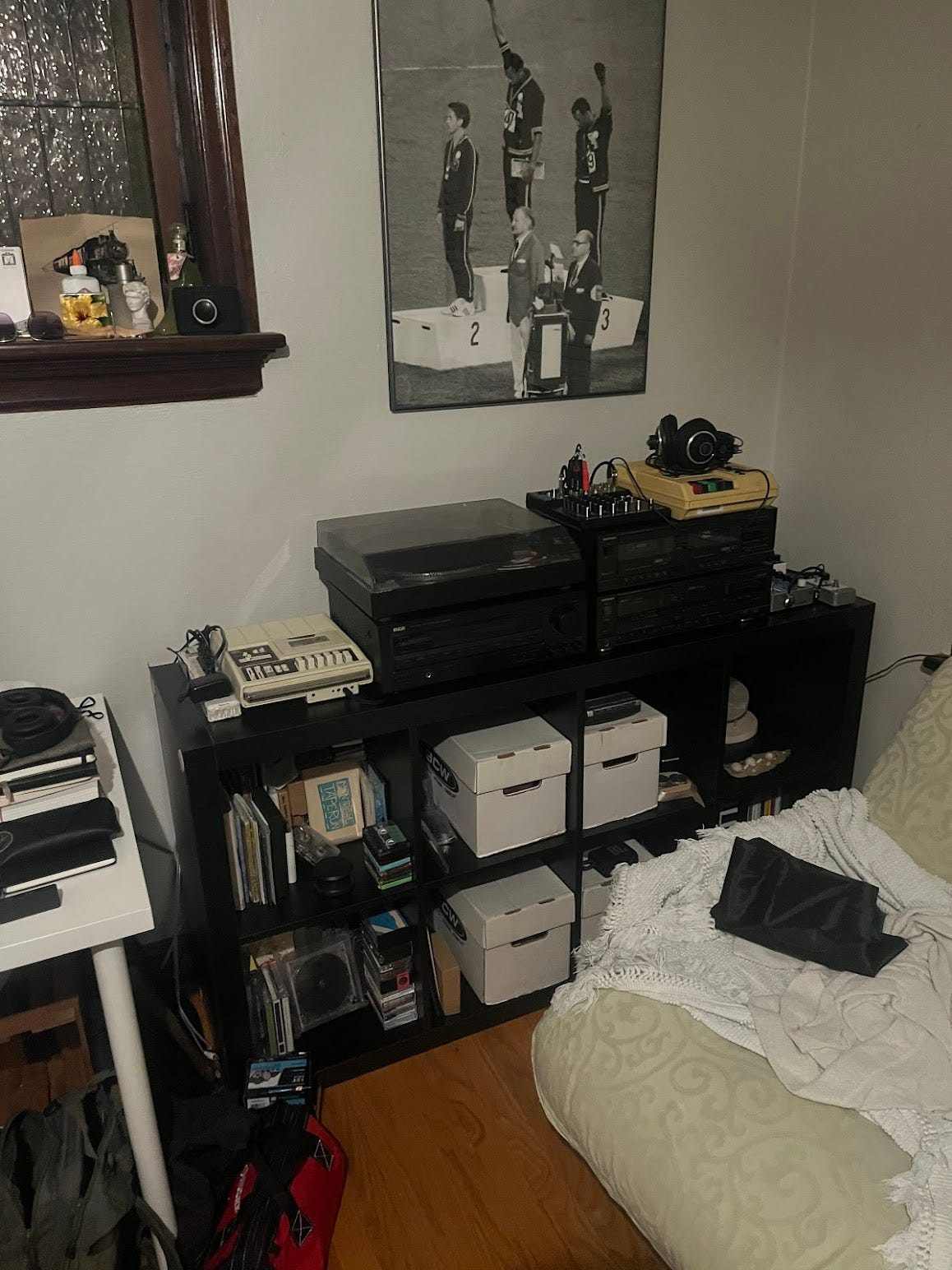
So now I’ve got room for my boxes of 7”s and unusual formats, plus I finally have my variable speed tape decks and turntable back in the living room, as you can see above. I praised my friend Matteo Uggeri’s interview series Concrete Shelves, saying that “I always love seeing how other people think to organize their books and records, it is a kind of microcosm of how someone’s mind works.” Matteo’s first question to me began by asking me about Montreal Taperun and Out of Standard!!, because those were “the most visible and exposed” in the photograph I sent him.
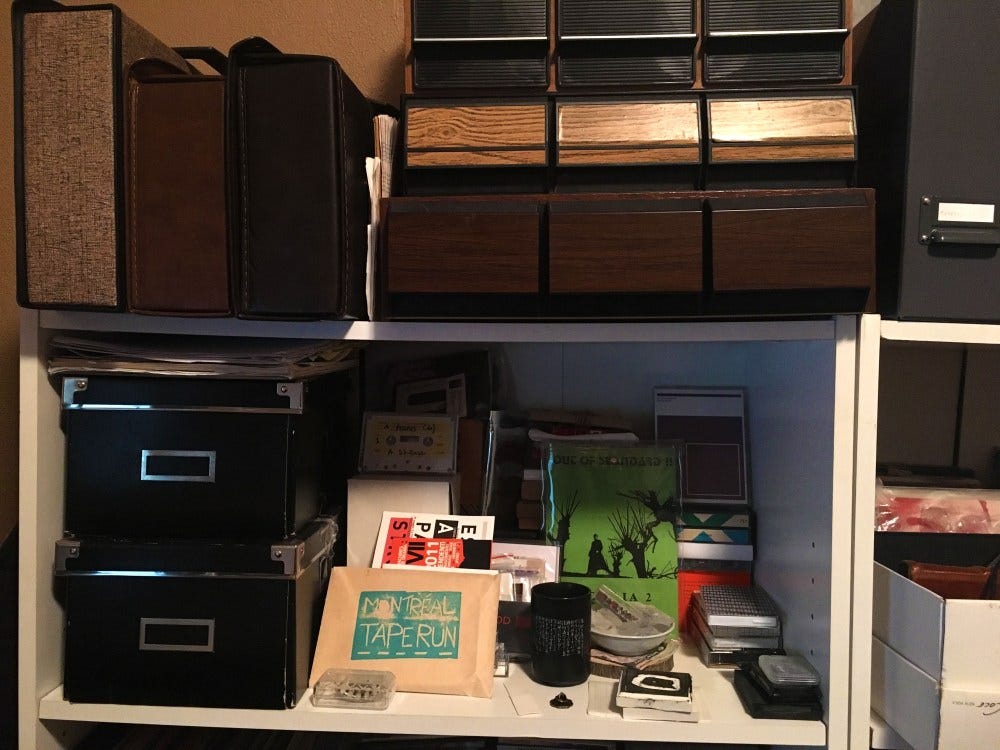
Despite both being cassette releases, they stood out because their unconventional packaging meant they didn’t fit with my other tapes. This reimagined iteration of OUT OF THE BOX, which has at least a dozen installments planned over the next year, will feature unusual cassette packaging, a micro-cassette embedded in an aroma therapy candle, a handmade CD-R mixtape, an SD card, and a number of unusual USB formats from the 2010s that never quite took off. The first installment is one of those, also visible in the bottom right corner of the above photo. (Joseph Sannicandro)
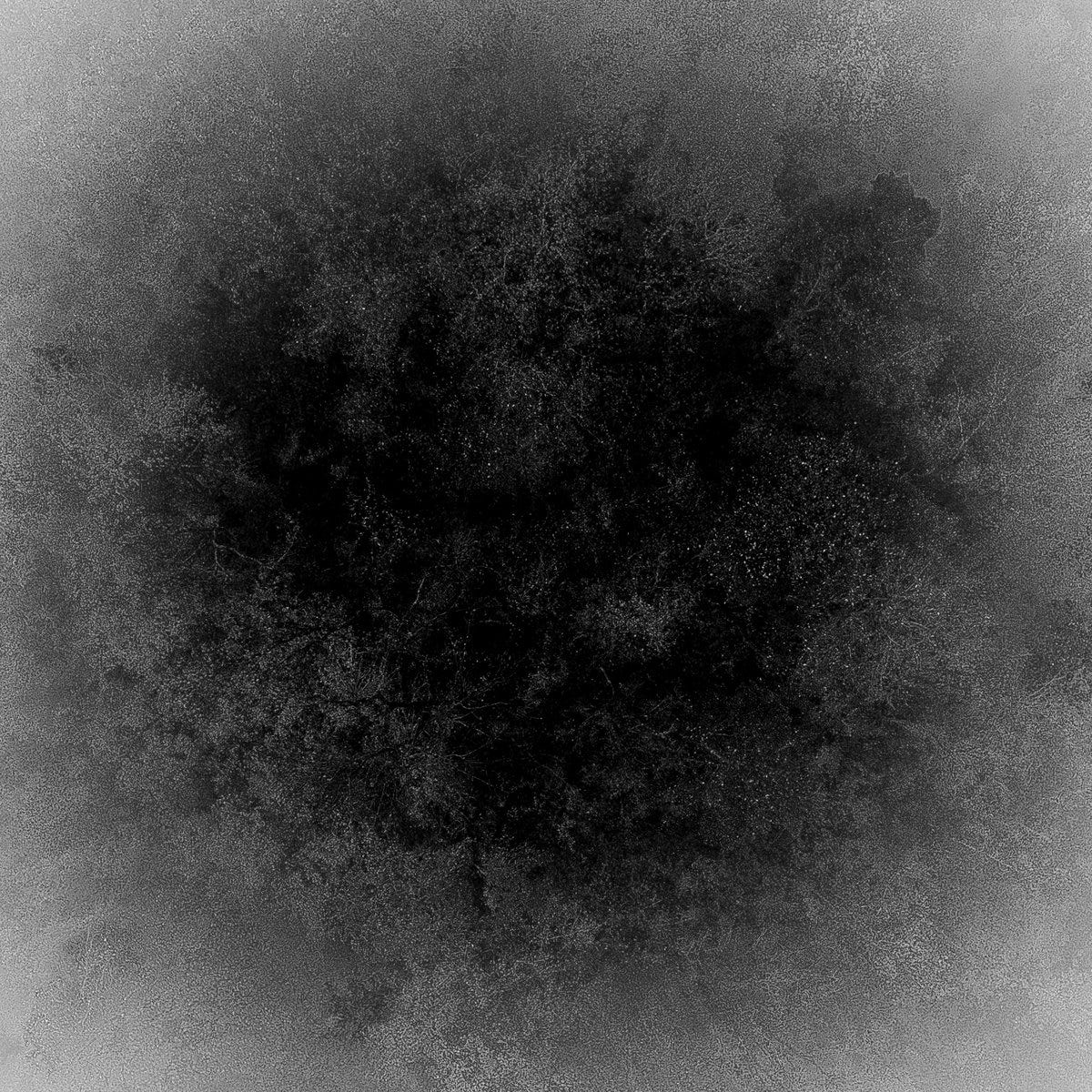
OUT OF THE BOX #26
Jeremy Bible ~ Music For Black Holes (2016)
In Sounds of the Underground (2016), reflecting on the persistence of physical formats, especially DIY formats including CD-rs and cassettes, Stephen Graham writes:
These sorts of creative, bespoke approaches to the physical musical artifact are almost ten-a-penny in the hobbyist underground. However, even more characteristic of underground labels is the deployment of a mixed release schedule of physical and digital releases, where audiences are free to make their own choice about what to buy, as we’ve been seeing in the case of Sacred Tapes and others. The online independent music retailer Boomkat, for example, carries music from a range of the more prominent underground, fringe, and alternative labels, with genres from extreme metal to sound art to dance. These include Southern Lord, Raster Noton, Hyperdub, Room 40, Mego, and many more besides. Boomkat’s multiformat model, with much of the music available on vinyl, CD, MP3, and lossless FLAC (depending on the label), is emblematic of how this somewhat more prominent music is getting released and consumed, as seen on other online sites for this kind of music, such as Experimedia. (138)
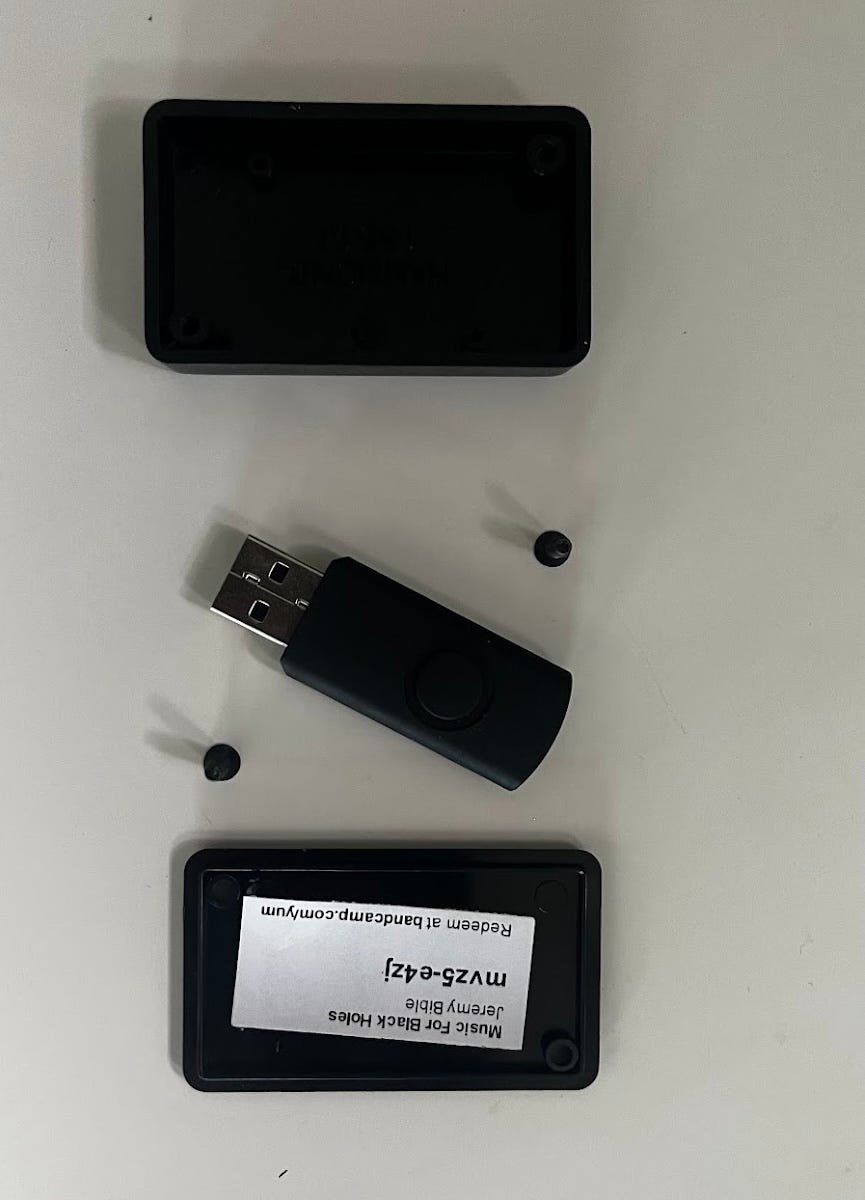
I wasn’t sure where to begin, but as Experimedia was the most important mail order and distributor of experimental music in North America, important to me personally and the scene at large, let’s start with Jeremy Bible’s Music for Black Holes. Released in an edition of 145, this 8 GB black flash drive comes encased within a hard plastic black box, itself in a resealable black plastic bag. The box itself is shut tight with two screws, and a Phillips head screwdriver and some effort are required to access drive. All black everything—a design choice that reinforces its physicality while also resonating aesthetically with the work.
Before I say more about the release, both the music and the format, first a bit more about Jeremy Bible and Experimedia. Based in Kent, Ohio, Bible launched Experimedia in 2000 as a catchall banner for presenting concerts, and releasing and selling records. But Experimedia is probably best known as a mail order site and distributor, a crucial channel for making international releases accessible in North America. The label has been much missed since ceasing operations circa 2018, after years of threatening to do so. As shipping costs have continued to rise, making mail order vinyl less and less feasible, I increasingly miss those days—and the community around Experimedia.
The label began in 2000 as a netlabel with jbible’s Ungreatest Hits LP, flirting with physical media in 2003 with a compilation 12”—the only release on the the Molotov imprint. CD-Rs began to be issued in 2007, with Bible’s I Am Very Uncomfortable Most Of The Time, followed by releases from Koen Park (Ian Hawgood), Billy Gomberg + Offthesky, Juan Antonio Nieto, and many others. 2010 was a breakout year. With the release of Aaron Martin’s Worried About The Fire, Piiptsjilling’s Wurdskrieme, and Black Swan’s In 8 Movements, Experimedia was now regularly releasing vinyl records. But 2010 also saw the release of a Svarte Greiner acetate, evidence Bible would continue to experiment with formats. From then on, Experimedia released excellent music in fine, detailed packaging and high quality vinyl pressings, alongside CDs and the occasional CD-R. By the end of the decade, they boasted releases from artists including Pascal Savy, Joshua Bonnetta, En, Damian Valles, Celer, From the Mouth of the Sun, and Lawrence English. My colleagues at ACL and I have written about all these artists, and collectively these releases rank among our favorites. Clearly Experimedia played an important role in shaping our tastes.

If Experimedia has been deeply influential, that is due to Bible’s expert curation. Kent, Ohio might not be the first place one associates with the avant-garde, but that stretch of Ohio from Cleveland down to Akron has many universities and a rich history in the annals of American DIY music. Bible listens deeply and widely, his taste reflected in his DJ sets, the records he stocked, and those he published. Beginning as a promoter of multimedia shows, Bible went on to cultivate his own practice as an interdisciplinary artist working at the crossroads of sound, light, and installation. Drawing on field recording and photography, he fuses organic materials with electronics and noise, as heard in the quadraphonic piece Collisions (2013), where bird song meets “fatiguing frequencies,” and in the multimedia project Human Savagery (2020), which contrasts natural landscapes with polluted Superfund sites.
Just as the Molotov sublabel was invented for a one off 12” in 2003, the Aole imprint was created for the one off USB drive release of Music for Black Holes in 2016. The project itself is “a four hour sound bath of pure tone minimalist ambient symphonics for withdrawal, isolation, contemplation, meditation, transcendence, intimacy & sensuality.” One can see why Bible opted for a USB drive; neither CD nor vinyl seems optimal for such a work. As a listener, it makes sense to be able to play the entire work without interruption. From an audiophile perspective, there’s something appealing about receiving the native HD audio 24bit / 88200khz wav format.
The all-black packaging, which includes black-on-black text, makes for an especially impactful physical object, despite its relatively diminutive size. That said, the severity of the packaging isn’t reflected in the music itself, whose tones gently morph across 15 tracks, each of which is distinct while remaining almost painfully minimal. Very few elements, gradually shifting parameters, given the time they need—be it 9 minutes of 24—to realize themselves. This is much more rich listening than that makes it sound, drones on par with those of Éliane Radigue, Stefan Mathieu, or Richard Chartier.
These droning tones are useful accompaniments to all the activities mentioned above, but I’ve found them most suitable as gentle background noise to cradle me while I’m working, writing, reading. Sometimes I need repetitive rhythmic music—be it Music for 18 or Dilla beat tapes—to help me reach that coveted flow state, but other times call for enveloping sounds like Music for Black Holes.


Part of me wants to resist the temptation to read Bible’s arc as a parallel to the wider music industry, but perhaps it’s inevitable. In 2000, a netlabel was still a rare thing: innovators including eerik inpuj sound, Kahvi Collective, and No Type began in 1998. Experimedia released CD-Rs and vinyl during the peak interest in those formats, but in general the emphasis always remained on high definition audio and high quality artists, not necessarily physical media.
By the end of the 2010s, logistics had come to work against small labels and distributors, as costs continued to rise and independent players became increasingly marginalized as big labels rushed in to take advantage of the “vinyl resurgence” and co-opt Record Store Day (coming to a shop near you this Saturday). Bible chose to focus on his artistic practice, and made a reasonable decision to shut down the label and mail order.
Bible didn’t do another USB release after this. I don’t know if it was ever intended to be anything other than a one-off. The label wound down by the end of 2018, so maybe there just wasn’t a release that necessitated such a treatment. When Human Savagery was released in 2020, Bible simply made the files available on Bandcamp. This tracks with my own experience. I purchase Music for Black Holes when it was released. I unscrewed the box and transferred the files onto my external harddrive with my digital music collection. If I’ve listened to this release in the past decade it’s either been via my music library or on Bandcamp. The physical format is really just for collectors now.
Experimedia began as a netlabel and had maintained a mixed approach for as long as they were releasing physical formats. To return to Stephan Graham’s argument, such a “mixed approach” has been typical in underground music, one that rejects the nostalgia often associated with vinyl, acknowledging its prohibitive costs. That’s the best explanation for the proliferation of tape labels in the 2010s, but that’s a story for another edition.
Where does that leave Music for Black Holes? Bible wasn’t chasing retro charm, but embracing the now. Black Holes wouldn’t work on vinyl, tape, or even CD. The USB drive, housed in that screw-sealed black box, isn’t a fetish object in the way a colored vinyl pressing might be. Its physicality serves a different purpose: it grants access to four hours of HD audio that no other consumer format could accommodate as seamlessly. The two screws aren’t there to evoke some imagined past. They’re there to make you work for it, to remind you that even something as ephemeral as a “sound bath” still requires a body.
The prohibitive costs Graham mentions helped shutter Experimedia. Bible knew the math—on mail order, on international distribution, on pressing plants backlogged with major label cash-grabs—and perhaps was ahead of the curve again. The USB was never going to be a sustainable model: edition of 145, one-off imprint, for the pathological collectors, never to be repeated. But that’s precisely its value. It exists outside any neat spectrum, neither purely physical nor purely digital. It’s a physical container for a file, a format that asks you to slow down and then hands you the same thing you use to print at the copyshop.
So, Why Do We Do This? Hoard physical media. Stockpile music for the day the desert island comes to us. Because the act of unscrewing that box, of inserting the drive, of committing to a four-hour drift—that’s not nostalgia. It’s a deliberate pace, chosen in full awareness that now is now. The USB release didn’t save Experimedia. It didn’t launch a trend. But it did something just as rare: it made the digital physical, not to preserve the past, but to inhabit the present more fully. And for that, it was worth it.
post script: Bible launched the moniker Indek—interestingly with two cassettes on small labels—in 2015, reviving the project for another two releases in 2024, Cringe World and Yope, available digitally and on cassette, with the latter also available on limited vinyl. Indek is much more focused on exploring rhythm, influenced by breakcore, IDM, and hip hop beats, and the weird, surreal, perhaps even grotesque art for that project makes clear that it has little to do with the work he’s previously done under his government name.