
Out of the Box is a monthly series focusing on seven inch records. It’s an excuse to engage with my collection in a new way, as well as to write about older records and genres we don’t often cover at ACL.
OUT OF THE BOX #25
The Books ~ All Bad Ends All (2003)
I first remember hearing the NYC duo The Books in 2003, when a friend played me the just-released The Lemon of Pink. I quickly tracked down Thought For Food, their debut from the previous year. No, in fact it was the other way around; I heard their debut and then grabbed their next record once it was released later that year. I confused the details because those two records are deeply intertwined for me. The Books’ style of musical collage—their pairing of melodic lines with sampled speech—was like nothing I’d heard at the time, and the use of found sound in particular was deeply influential. In retrospect, The Books served as an onramp for me to contextualizing work by figures like Steve Reich, who used similar techniques unbeknownst to me at the time in compositions such as Different Trains (1988).
I saw the duo perform at the Knitting Factory in May 2005, on my 21st birthday, shortly before leaving for a summer studying in Beijing, a show which must have been a record release for their third album, Lost and Safe. If I recall correctly, the only other time I saw them perform was in April of 2007 as part of the Wordless Music concert series. (I really need to do a post about Wordless, in which I not only saw many memorable concerts—Mono, Tyondai Braxton, Explosions in the Sky, the music of Xenakis and Reich, and STARS OF THE LID (!)—but through whom I met many friends and even got to perform as part of Rhys Chatham’s 200 guitar orchestra.)
For those unfamiliar with the group, I can’t top the economy and precision of the press text that accompanied this seven-inch:
The Books are Nick Willschire Zammuto from Massachusetts and Paul De Jong originally from Rotterdam. These two tracks encompass everything that makes The Books tick; post-laptop glitch, voyeuristic radio waves, sick humour and virtual indie rock. Itʼs as if Todd Solondz had decided to make music instead of following a filmic line.
Temporary Residence Limited, who would go on to release their final album and Zammuto’s solo work note that The Books made “what they considered pop music.” And that feels right, there’s is no doubt something pop at work here, but the way Negativland is pop, or Prince Paul is pop; pop that is also doing something unsettling, funny, and beyond categorization. The Books were playing with pop song structures—the economy of pop songwriting—but with entirely unexpected and idiosyncratic results. There is something nostalgic in the use of samples and references—like cratedigging with Woody Allen—and yet arranged in a way that sounds like the future.
I have little recollection of The Books’ fourth and final album, The Way Out, and I never acquired a physical copy. By the time it was released in 2010, I’d moved onto other genres. I liked Lost and Safe, but the additional reliance on Nick Zammuto’s vocals didn’t appeal as much to me, a direction that also contributed to why I was never very interested in the debut Zammuto LP, which also moved in the direction of a (very slightly) more conventional rock band. I have been a fan of Paul De Jong’s solo work, however, something I’ve bonded over with Joni Void, who brought De Jong up to Canada for a few dates years back. De Jong’s IF (2015) showed me that what resonated most with me in The Books is that “found sound” aspect, and made it easier to tease apart their individual contributions. I would also recommend Spiral (2020).
So back to the seven-inch at hand. I may have picked up this record from the duo at that show at The Knit in ‘05, but it may also have been something that I just grabbed in a random record store somewhere in the world at some point.

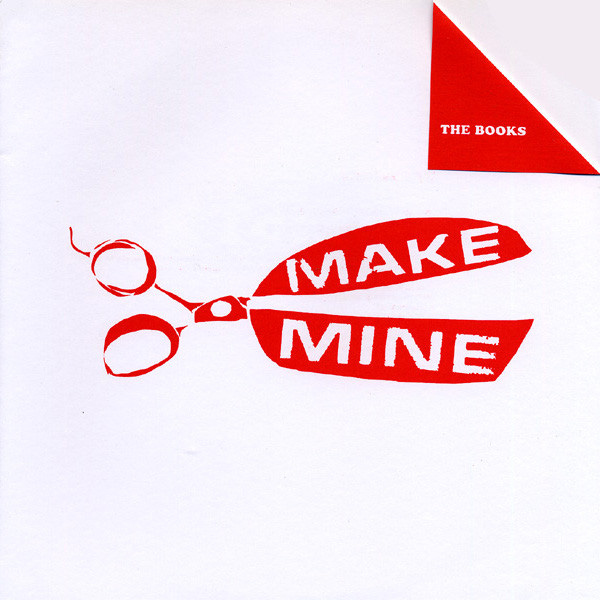
It was release on Make Mine, which was a seven-inch label from the UK active from 2003-2013. All Bad Ends All was their first release, with records following from Canadian rapper Cadence Weapon, the art pop of frYars, the glitchy debut of Gold Panda, and solo work from Zammuto. The final release from Make Mine was the 2013 debut single from Rina Sawayama (seven years before her debut full length and nearly a decade before she featured on Charli XCX’s “Beg For You”). It’s a quite good take on a kind of bedroom pop fused with R&B and house influences. Which is all to say, an interesting if not entirely coherent track record. There’s a lot of turn of the millennium, post-laptop, glitch-inspired pop, but I the label didn’t seem to have a much of a distinct identity. The scissors logo feels appropriate, especially considering the label debuted with The Books’ pop cut-ups.
Both songs on this record come from Thought For Food—no alternate versions or exclusive b-side. So there’s not much to recommend about this record in particular, and if you aren’t already familiar, you may as well go straight to that full length. Speaking of which, I was happy to learn—after picking this single—that Thought For Food has since been remastered by Zammuto and re-released, originally back in 2011. I’m often skeptical as to the need for such remasters, but the tracks really do benefit from the experience gained over the course of their career, making this version of the record the definite edition.
“All Bad Ends All” begins with a dusty found sound vocal sample right into a jaunty guitar loop, punctuated by short vocal samples and sound effects throughout, and ending with a clipped outro of classical music. It’s the kind of feel good formula that The Books would continue to build on, fusing instrumentals with an accessible take on cut-up techniques for the digital age. A bit of Django, some Churchill, and a toe tapping beat to keep it all grounded. The song structures and techniques would grow more sophisticated as the project progressed, but simplicity and joy here is very much part of the appeal.
“Motherless Bastard” is less energetic and more melancholic, making for some nice contrast between the sides. Beginning with a memorable sample that takes me back to the first time I heard it: “Mommy Daddy! Mommy Daddy! Mom? Dad?,” a small child exclaims. “You have no mother or father… They left, they went somewhere else. … I don’t know you,” their father meanly insists, as the child grows more worried. That context makes the Americana-twinged jam that follows feel all the more dramatic, what otherwise might feel a bit banal. Something about the low end has extra personality, but none of the madcap spirit and hijinks of the A-side. De Jong’s cello shines, however, with the layers of arrangements gradually accumulating, perhaps demonstrating that The Books were not a gimmick that relied on ADHD editing. The whole affair ends too soon, at just over four minutes, with the return of the “Mommy Daddy” refrain, letting the instruments fade out rather than resolve in any way.
Like the inversion of the words in so many of their title, slight changes in sequence can be quite meaningful, humorous, and profound. There’s still something fresh about this music, and while Thought for Food isn’t necessarily their best work, it has the endearing freshman and energy of a first project.
As 25 is a nice number, I’ll be taking a short hiatus from OUT OF THE BOX, but the series will return in 2026.