
Le Révélateur
An Interview with Réka Csiszér & Radwan Ghazi Moumneh
Réka Csiszér & Radwan Ghazi Moumneh ~ Le Révélateur
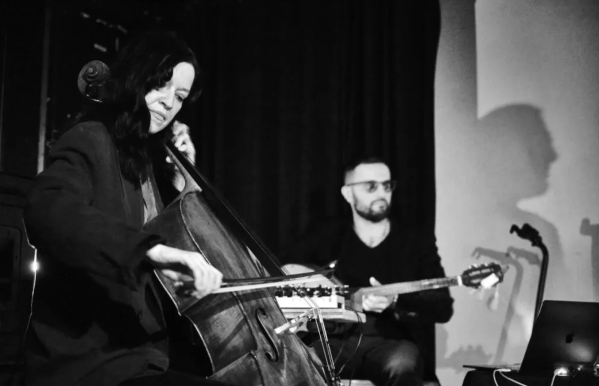
Originally conceived as a silent visual poem by Philippe Garrel in 1968, Le Révélateur emerged in the aftermath of the May ’68 student uprisings, carrying their disillusionment in a stark, non-verbal form. Shot in austere black and white, the film follows a couple and a child moving through ominous landscapes, from dense forests to barren, almost post-apocalyptic terrains. Refusing overt political statements, Garrel instead constructs an enigmatic space of tension and estrangement, a blank surface onto which meaning is projected rather than declared.
It is precisely this openness that Réka Csiszér and Radwan Ghazi Moumneh engage with in their “fictitious soundtrack.” Rather than filling the film’s silence, they orbit around it. Emerging from a series of ciné-concerts and later shaped into a recorded work, Le Révélateur retains the immediacy and restraint of its live origins. Field recordings—radio static, distant mechanical hums—form a fragile ground, while ambient loops and elongated drones gather slowly, never overwhelming the image they accompany.
The duo avoids direct commentary, instead constructing a parallel sonic field that mirrors the film’s sense of displacement and quiet disarray. Moumneh’s sonic language surfaces gradually, while Csiszér’s voice, subtle and often hovering at the edge of articulation—threads through the textures as a searching presence. In the sixth movement, her voice comes to the foreground shaped through improvisation and processing, as if relearning how to speak after a prolonged silence.
The album unfolds with a careful attention to restraint. Tension remains understated, simmering beneath even the sparsest passages, occasionally bubbling up, as in the brief distorted part 4, and loosening as the work progresses. By its later moments, a fragile lightness appears, though never fully dispelling the underlying unease. Like Garrel’s film—culminating in the image of a child reaching the edge of a lake animated by swans—there is no closure here, only an opening.
What Csiszér and Moumneh achieve is not an interpretation but a coexistence. Their music inhabits the same liminal space as the film, where sound and image drift alongside one another without resolution. In Le Révélateur, nothing is explained; instead, everything lingers—dissolving into a quiet, unresolved presence that continues beyond the frame.
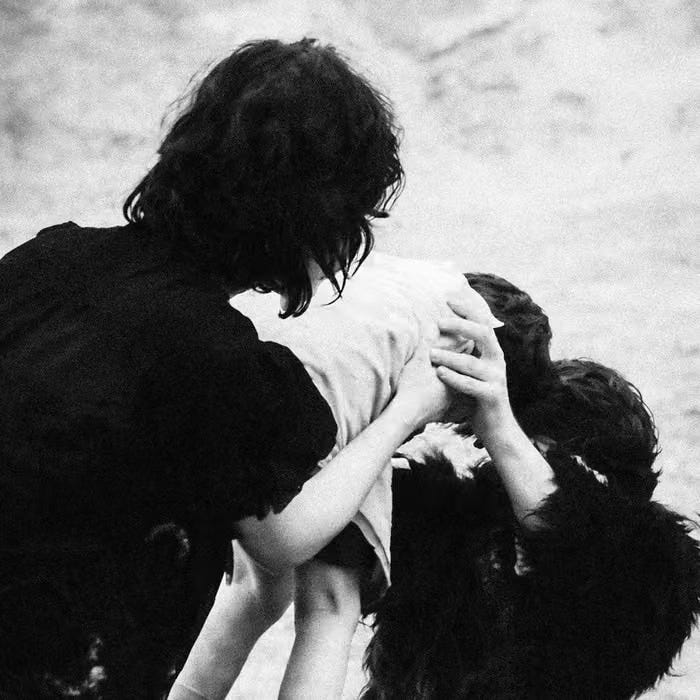
To guide us through the production process for the album Réka Csiszér and Radwan Ghazi Moumneh have answered a few questions for us.
You have crossed paths creatively before—Réka, through your contribution to Qalaq with Jerusalem In My Heart, and with Danse des Larmes, which Radwan recorded and mixed. What led you to extend this dialogue into a fully co-authored work? Was there a particular moment or impulse that sparked the idea for a complete collaboration?
RGM: We have been friends for many years, and Réka and I have always had a dialog around music, creation and production. We had recorded in a studio in Belgium many moons ago and that is what gave birth to our collaboration. We share many aesthetics artistically speaking.
RC: We met many years ago at a festival in Switzerland. Seeing Radwan’s project Jerusalem In My Heart for the first time was a deeply moving experience—especially the way he works with his mother tongue and traditional Arabic elements in a contemporary context. That encounter stayed with me and encouraged me to begin something I had been thinking about for a long time: a personal solo project. That became VÍZ - a space to reconnect with my Transylvanian Hungarian roots and to experiment with my own mother tongue, which I hadn’t previously dared to use in my work. My debut as VÍZ was released on JIMH’s Qalaq, which marked the beginning of an ongoing and meaningful collaboration between us.
Could you expand on the production process behind Le Rélévateur? To what extent was the album shaped by prior conceptual discussions, and how much emerged intuitively through the act of making?
RGM: The composition for the album came about in 2023 when Réka had organized a small tour for us doing a series of ciné-concerts for the film Le Révélateur. We intuitively came up with what to us was a very strong interpretation of an intentionally silent film, and so we decided to do this series of performances, seeing as it was ‘low pressure’. In the end this approach gave birth to the whole aesthetic of the soundtrack. We left it dormant for a couple of years, but last year, we decided to re-do it in Berlin and it actually had transformed into something much more moving, so we decided to record it and release it.
RC: The record grew out of our live score, which we developed during a short two-day residency just before the ciné-concerts. The limited time led us to work very instinctively, and that immediacy became a defining quality of the piece. When we later adapted it into an album, we chose not to expand it outward, but rather to preserve its original tension and focus. The process was less about adding material and more about carefully translating the energy and structure of the live performance into a recorded form.
Do you see your album conversing with or diverging from Philippe Garrel’s 1968 film’s themes and aesthetics? Also, I take it the artwork is an actuall still from the film as well?
RGM: We have Philippe Garrel’s full blessing for the live ciné-concert and album, and he has been very generous and trusting in the process. The album is a fictitious soundtrack, so the inspiration is very much direct! We did use stills from the film for the artwork and it all came together with artist and designer from Beirut, Hatem Imam, who did the design for the back with his typography.
RC: The film’s suspended atmosphere, emotional intensity, and quiet political undercurrent were very present for us throughout the process. Although it is silent, it carries a strong sense of tension and displacement that resonates with how we both think about identity and in-between states.
Our approach wasn’t to interpret the film in a literal way, but to remain in dialogue with its mood and internal rhythm. In that sense, the album exists alongside the film; echoing certain emotional and spatial qualities while opening its own path.
As multi-instrumentalists and vocalists, how did you approach the distribution—or perhaps the intertwining—of instrumental and vocal roles within the project? Did these roles evolve organically, or were they more deliberately defined?
RGM: Very much an organic process. We would talk about ‘movements’ in the film and each would purpose an aesthetic or an instrument and we experimented. It was a very natural process.
Field recordings seem to play a subtle but important role in the album’s sonic architecture. How did you source and integrate these elements, and what function do they serve within the broader narrative of the work?
RC: I’ve always been drawn to field recordings because they carry an imprint of a specific moment - something direct and unfiltered. Introducing them into the live score added a layer of reality that extends beyond the musical dimension. At times, we allowed these field recordings—such as radio static or distant mechanical sounds - to stand on their own, creating space, duration, and tension within certain scenes.
We also incorporated a fragment from the Hungarian student film Szél (Wind), where you hear a distant song, wind, and cowbells. In the context of Le Révélateur, we used it for certain scenes, for example in a bedroom or kitchen setting, where it introduces a subtle dissonance, a slightly surreal quality that I find compelling, especially when sound and image don’t fully align within an otherwise grounded moment.
Your musical practices engage deeply with traditional forms, yet you come from distinct cultural backgrounds—Lebanon and Transylvania. How did these different sonic histories intersect in the making of this album?
RGM: Like I had mentioned, we share so many aesthetics, and actually I feel for my part, I am able to orbit around traditional aspects of Arabic music but not in a circular form, but rather elliptical, where I come close or drift away from that aesthetic. It allows us to experiment with form and have it be as free as we want it to be while still sometimes grounding it.
RC: I think we both, in different ways, connect our historical paths to our artistic practices, shaped in part by our experiences within the diaspora. The film itself carries a nomadic quality—three figures searching for direction—which I deeply relate to.
I guess that that sense of being in-between is also where Radwan and I meet. Working with traditional elements felt very natural for both of us; not so much conceptual as instinctive. Our different sonic backgrounds created a space of exchange that felt open, fluid, and continuously evolving.
Many of the pieces seem to unfold through gradual accretion—layers of loops, textures, and voice—yet the overall effect is strikingly restrained, almost minimal. How did you navigate this tension between density and sparseness in your sound design?
RGM: we always had a goal to maintain a minimalism, as the film IS a silent film, and was created with the intention of being viewed as silent. It would be rather obnoxious to upstage the film by leaning into something beyond minimalism, in my opinion. Musically, we tried to maintain the sentiments that were explored visually, and echo them more than challenge them.
RC: When translating Le Révélateur into a record, we were attentive to how sound accumulates without overwhelming the image. The pieces evolve through layers, loops, textures, voice, but always with a sense of restraint. We worked with field recordings, processed voices, extended techniques, and layered textures of buzuq, violoncello, dvina and electronics. The sonic world moves gradually from something more enclosed and intimate into a more open, almost post-apocalyptic space.
For me, it evokes a sense of isolation and transformation, but also a quiet, internal resistance. It felt essential to respect the film’s stillness, not by filling it, but by allowing its silence to remain active and present. The film holds a particular kind of silence, not just the absence of sound, but a weight within it. It feels blank, even numb at times, yet charged.
Finally, could you shed some light on the spoken words featured on track six? What is their origin or significance within the context of the album?
RC: The track is based on a simple vocal improvisation shaped through effect pedals and subtle processing. While watching the film, I felt that the characters - especially the female figure - exist almost beyond language, not simply because the film is silent, but because, within its narrative, words themselves seem to have disappeared.
The film feels timeless, and in many ways its atmosphere also mirrors the present. I often find myself struggling to articulate what is happening around us today, and in that sense, the improvisation became a way of imagining how the voice might return after a long silence - hesitant, searching, almost like a child trying to sing a song for the first time.
It’s a very solitary expression, emerging from a state of suspension and disorientation, where sound slowly begins to take form again. (Gianmarco Del Re)