
I’ve been a big fan of Rosalía since El mal querer (2018), her breakthrough sophomore record. I’ve included “Barefoot in the Park,” her 2019 collaboration with James Blake, and several songs from the brilliant post-modern genre-crossing Motomami (2022) in my DJ sets overs the years.
Her latest, LUX, was released last month, and much of the discourse about that record has focused on the string arrangements performed by London Symphony Orchestra, conducted by Daníel Bjarnason. We’ve been fans of Bjarnason, an associate of Iceland’s Bedroom Community (Valgeir Sigurðsson, Nico Muhly, Ben Frost), since the very beginning, and I’d wager our Richard Allen has written more about his work than any other critic.
In our 2017 Interview with Bedroom Community founder Valgeir Sigurðsson, the producer described an encounter with Bjarnason.
The process started with the discovery of this Mozart string-quartet, and particularly the opening which is unlike anything else he wrote. I learned about it from Daniel Bjarnason when we were teaching a seminar together at a castle in Denmark. One evening we decide to make a pop-quiz for the students and one of the questions that Daniel came up with was “who is the composer of this piece” and then we played them the opening movement of String Quartet K.465 which at the time I don’t think I had heard. If I had I was certainly not paying attention. But I immediately wanted to inhabit it, somehow
We are also fan of Ben Frost and Daniel Bjarnasson’s new score for Tarkovsky’s 1972 film Sólaris, based on the novel by Polish writer Stanislaw Lem, which they performed in cooperation with Kraków’s Sinfonietta Cracovia, debuting at Unsound Kraków in 2010, and at Unsound New York in 2011, both accompanied by film manipulations courtesy of Brian Eno and Nick Robertson.
Below, I’ve collected our reviews and blurbs of Daníel Bjarnason’s solo records and his work with the Iceland Symphony Orchestra as conductor and composer. Happy Listening! (Joseph Sannicandro)
From the Archives #29
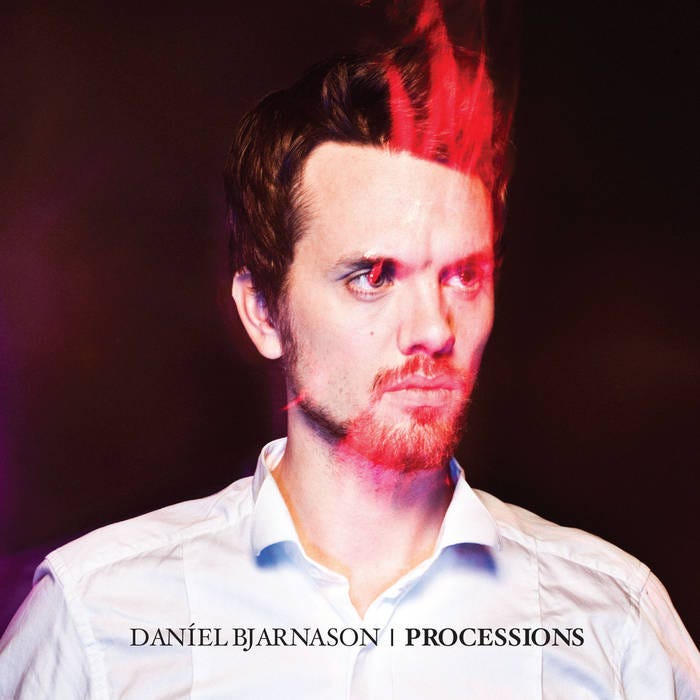
Daníel Bjarnason ~ Processions (Bedroom Community, 2010)
When Ísafold Chamber Orchestra’s second album was released in 2008, one song stood while the others sat: the nineteen-minute title track, “All Sounds to Silence Come.” Until this composition was committed to disc, Daníel Bjarnason had been better known as a conductor than as a composer, and the ICO had been more famous for its fantastic covers (Pärt, Schönberg, Stravinsky) than for its originals. This piece, with its fierce first movement and restless, contemplative second, garnered numerous awards for the composer not only in his native Iceland, but as far afield as Dublin.
By any estimation, “Silence” would be difficult to surpass, but with Processions, Bjarnason topples expectations like Tinkertoys. Bedroom Community (whose last release was Ben Frost’s By the Throat), has shown remarkable prescience in choosing this album as its first release of 2010. The year may be in its infancy, but to this reviewer, Processions is already the one to beat.
The field of modern composition is crowded, but it’s thin on top and bulges in the middle like a sedentary retiree. A few composers have been able to distinguish themselves through a combination of talent, originality, and verve. Bjarnason’s greatest asset is that he doesn’t sound like any of them. Max Richter, Jóhann Jóhannsson, Ólafur Arnalds, and Valgeir Sigurðsson (the last three from Iceland) offer experimental excursions and soundtrack sensibilities, but their output rests securely in the “alternative mainstream” - neither bland nor bizarre, traveling the Ring Road (the sporadically dangerous highway that traverses Iceland’s borders) while avoiding the treacherous, unpaved center. These composers are careful not to alienate potential listeners, a risk that Bjarnason gladly takes. Instead of walking one step at a time, testing the ground to see if it is moss or rock, Bjarnason leaps, trusting that the ground will hold as he races breathlessly to an unseen destination. Processions is one musical millimeter away from being too avant-garde, too inaccessible, but the occasional clusters of major notes that comprise its main themes anchor it like a crampon to the ice. This leaves Bjarnason free to veer into the dissonant and the atonal, two roads less traveled, in search of the thematic glue that will bind it all together.
Processions boasts a huge supporting cast, which lends the project an immediate air of respectability. The aforementioned Valgeir Sigurðsson serves as producer, engineer, and mixer. The Icelandic Symphony Orchestra dominates three tracks, while orchestra members guest star on others. Riding bareback is Bjarnason, as composer and conductor. Remember those Sigur Rós sessions at Abbey Road with the London Sinfonietta? That was him. But this sounds nothing like that. This is wild, untethered music, swirling around a core that often disappears, spitting off in every direction, splintering and reconfiguring, jagged and sharp. Bjarnason marches into this maelstrom with rugged determination, like an explorer who refuses to return for his coat. At times, we hear echoes of Ralph Vaughn Williams’ Antarctic Symphony, but more often than not, the tonal shifts and instinctive chord changes have no identifiable antecedent.
The album kicks off with a flutter of percussion and a wildly active series of multitracked cellos, immediately engaging the attention of the listener. The soaring arpeggios and sense of menace call to mind Jonny Greenwood’s score to There Will Be Blood, another broadly atonal work whose seeming randomness was actually the result of clever construction. The beauty of “Sorrow Conquers Happiness” is that each instrumental passage goes through multiple stops and starts; no single thread runs the length of the composition, yet the piece retains a staggering momentum. The components are part of a well-oiled machine, analogous to an American football team who makes multiple substitutions while plowing relentlessly forward. The final frame is the selection’s most subdued, the breathcatcher at the end of the touchdown drive, the brief celebratory pause before the next kickoff.
“Sorrow Conquers Happiness” is the first of the three movements that comprise “Bow to String.” The second, “Blood to Bones,” is lithe and toned. Plucked strings occupy the foreground, while seething cellos lurk in the background like a mongoose, awaiting an opportunity to strike. Yet when the time comes, the anticipated pounce is absent; instead, the cello symphony unveils a dirge-like anthem. Occasionally, the music comes to a complete stop, so when the first tentative notes of “Air to Breathe” arrive, they seem like a continuation of the same piece. The tone of this selection remains mournful throughout, calling to mind the words of Ella Wheeler Wilcox:
After the fierce midsummer all ablaze
Has buried itself to ashes, and expires
In the intensity of its own fires,
There come the mellow, mild St. Martin days
Crowned with the calm of peace, but sad with haze.
“Sorrow Conquers Happiness” seems to trump its siblings with sheer bombast, but the three movements actually complement each other, producing a rare melancholic blend of nostalgia and hopeful yearning. This ternary enhancement – three tracks operating as more than the sum of their parts – illustrates the principle that classical music, whether modern or traditional, often suffers when broken down to singles and soundbytes.
The second triptych is the album’s centerpiece and the source of its title. The piano holds court, but the Icelandic Symphony Orchestra provides a stunning backdrop. The overall effect is like gazing at a flower in front of a fjord. “In Medias Res” echoes the album’s first track by beginning with a percussive blast, but this time around, the keyboard has replaced the cello and the percussion has taken on the timbre of shattered glass. As the listener searches for a central melody, the brass offers little aid. The horns herd listeners away, shooing them toward the strings, which jostle the pilgrims like riders in a subway car, causing them to return to the piano for a semblance of sanity, which it only briefly provides. In the sixth minute, all the instruments relent, providing a soothing narcotic sensation: there, there, it’s alright. But in the seventh, they explode with a clear denunciation: no, no, it’s not. At 7:44, what seems like a main theme emerges, only to have its head pushed violently back underwater, and when the track finally concludes at the ten-minute mark, it does so with an unsettling cacophony of crash and trill.
“In Medias Res” would be the highlight of most albums, but the two premier tracks are still to come. The twelve-minute “Spindrift” begins with subdued melody (finally, something to hold onto!), and in its first two minutes provides a shelter from the storm. As the track progresses, it becomes apparent that the storm has not ended; what seemed like a break in the clouds was actually the eye of the hurricane. Whenever the pianist abandons his usual restraint in order to hammer on a single key, we are warned that it is time to go back inside, that shards of melody will soon become as rare as driftwood on a wind-tossed sea. When the strings finally return, they sound like salvation, then doom, which in turn makes the piano’s surprisingly delicate coda all the more welcome.
“Red-handed” draws the triptych to a close, forming itself out of echoed fragments and building swiftly to a surging series of staccato strings, enhanced by virtuoso ivory scales and pounding percussion. The excitement of this piece, and its occasional excess, hearkens back to the album’s first track. Like “Sorrow Conquers Happiness,” “Red-handed” draws down to a refined close, setting up a quieter track, in this case the album’s coda.
Since “Red-handed” bursts at the seams with internal dynamism, the left turn of “Skelja” makes perfect sense; to attempt to trump a finale with a larger finale would just be ridiculous. At first listen, this piece comes as somewhat of a disappointment – we’ve been trained by Michael Bay to expect “Boom Boom Pow” rather than “Boom Boom Hush” – but on subsequent listens, it works. This closing track is a simple combination of harp and light percussion, and it gives us time to reflect on all that has gone before, while operating as a cushion between the dramatic world of “Red-handed” and our reluctant return to ordinary life. I’d have made it a couple minutes shorter, but that’s a minor quibble.
Bjarnason, recently thirty, was lucky enough to have been born in the digital age, and so unlike his classical predecessors, he may experience the good fortune of being appreciated while alive. Processions deserves to be his global breakthrough. It’s the sound of fire and instinct, the musical equivalent of a controlled burn. Perhaps all sounds to silence come, but thanks to Bjarnason, that sonic Armageddon seems a long distance away. (Richard Allen)
Daniel Bjarnason ~ Processions (Bedroom Community, 2010)
While visiting Iceland a decade ago, I picked up a disc from Ísafold Chamber Orchestra that contained a remarkable two-part suite titled “all sounds to silence come,” from conductor Daníel Bjarnason. The piece was unlike anything I’d ever heard, as if beamed over from an alternate reality. When Bjarnason released Processions, the future arrived, with Penderecki-like staccato strings and a tenderness all too rare in modern composition. Since then, the composer has gone on to release numerous other albums, and attention to Icelandic composers have bloomed: Valgeir Sigurðsson, Hildur Guðnadóttir and Anna Thorvaldsdottir, to name but a few. But this is where it all began; and now “all sounds to silence come” has found a new home as well, tucked away as a digital bonus. (Richard Allen)
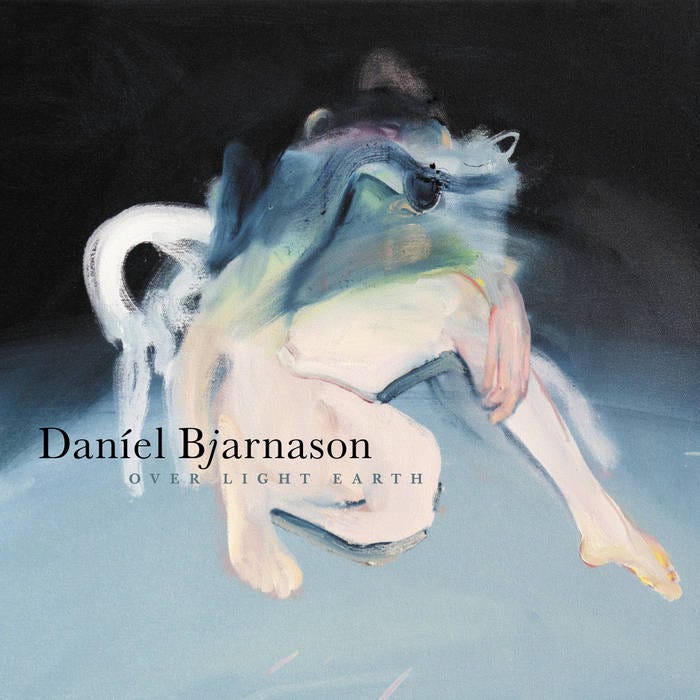
Daníel Bjarnason ~ Over Light Earth (Bedroom Community, 2013)
I first encountered the work of Daníel Bjarnason in 2008, when I picked up a CD, unheard, in a Reykjavik shoppe. The suite “All Sounds to Silence Come” was immediately enthralling, and I suspected that the young composer might be the nation’s best kept secret. Soon afterward, the album Processions broke this secret to the world. This was followed by the intricate Solaris, recorded with Ben Frost. Frost is present here as well, as are Valgeir Sigurdsson and the Reykjavik Sinfonia. Bjarnason conducts the orchestra and plays piano and synths; Frost and Sigurdsson grace the final suite with processing and programming.
A good word to describe Over Light Earth is unrushed. Four years have passed since Processions, and in the interim, Bjarnason has been tested by fame and honed by collaboration. The influence of Solaris is clear on the new work; these pieces take time to develop and ignore linear progression. There may be nothing so immediate as “Sorrow Conquers Happiness” or “Spindrift” here, but the patient approach – from both composer and listener – makes this album a more consistent collection. Big moments still abound – explosions of brass, flourishes of strings – but quieter, subtler moments are also frequent, and the piano veers from contemplative to abstract. This is especially fitting as the paintings of Mark Rothko and Jackson Pollock inspired the title track.
The two-movement “Over Light Earth” is an anticipatory piece that erupts briefly at 1:56 of the first movement, only to retreat again into a larger framework. Plaintive piano notes feed into a stream of brass, only to be beaten into submission by a large drum. The less percussive instruments bide their time, shy until the second movement, when the entire ensemble grows more active. One imagines the dancer on the cover (painted by Winston Chmielinski) racing to portray the myriad emotions as they unfold in turn. At exactly 4:30 (the exact midpoint) of this movement, a perfect chorus emerges, but is swallowed by silence only 15 seconds later, imitating Bjarnason’s inaugural work.
The complex, three part “Emergence” offers a series of harmonic convergences and divergences, a temporary separation of magnetic attractions. The first movement boasts an ironic title, “Silence”, and attempts to suggest silence through the sound of extended chords and trills. The brass-filled finale jolts the timbre into the opposing realm, offering an indelible sequence topped only by the blasts that conclude “Black Breathing”: two dark notes, in and out, like respiration.
“Solitudes”, originally Bjarnason’s first piano concerto, now includes added electronics from Frost and Sigurdsson and arrives in five movements. The most abstract, “Dance Around in Your Bones”, wanders in multiple directions like a drunken coquette, yet eventually lands on its feet as if it were sober all along. “Selge Ruh” offers a sense of the haunted sublime, while the closer “T’aint No Sin” toys with dramatic tension like a cat with a wounded mouse. With fierce intelligence confirmed, Bjarnason now seems primed for a romp through the rest of the 21st century. (Richard Allen)
Daníel Bjarnason ~ Over Light Earth (Bedroom Community, 2013)
It was always going to be a monumental task for Daniel Bjarnason to follow up his debut, Processions. A lesser musician might have taken the easy way out, sticking to the same formula on his sophomore effort out of fear of not getting the same response. Not Bjarnason, who with Over Light Earth has extended his repertoire in the rightest of directions. While Processions went straight for the kill, Over Light Earth takes the scenic route, building tension slowly and releasing it even more slowly. In a way, it’s a more complete album, one that cements Bedroom Community’s status as the home of today’s most forward thinking contemporary classical music. (Mohammed Ashraf)
Daníel Bjarnason ~ Collider (2018)
We’ve been fans of Daniel Bjarnason from the start, and with each new release, he’s continued to cement our initial reaction. Collider is a spectacular album, collecting compositions from the artist’s “American period,” initially written for ensembles in Cincinnati and Los Angeles and performed here by the Icelandic Symphony Orchestra, also conducted by Bjarnason. Reykjavik’s Harpa yields remarkable acoustics, best reflected at home with the volume turned high. Rife with density, dynamic contrast and tonal variation, Collider reveals new pleasures at every turn.
The entry point is the 11-minute “Blow Bright.” In form, the piece is described as “variations on a repeating bass pattern,” but in execution, it’s a whirlwind of motion, with brief starts and quick stops, dancing percussion, assertive brass and emotive strings. Despite its bombastic nature, the composition peels back its own skin to expose the song of the solo violin, plaintive and desperate. The imagination drifts to modern dance as one imagines a single dancer attempting to stretch the boundaries of the stage, reaching out again and again, breaking the plane with her hands but not with her feet. And then the world comes rushing back in, jostling, swirling, even pounding. Then sweetness seeps over the orchestra, led by celestial, descending strings, intent on rescue. The frenetic finale implies that while the dangers remain with us, we no longer face them alone.
The quarter-hour title track represents a different approach, its slow-growing atmospheres more Solaris than Processions. But grow it does, doubling its volume before a light implosion. The pas-de-deux between restrained and unleashed provides the piece with its greatest tension. Massive blasts punctuate the field like land mines. The title is well-suited to the material. Again the composition darts to a massive finale, smashing into walls, picking itself up, trying others directions and finally breaking through.
In the center we find the three-part “The Isle Is Full of Noises,” which comes with a surprising near-apology in the liner notes for the fact that The Tempest has been covered so much. It’s like suggesting that all preachers should fall silent because there’s no life left in the texts. Shakespeare’s canon is as close as we come to scripture on a fictional front, and this reading, graced by the Hamrahlid Choir, is sublime. One can sense the tempest, even if unfamiliar with Caliban and the island. The approaching conflict is signaled by gathering chords and rising scales. Bjarnason mirrors the Bard by “covering” not his full script, but the depth and wealth of its emotion.
Collider is one of the best orchestral albums of the year, by one of the world’s finest composers. The album’s only flaw ~ it’s a digital release. We’ll never be able to hold it in our hands, to flip the vinyl, feel the depth of the music as it is released from the grooves. William Robin’s excellent notes can be read here with one benign pop-up ad. We implore Bedroom Community to press this on CD and/or vinyl!
Available Here
Iceland Symphony Orchestra ~ Recurrence (2017)
A sense of wonder develops when one realizes one is listening to one of the year’s best albums. This takes a while to solidify ~ first impressions are hard to trust ~ but by the tenth play or so, it hardens. While I’ve lost track of how many times I’ve played Recurrence, I’ve retained that sense of wonder.
Not that this should come as any surprise, as Recurrence has been one of our site’s most anticipated albums ever since its announcement way back on November 19. This is the second Icelandic set from Sono Luminus this year, following Raindamage. Recurrence highlights Daniel Bjarnason at the helm of the Iceland Symphony Orchestra, conducting pieces from Anna Thorvaldsdottir (another of our favorite composers), amiina’s Maria Huld Markan Sigfúsdóttir (last heard here on Nordic Affect’s Clockworking), Thuridur Jónsdóttir, Hlynur Aðils Vilmarsson and himself. The album operates as a showcase for the entire nation, a gauntlet thrown down to the global music community. Despite its many authors, the set flows perfectly as a whole, a credit to Bjarnason’s conducting skills as well as to the skills of the orchestra. While listening, one yearns for a musical Olympics where all national orchestras might compete, each performing new music from their homelands.
When one reads that composer and flutist Thuridur Jónsdóttir has worked insects and infants into her compositions, one is unsure what to expect from her next work; suffice it to say that one is intrigued. “Flow and Fusion” is a strong start to a strong set, a whisper building quickly into a scream. The sound of triangles cedes space to swirling strings and buzzing electronics. The first thrilling surge occurs less than three minutes into the eleven-minute piece, a foretaste of what is to come. The mood is suspenseful, yet measured; chaotic, yet controlled. The composition is a perfect example of why composers shouldn’t see film work as an ultimate goal. The track is its own story, a self-contained drama that operates best as itself, instrument commenting on instrument, stanza on stanza. Its awe-filled, awesome grandeur provides a perfect expansion of its title.

Hlynur Aðils Vilmarsson’ compositions also appeared on Raindamage, but the eleven-minute “bd” travels somewhere the last two compositions did not. The last three minutes are a thrilling explosion of full orchestral involvement. In order to arrive at this point, he earns the listener’s interest with a series of small twists and turns, sometimes dipping into near-silence, offering sounds that range from small footsteps (percussion) to large elephants (brass). When those low marching notes finally hit, we recall his rock background. The pulse pounds, emotion takes over, and all thought goes out the window, replaced by pure visceral enjoyment.

Maria Huld Markan Sigfúsdóttir’s “Aequora” may surprise those used to the more accessible works of amiina, but will be a treat for any familiar with the elegant “Clockworking” and “Spirals”. Her sonic peaks arrive early and often, offset by slower, more contemplative segments of string. Every surge brings a new wave of excitement, along with additional instrumentation. First the brass elevates the strings, augmenting their power. Then dramatic drums enter the fray, their rattle and rumble presaging even greater themes. At this point, the tone shifts to something more sedate, a yearning for higher things. The title is roughly translated as “the calm, smooth sea, even in times of storm”, and the composition offers a perfect reflection. Despite all of the drama, the confidence of the composition keeps it on an even keel. The boat will reach port, no matter the weather. One need only stay the course.

Is it humility that causes Bjarnason to wait this long before introducing his own composition, “Emergence”? Yes, in part. But the Icelandic music scene is also one in which community and collaboration flourish. The success of one is the success of all. Bjarnason needs no other adornment. Others have stretched their hands to him, and now he stretches his hands to others. This being said, “Emergence” (first heard on Over Light Earth) is an astonishing three-part composition, the opening part heavy enough to anchor any boat. To hear such emotion erupt in such a short piece is to admire the restraint that has preceded it. Again we credit the composer, this time not only for his composing and conducting abilities, but for his sequencing skills. The first movement is the album’s center, offering the segment that puts the album over the top. After hearing it, one can’t do without it. The second and third parts go even further, adding contrast and complexity. As the second movement descends into the depths, it drags the listener happily along to a state of hypoxia. The third is like the rescuing diver, plunging in with a fresh canister of oxygen. The longest of the movements, it falls slowly through the layers of sound before reaching the one it intends to save.

Anna Thorvaldsdottir’s “Dreaming”, first heard on Rhizoma, closes the album down. Instead of a coda, the piece offers a new launching point. “Dreaming” invites the listener to look back ~ nay, listen back ~ to all the experiences that have come before, and to consider what might happen next. Soaring seas, sinking bodies, danger and rescue ~ would we want this life, or would we wish to stay in port? As the saying goes, “a ship is safe at port, but that’s not what ships are for.” And Thorvaldsdottir has never played it safe. Her works dance on the edge of expectation, venturing out into directions unforeseen. Instead of wrapping her compositions in tidy bows, she offers listeners the joy of unwrapping sounds. After four minutes of beautiful lull, she allows the drums off the leash, like an impending eruption or a feverish dream. When she pulls back, it is as if surveying multiple plumes of smoke and fire. “Dreaming” thus becomes the sonic expression of Eyjafjallajökull and Bárðarbunga, paired with the threat of Katla, Hekla, and Grímsvötn. The next eruption is on the way. No one can predict where or when. How then shall we live? Thorvaldsdottir’s answer seems to be dangerously, bravely, fully. As the album concludes, her composition pushes us outward rather than inward. Seldom has a set felt so completely alive. (Richard Allen)

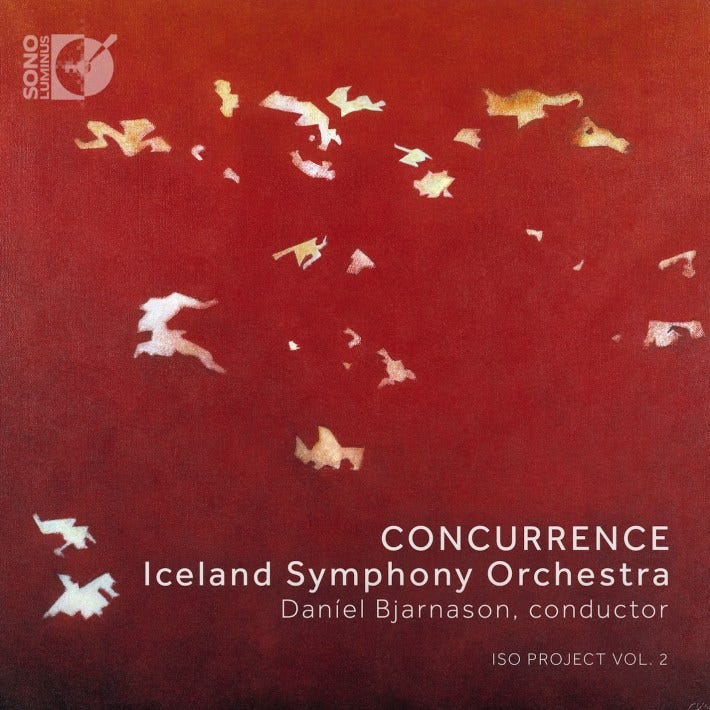
Iceland Symphony Orchestra ~ Concurrence (2019)
The Sono Luminus follow-up to the 2017 CD Recurrence affords listeners a golden opportunity to hear new works from Anna Thorvaldsdóttir, Haukur Tómasson, María Huld Markan Sigfúsdóttir and Páll Ragnar Pálsson as performed by the Iceland Symphony Orchestra and conducted by Daniel Bjarnason, and all without the cost of a plane ticket. Otherwise we might have to wait months or years for new albums from each composer, which makes this album an invaluable preview.
In one of the strangest coincidences of my entire life, I happened to be reading John Mauceri’s excellent new book For the Love of Music when the CD changer landed on Concurrence, plunging me into Thorvaldsdóttir’s “Metacosmos” at the exact same time as Mauceri began to discuss the work ~ the very definition of the album’s title. There’s no explaining such an event, except to remark that the book and album will forever evoke a magical connection. Mauceri discusses the manners in which reviewers often befuddle readers with esoteric descriptions, while encouraging listeners to draw their own associations from the music, even if they may differ from the artist’s intentions. The composer writes that “Metacosmos” is “constructed around the natural balance between beauty and chaos” and inspired by “the speculative metaphor of falling into a black hole – the unknown.” Given such a description, one can hear such tension in the work, just as one may conjure a visual collision of Icelandic landscapes ~ the emphasis of Steve Smith’s liner notes. Those fascinated with symbolism may also note the duration of the piece on the disc ~ 13:13 ~ albeit longer in the clip below.
Thorvaldsdóttir has always been a conveyer of the unknown, her non-linear music a treasure trove of tones and trajectories. “Metacosmos” begins with a drone that leads swiftly to a crash, like a Big Bang, and a series of dissonances meant to dislodge the listener from expectation. There’s more melody here than Mauceri lets on, although the melodies are unmoored from common notation. More important is the feeling that one is headed into great darkness, unable to turn around, which leads to the question, “how do we feel about this?” The answer will differ from listener to listener, as some will choose fear and others courage, the same range of reactions one might feel when facing a great internal darkness or inevitable, life-altering event. Glissandos are only the starting point; some of the mid-piece chords might even be considered triumphant. Startling percussion leads to the launching of foghorn tones, signaling battle. The music grows frantic. But when only three minutes remain, a blending note like butter spread across toast. In a merciful sequence of major chords, balance is restored. Or is it? The piece concludes with a rising pitch, the ending left open to interpretation.
María Huld Markan Sigfúsdóttir’s “Oceans” seems ~ literally ~ more down to earth. While this is the album’s third track, Smith chooses to pair them in his liner notes, so we’ll do the same here. There’s actually a continuity to be sensed from the end of “Metacosmos” to the beginning of “Oceans,” found in the more accessible moments. Thorvaldsdóttir leans into such segments reluctantly and highlights them only briefly; Sigfúsdóttir embraces them and allows the more difficult themes to signal from the outskirts, always present but never a threat. One hears grand themes, like the return of the sailor, the embrace on the jagged shore. The tones seem always about to clash, but the composer pulls back just in time, like a ship avoiding the rocks.
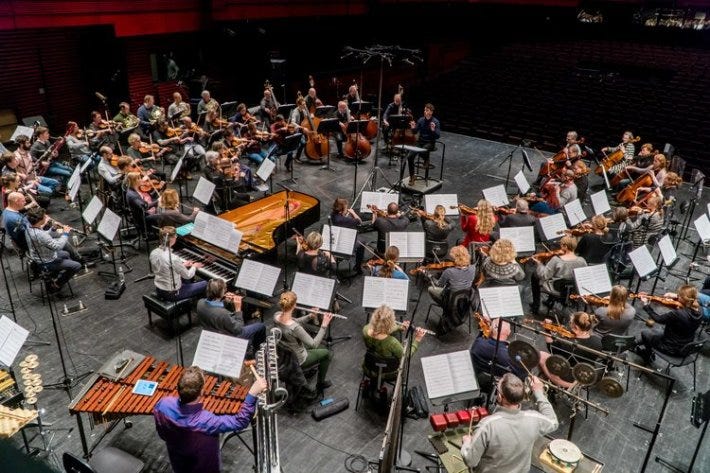
In contrast, Haukur Tómasson’s “Piano Concerto No. 2” and Páll Ragnar Pálsson’s “Quake” highlight single instruments, in turn the piano and the cello. Counterintuitively, the power of the former is in the contrast between the playfulness of the piano and the mercurial quality of the strings. The orchestra makes the ivories seem more frightening than they are, a fact that Viningur Olafson seems to address when he slows the whole concerto down, allowing space for introspection should the listener choose. Then into the maelstrom once more. One might interpret the tension as that between the enjoyment of life and the worries of the world, or the comfort of friends and the crassness of public discourse, but such are only suggestions. The piece continues to unsettle, landing on notes no softer than the start.
Finally we arrive at the award-winning “Quake,” whose success has already inspired a follow-up, suitably titled “Afterquake.” We loved Páll Ragnar Pálsson’s Nostalgia and the new work continues to justify our faith in the composer. Due to the title and timbre, the piece recalls the Norwegian diptych “The Wave” and “The Quake,” and as the most cinematic piece on Concurrence, it lends itself well to premonitions of disaster. One can hear the creaks of crevasses on the brink of collapse, the panic of scientists whose prognostications remain unheeded, and finally the all-out panic as the tectonic plates shift. Saeunn Thorsteinsdottir’s cello is often overwhelmed by the reverberations of the orchestra, but shines in quieter moments, such as the immediate center of the piece, accompanied by foreboding percussion, most curiously a single hit on wood block. When the cracks begin to break, they sound like shattering ice. In terms of natural disasters, Iceland is better known for volcanic eruptions, but the two are related, and in fact, hundreds of minor earthquakes may occur in Iceland in a single week. “No cause for alarm,” says the Icelandic Meteorological Office, but many are still “waiting for the big one.” Pálsson’s piece is a reminder not to relax too much; it’s also a thrilling story in its own right.
Concurrence reminds us of Daniel Bjarnason’s consumate skill as a conductor. In his capable hands, the Icelandic Symphony Orchestra triggers its own tectonic shift. This album is where to turn to hear tomorrow’s music today. (Richard Allen)
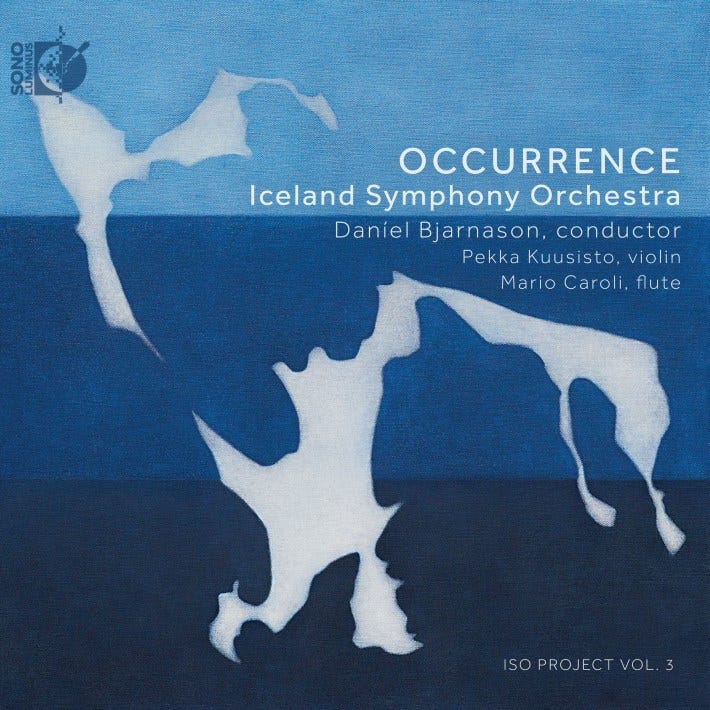
Iceland Symphony Orchestra ~ Occurrence (2021)
Occurrence is the conclusion of a masterful trilogy that began with 2017’s Recurrence and continued with 2019’s Concurrence. All three are published by Sono Luminus, who has captured lightning in a bottle with the Icelandic Symphony Orchestra. Over the past two decades, Daniel Bjarnason has gone from strength to strength as conductor and composer, and this series has been a showcase for the vast breadth of Icelandic composition. Perhaps we are getting a bit greedy, but these discs would make an amazing box set.
The album launches with Bjarnason’s own “Violin Concerto,” written for lead violinist Pekka Kuusisto. Nearly half an hour in length, this piece steps steps softly on a quiet carpet, but soon begins to veer wildly from introspective to proclamation ~ a hallmark of Bjarnason’s work. Suffused with emotion, the concerto seems like an imploding storm, especially when the violin establishes a call-and-response with the full orchestra. But even this cannot last, as so much tension is bubbling beneath. The brass and drums erupt like an attack of the winter gods. Ten minutes in, the entire composition falls hushed, like a sleeping dragon; one can even hear its breath. We all know what’s going to happen next; we just don’t know how or when. After a thick, cathartic rush, the composition revisits the friendly whistling of its opening moments, only to dive once again into the maelstrom. Will a better composition be committed to disc this year? The bar is set so high, all we can say to other composers is good luck.
Veronique Vaka is the next out of the gate with “Lendh,” already a multiple award nominee and as such a worthy track to follow “Violin Concerto.” While half the length of the preceding piece, it bursts with energy and power, curling like Jörmungandr and preparing to strike. “Lendh” means “open land,” of which Iceland has an abundance, as does Vaka’s original land of Canada. Like so much of the music in this series, the piece surprises by retreating when we expect it to advance, as if changing evaluations based on perspective. The land is wide, and dangerous, and ominous, but also stark and lovely. One cannot make it through unscathed; if the body is intact, the heart has still been changed.
Haukur Tómasson “In Seventh Heaven” (also known online as “In the Seventh Heaven” is a seven minute (of course!) palate cleanser in the center of the set, playful and inviting, a welcome contrast to the preceding pieces as it lightens the mood while preserving the orchestral intricacy and sense of largesse. While listening, one is tempted to throw open the doors, take a few steps into the snow, and dance. The title is perfectly chosen; as the piece progresses and the players grow more intense, one gains a feeling of striving, especially with the arrival of staccato strings: ladders to bliss. The dramatic turns underline Tómasson’s opera roots; he can accomplish much within a short frame.
The album’s second lengthy piece is Þuríður Jónsdóttir‘s 21-minute “Flutter,” featuring Mario Caroli on flute. The orchestra holds back, as if in awe of the soloist. Like Tómasson, Jónsdóttir can be playful, as evidenced by her work with Björk and her pendant for audience participation. A cinematic, cartoonish mid-piece segment features woodblocks like sneaking feet and yowls like hungry cats in pursuit of their feathered prey. In the closing third, we hear crickets and (once again) whistling, albeit brief. Is the bird taunting its pursuer? A final, surging chord indicates freedom; no creature has died today.
But how to end? How to complete not only this set, but the trilogy? The honor of the concluding piece goes to Magnús Blöndal Jóhannsson, whose “Adagio” offers the perfect coda. We’ve already heard loud and dramatic; we’ve heard foreboding and cinematic; we’ve heard teasing and playful. Now it’s time for elegant reflection. Adding to the weight of this lovely work is the back story; this was the first piece the artist wrote after the death of his wife, a struggle with alcoholism and an eight-year silence. Now deceased, Jóhannsson continues to speak through his music. “Adagio” becomes an elegy not only for a loved one, but for the composer himself, a statement on loss, recovery and the ability to endure. Early in the set, we were entertained; now we are moved.
Congratulations to the Icelandic Symphony Orchestra, Daniel Bjarnason and Sono Luminus for this astonishing trilogy, a labor of love whose influence will echo through the years. (Richard Allen)
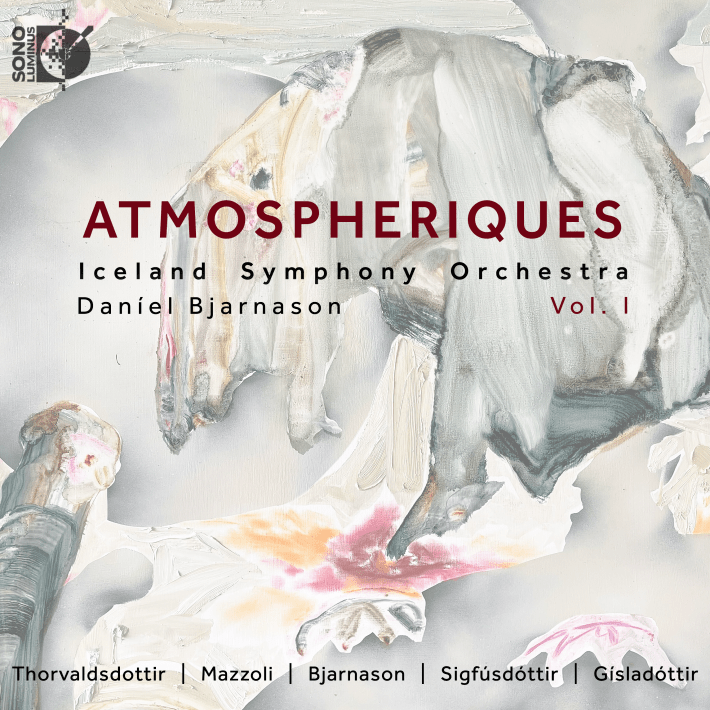
Iceland Symphony Orchestra ~ Atmospheriques Vol. 1
The best thing about Atmospheriques Vol. 1 is that it is only the first installment. With this set, Sono Luminus continues to shine a spotlight on Icelandic music, this time through the Iceland Symphony Orchestra, fresh from the success of triptych Recurrence, Concurrence and Occurrence. Four of these five pieces come from Icelandic composers, the exception being Missy Missoli (U.S.); tonally, they are a match.
Anna Thorvaldsdottir (whose own CD is due next month on Sono Luminus) starts the set with the 21-minute title track. This is enthralling music, but challenging, beginning with a foreboding series of glitterings and glissandos. Four minutes in, the first inkling of a melody appears in skeletal ivory notes. The brass processes like an advancing army. The strings grow agitated, as if their hive has been attacked. But then instead of advancing more, the music retracts, or more properly crouches, inviting the listener to lean in. While reminiscent of a lurking cat, the prefix is cata-, suggesting a downward trajectory, darkened prospects, a descent. While this bleakness may be gleaned in society, the interpretation is left to the listener, and the additional tracks extend its story past the last echoing note.
Missy Mazzoli‘s “Sinfonia (for Orbiting Spheres)” travels past the boundaries of Earth, adoptng a wide-angle approach. An early glissando links the piece to the earlier track, leading in turn to a series of definitive brass notes, a rush of percussion and a gentle bell segment, gliding through the stars to experience sequential renditions of awe. As the piece progresses, the sounds grow more definitive, even accessible, the percussion almost leading to euphoria yet retracting once more. The clearest passage arrives at 7:53, just as the piece is ending: am arrival back at dock.
“From Space I Saw Earth” continues the theme, as conductor Daniel Bjarnason references Apollo astronauts. The music twists and bends, surging in the center to a previously-unimagined height. One imagines a shift in perspective, a recognition of commonalities instead of an exploitation of differences. This macro view transcends borders, cultures and life itself, revealing only a ball of blue and green. Triumphant tones appear toward the end, albeit slightly muted, as if to suggest that the epiphany has not yet arrived. Dark notes dominate the eleventh minute, suggesting two paths diverging in the cosmological woods.
María Huld Markan Sigfúsdóttir‘s “Clockworking for Orchestra” (an earlier version found on Nordic Affect’s Clockworking, also on Sono Luminus) picks up the narrative thread, addressing permutations of time. Humans have always sought to organize time, placing themselves at the center of Earth’s story despite the fact that they are a very recent addition. “Clockworking” may suggest either forward progress or the Doomsday Clock, depending on how one receives it. The soft tempo of the mid-section imitates a timepiece, while the rising xylophone melodies of the second half imply a decision made, a direction taken.
The CD’s press release asks, “Is Bára Gísladóttir’s ÓS gasping in air, or desperately exhaling? The answer is likely: both.” This concluding piece is the album’s shortest; in its early section, it’s also the album’s quietest, and in its later section, the album’s loudest. As metal sheets are shaken and struck, one thinks of street protests and a commensurate rattling of sabres. A mid-piece buzzing hearkens back to the opener; the collection, despite having five composers, has not forgotten its history. As the metal returns, the album falls into silence, waiting to be broken, the last question being: by what? (Richard Allen)