
Dear Listeners, it’s Joseph here again with another off-week installment of the A CLOSER LISTEN newsletter. I try to get my weekly missives out on Wednesdays, but this past week+ has been a lot, for many reasons. I’m back in Montreal, and needed some time to get settled and catch up on other work, as the new semester begins and I’m back to teaching. It’s also been difficult (and also, in many ways, heartening) watching my friends and colleagues and neighbors in Minneapolis—where did my doctoral studies and a city I still have a relationship with—struggle with more violence from ICE. I’ll have some news soon about a benefit compilation, but for now, please support in whatever ways you are able, and solidarity to all on the ground, everywhere.
This edition is also late because it’s a long one. Regular editions are bi-weekly, and in 2024 and 2025, off-weeks were mostly dedicated to my series OUT OF THE BOX. While that series will eventually return, for now the plan is to use the off weeks to get out some writing that has been on the back burner for too long. And don’t worry, a regular edition will follow this Wednesday. Now, without further ado, let’s take a closer look back at some live music events from the last three months.
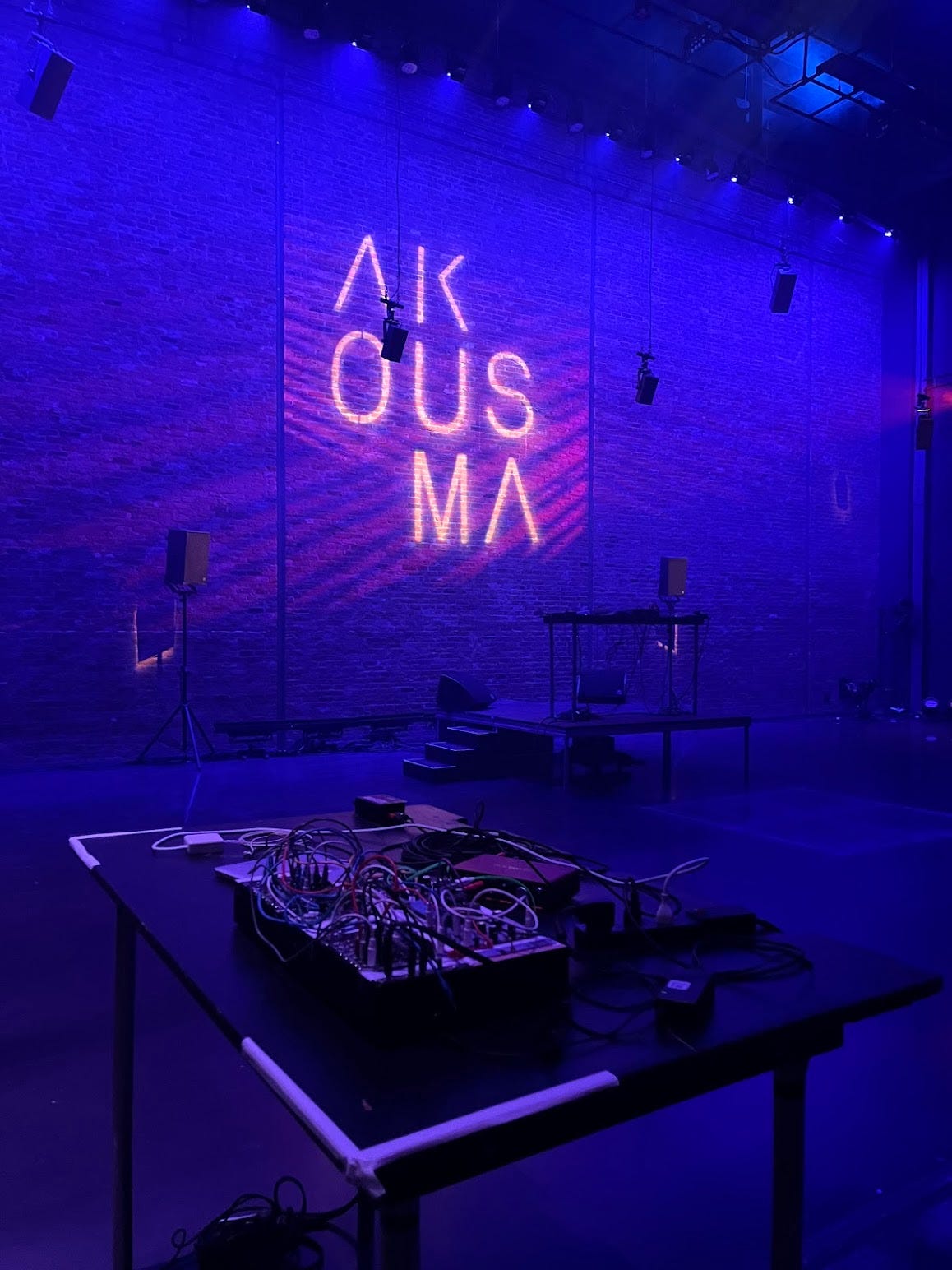
Quarterly Report: A CLOSER LOOK at AKOUSMA, UNSOUND, and DURATIONS Festivals (and more)
Back in high school, sometime around the turn of the millennium, I started writing about music mostly in order to get into concerts for free, launching a small photocopied punk zine—that lasted four issues—called XO with my friend Dave. We also ran a small distro company selling CDs at local shows, so I could get CDs for wholesale prices. CDs were expensive, and I was always desperate to listen to as much as I could, be it tapes dubbed by friends, CDs borrowed (and ripped) from the library, or p2p file sharing. But I’ve always been an obsessive music collector—no surprise—and found ways to participate in order to widen my access and discover new sounds.
When we started The Silent Ballet in 2006, and ACL at the very end of 2011, my motivations were very much the same. Back in those days, even if we were sent digital promos, we would be sent physical copies of what we reviewed. That was the remuneration for our labour, but at some point that ceased being the case. I was never interested in corporate magazines; I wouldn’t take a paycheck from Condé Nast on principle, and I generally disdain celebrity culture and everything that comes with it. ACL and my writing in general remains an extension of my youth in various DIY music communities, but every year it becomes harder to justify the effort.
All of that is to say that, looking back on all the great live music I experienced in 2025, I’m feeling the need for some kind of paradigm shift. I know very well that margins for everyone are growing thinner. I also run a small label, book live events, and release music of my own. But I’ve just gotten so sick of people paid to flood our mailbox asking us to do work for them for free. I get it, it’s up to us to monetize what we do or not, but the contradiction there continues to grate me, especially following some pretty negative recent experiences with some PR folks. (Others are great, of course!)
In any case, I’ll be reporting from the Big Ears festival in Knoxville later this year, so expect a preview article and post-festival review on the blog. As I did with UNSOUND 2023, daily newsletters with behind the scenes stories and notes will be available for our paid subscribers. Endless thanks to all of you who support the work.
Now, looking back on 2025, I previously wrote about my experiences with this year’s Suoni festival and some other gigs as they happened, but my schedule was just so packed in the fall, especially late October/November, that I didn’t have a chance to write about many of them due to end of the early start of our year posts. So I wanted to dedicate an entire post to those shows in what I’m calling a Quarterly Report, something I may continue with in the future.
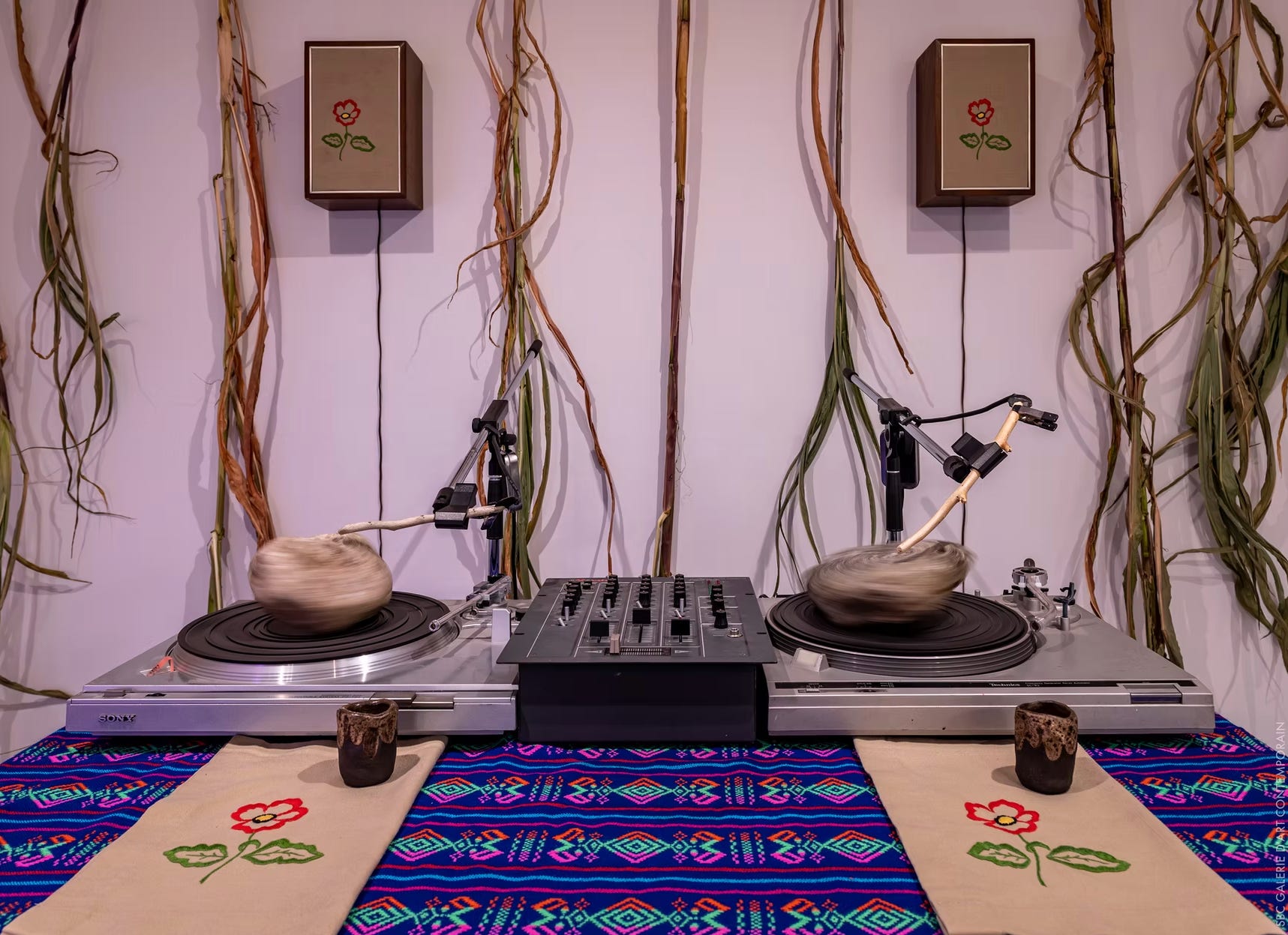
MARTÍN RODRÍGUEZ’s NOUS/OTRXS
SBC Gallery, Belgo Building, Montréal
I first met transmission artist Martín Rodríguez when he performed at the AKOUSMA festival in the fall of 2021, the first indoor concert I’d (cautiously) attended since the start of the pandemic. We became quick friends, and I joined his studio space 2022, helping him prepare for his performance at the OK LÀ festival that same summer. In 2023, he delivered a lecture to my Podcasting class entitled “Embodied Transmissions,” and later, until I left, we both had studio spaces at Ateliers Belleville. I include all these details for the sake of transparency, as I’m too close to be “objective,” but I also don’t write about my friends work unless I actually care.
Like me, Martín is an American in Montréal, and much of his work foregrounds his intersecting identities, directly addressing sound across borders. Martín is a multidisciplinary Chicanx artist and independent curator, whose work emerges from personal experiences. Trained as a guitarist at Berklee College of Music, he was forced to cultivate new means of creation after a brain tumor left him temporarily paralyzed. He discovered that the pickups of his guitar could pick up radio signals, an epiphany that became the source of his ongoing artistic practice. He is also the instigator of Acoustic Mirror, a streaming web app.
The exhibition NOUS/OTRXS—with a polysemous, gender-neutral title drawing on French and Spanish [We/Others, but together a homophone for nosotros, Spanish for we/us/ourselves)]—was the culmination of Martín’s MFA at Concordia University, and while all the hallmarks of his previous work (radio transmissions, concepts rooted in the tension between rootedness and migration, communications across borders, investigations at the frontier of history and culture) are present, I was impressed by the scale of the installation, which covered the gallery floor in a deep layer of wood ships, surrounded by plants that Martín had grown himself from seeds taken from México. Buried in the earth of some of the plants are copper wires receivers inspired by traditional practices, to ground Martín’s transmissions back into the soil.
Another central tenet of Martín’s work is community engagement. For example, I think it was at Nuit Blanche some years back, he hired a Mariachi band to accompany him through Montreal’s underground city, often playing for service workers and calling into question expectations about the festivals audience. Another work, a video presented on the side of a rented truck driven through the city, with Martín leaning out the window with a megaphone, again resituates the relationship between work and public, bringing the work to the people. When I went to see the NOUS/OTRXS on 22 October, Martín was in conversation with Amanda Gutiérrez and Stefan Christoff, who played various examples of their own work with radio, including some collaborations with Mexico City’s Radio Nopal and experiments in community broadcasting in rural Mexico. The conversation touched on many of the themes of the show including historical cycles, sustainability, and communal resilience.
Also shout out to Tom Roe, who co-founded pirate radio stations free103point9 (later non-profit Wave Farm), and author of the wonderful newsletter Turn On The News, who I met at this event, and who was also at Amanda’s performance the following evening.


NO HAY BANDA: Nina Garcia & Leila Bordreuil + Amanda Gutiérrez & Nik Forrest
La Sotterenea, Montréal
The next night, on 23 October—marking the tenth anniversary of No Hay Banda—Amanda Gutiérrez & Nik Forrest performed a radio-centric live performance at La Sotterenea, which also featured a shockwave of guitar and cello courtesy of Nina Garcia & Leila Bordreuil. J Dilla’s Donuts blared on the sound system as we waited for the performance to begin, a pleasant contrast to the abstraction to come.
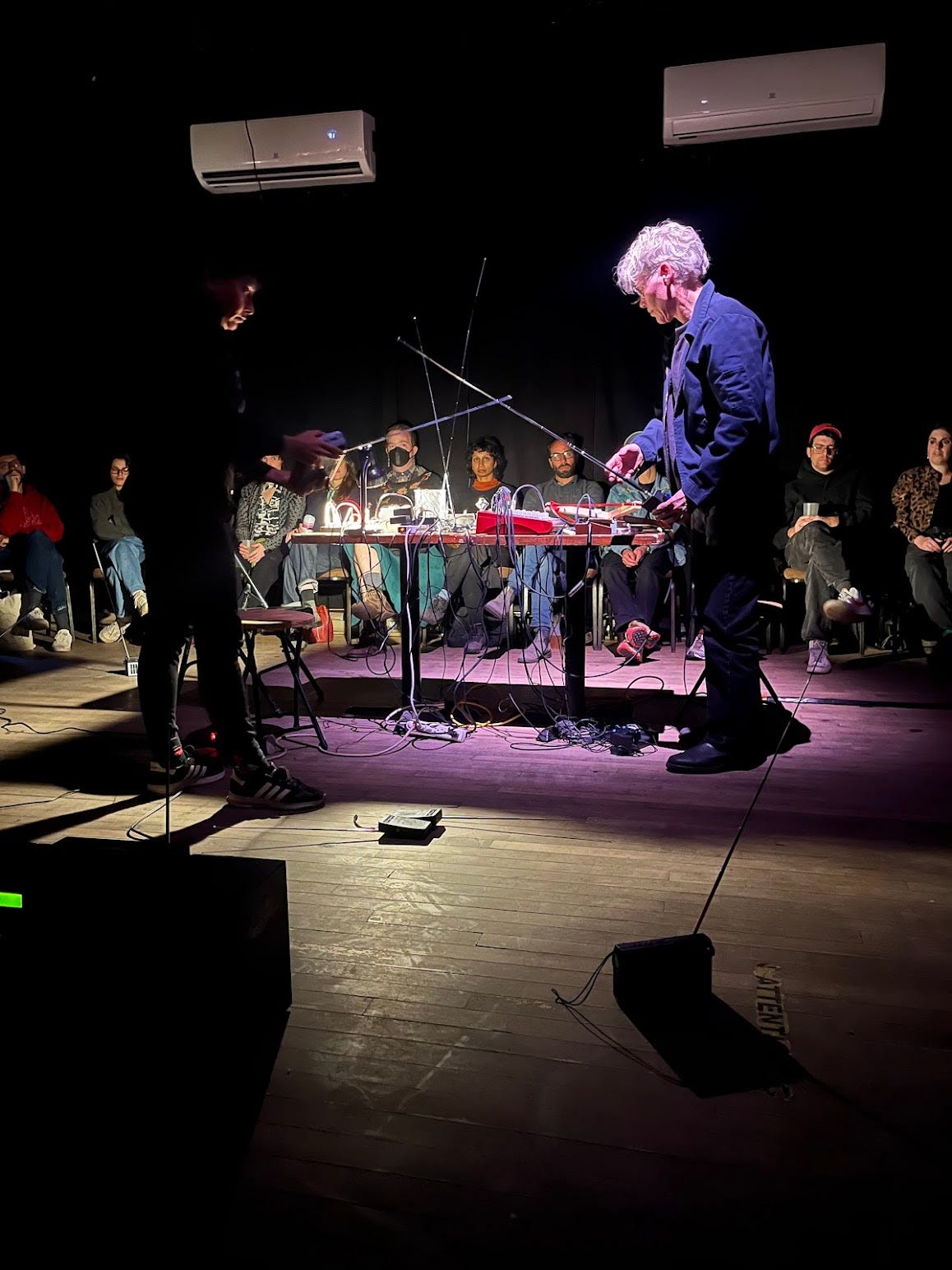
The collaborative performance from Amanda Gutiérrez and Nik Forrest found the duo manipulating various FM radios, VLF signals, and terrestrial radio frequencies, as transmission and reception fold back into one another. As with Martín’s radio performances, they foreground the performative activation of space; radio as gesture. The performers, and by extension, the audience, must feel the medium. At times noisy, and even abrasive, their set never felt aggressive. The set began with Gutiérrez walking around turning on various radios, building up the sound bit by bit, but also creating a structure for her dialogue with Forrest. The process of turning the radios on entails eventually turning them back off, a kind of symmetry that inevitably structures the set. But this doesn’t feel prescriptive, and in fact the set concluded with field recordings of lapping waves. The duo were positioned in the center of the floor, the public encircling them, with the many radios positioned in a U-shape around the floor. As in the picture above, the two would occasional physically cross their antennae in gestures that were mildly theatrical, like a pantomime of a sword fight but without any hostility or danger, I suppose evoking instead some sort of dance or ritual movement. Binaries like proximity and distance, repetition and difference underscored their dialogue, becoming blurred. Amplifying sounds that are beyond our notice or outside our perception, their work asks “what else escapes our attention, and who else remains unheard?”
Cellist Leila Bordreuil and guitarist Nina Garcia also presented a dialogue rich in gesture, but the highly-amplified duo were happy to cross the threshold into aggression. I have some of Bordreuil’s records and am familiar with her approach tp improvisation, but was largely unfamiliar with Garcia, whose minimal set up (guitar, volume pedal, amp) draws inspiration from punk rock and Sonic Youth. Bordreuil’s often extreme textures swarmed with overtones as Garcia plodded straight ahead, beating her guitar with a metal apparatus in a way that recalls the reductive force of Arnold Dreyblatt’s single string, the quotidian repurposing of Ellen Fullman’s long string instrument. And yet, those punk influences manifest in the form of blunt attack and shockwave of feedback, Garcia pummeling her instrument with great focus, almost laconic in its aggression, bordering on the abusive, with Bordreuil’s cello more than ready to match. The resulting mass of sound was the kind of physical drone that reminds me why I continue to come to see live music. They literally shook the building, and I was still vibrating as I stumbled back out into the autumn night.
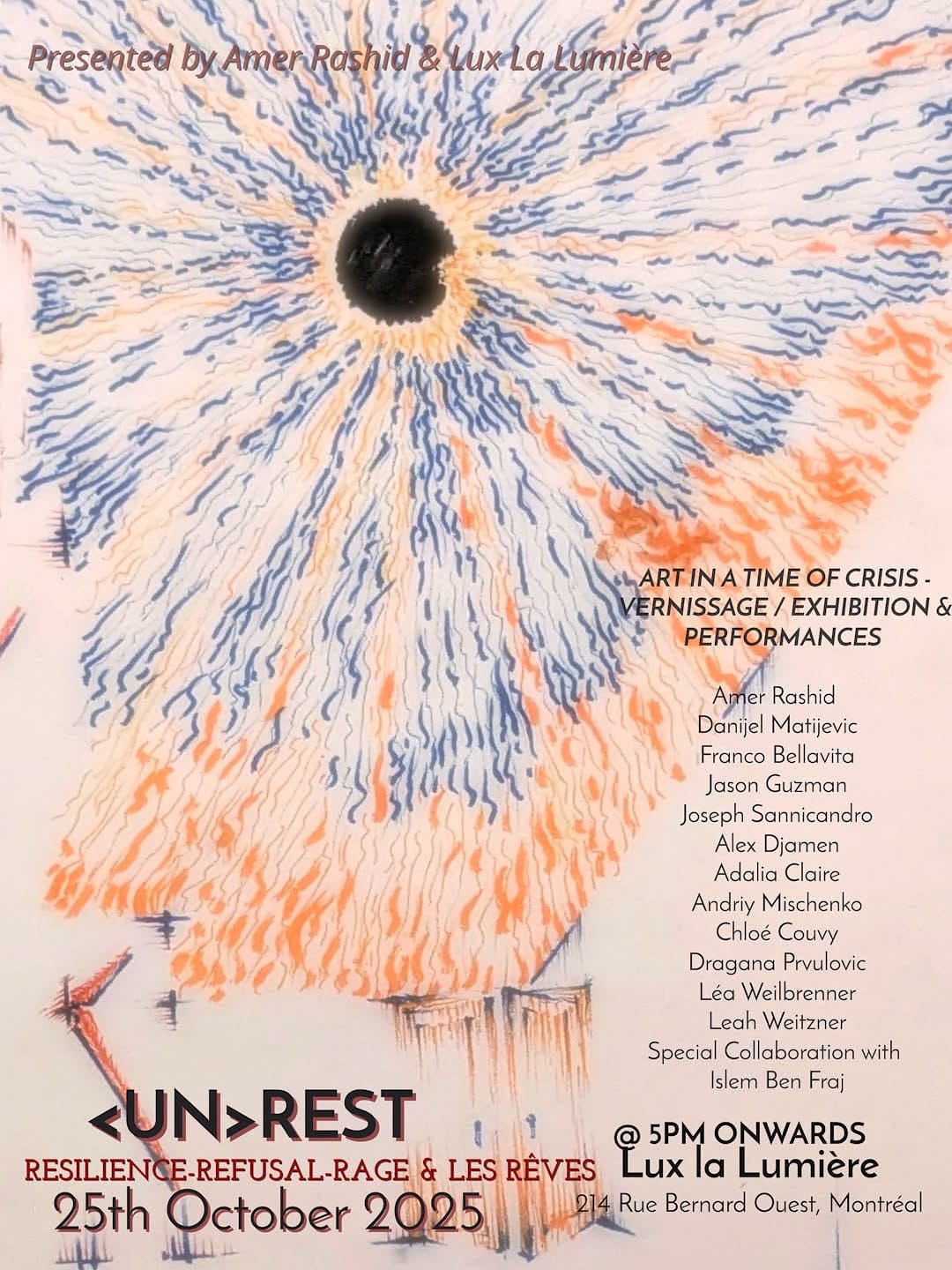
<UN>REST
Lux La Lumière, Montréal
That Saturday, 25 October, I participated in a group event organized by my friend Amer Rashid. The evening included the premiere of a new video work, the launch of a visual art exhibition, and multiple musical performances, poetry readings, and collective rituals convened in response to the ongoing crises facing the world today. Though most of us now reside in Quebec, the various artists come from Bangladesh, Tunisia, Argentina, France, Serbia, across Canada and the US and more. It was a moving program of collective grief and empowerment, which culminated in a ritual in which a scroll upon which all the participants and audiences members were invited to write their dreams was buried in the back courtyard. We were also encouraged to take seeds and sea glass to take with us, to disperse and to hold on to, to grow and to remember.
I installed a multi-speaker sound installation in the back court yard, which ran throughout the event, turned off one by one leading up to that final invocation. I called the piece “al-umm al-ḥazīna / the sorrowful mother / mater dolorosa,” reflecting the various sound sources. I took samples of grieving mothers from around the world—Palestine, Lebanon, Italy, Canada, the United States—as well as various conceptually relevant musical samples. Each of the six speakers contained a mixture of sounds on an SD card, which shuffled on a loop. Mixed in with those sounds were various silences, the result being an ever shifting sonic sculpture, a rumination on the universality of the grieving mother—from the Holy Mother, whose image adorned the venue, to Black Lives Matter, to Missing and Murdered Indigenous Women to Palestine.


Raven Chacon, Place Where the Waters Crossed
MOMENTA x Leonard & Bina Ellen Art Gallery, Concordia University, Montréal
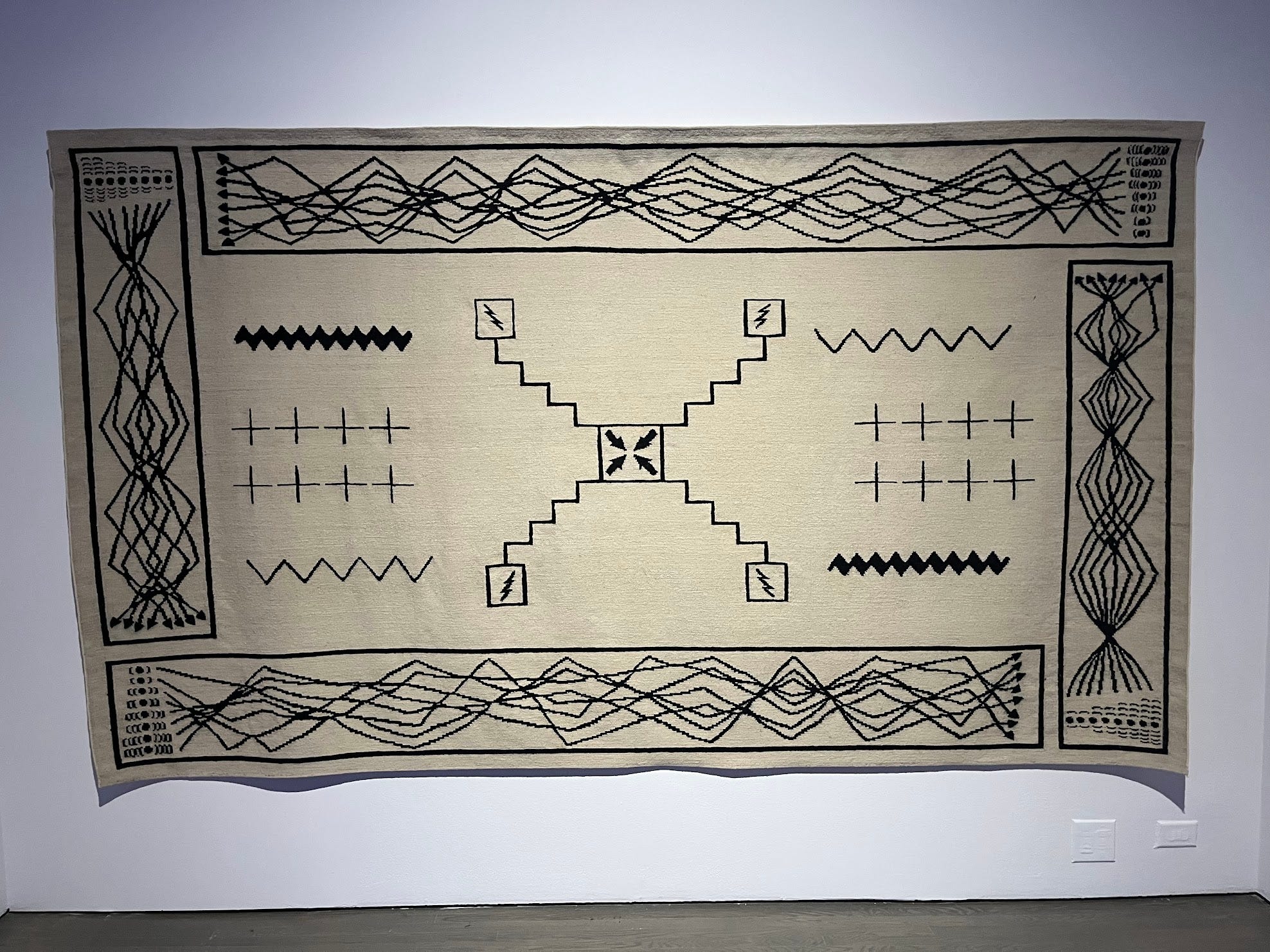
I stopped by the Leonard & Bina Ellen Art Gallery to catch Raven Chacon’s installation shortly before the end of MOMENTA, Montreal’s Biennale of contemporary art. I’ve previously mentioned Chacon’s work (#36, #86.5, and in my podcast with Patrick Nickleson), and I suspect many of you are familiar with his graphic scores and his various musical projects, including 2022 Pulitzer Prize for Music winning composition “Voiceless Mass.” I’ve seen Chacon perform a few times (see #36), most recently alongside Wolf Eyes as part of the 2025 Suoni festival last June. But I’m glad I set aside a leisurely afternoon to spend in the gallery taking in his scores, textiles, installations, and video works. A member of the Diné (Navajo) Nation, Chacon’s work consistently returns to the essential questions of how sound carries place, memory, and resistance, framing listening itself as an act of political and historical witness. The wide variety of work in Place Where the Waters Crossed forms a resonant archive in which sonic experimentation charts marginalized histories, embodies stories, and asserts a persistent Indigenous presence.


AKOUSMA 21
Usine-C, Montréal
My history with the Akousma festival is a long and personal one, a thread running through over a decade of engaging with Montreal’s sound art scene. (For past writing on the festival, see: AKOUSMA 2012, AKOUSMA 2019, AKOUSMA 2023, and interviews with Francisco Lopez, Kassel Jaeger, and Aho Ssan.) It began in 2012 when I spotted a poster for the acousmatic sound festival at the late great Café Laika. I moved to Montréal in 2009, and was surprised that it somehow hadn’t been on my radar, though I soon realized this was an instance of the city’s Francophone-Anglophone divide. The cultural association behind the festival, Réseaux des arts médiatiques (now simply AKOUSMA) has close ties to the Conservatoire de musique de Montréal, and thus is very much rooted in the city’s Francophone community, as well as fostering strong ties with likeminded institutions in Paris (namely, Ina-GRM).
I quickly reached out to the organizers and obtained a press pass to cover the 2012 edition, for which I interview Lopez and published a full review of the festival at ACL. A reworked section of that review appeared as “Martin Tétreault’s Turntable Quartet in Akousma 9” in the journal eContact. As I was in Minneapolis for the fall semesters from 2014-2018, I missed all those editions, but in 2019 I interviewed Francois J. Bonnet (aka Kassel Jaeger) for the Sound Propositions podcast and also a feature for local alt-paper CultMTL, pursuing a similar approach to the 2023 edition.
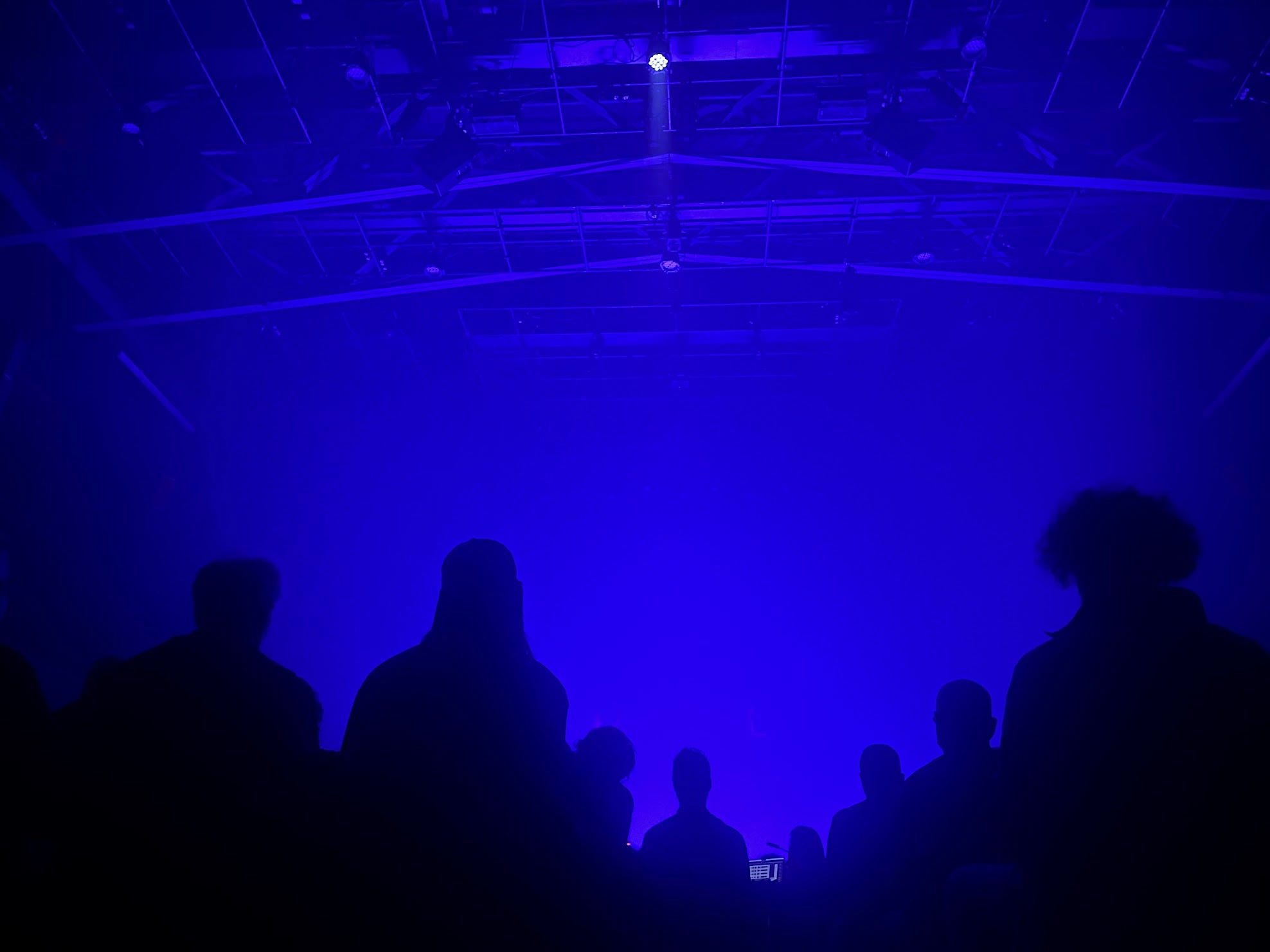
This year, the relationship deepened in a new way, as I was invited to trade my critic’s hat for that of a composer. Artistic director Louis Dufort saw an excerpt of my piece al-rambla, which I presented in Brooklyn earlier in the year, and invited me to do a live diffusion as part of the 21st edition of AKOUSMA. I'd never. had the opportunity to do a multichannel diffusion before, and learned a lot in the process. While some performers prepare 4 or 8 (or more) track versions of their work, I played it safe with a stereo version, allowing for a more performative approach to moving my sounds around the 48.8 sound system at Usine-C.
My contribution, al-rambla, is comprised of recordings I made in Granada and Blanca during my residency at Centro Negra (AADK Spain) earlier in 2025, essentially treated and collaged field recordings. As such, it largely eschews some of the orthodoxy (and clichés) associated with acousmatic music; sub-bass, filter sweeps, booming dynamics, and dramatic silences and so forth. I was relieved that the work went over well, and I’m looking forward to approaching multichannel work in the future, now that I have had some experience and better understand the possibilities.
The three day festival, which ran 29-31 October, had many highlights, which I’ll only briefly recount [but you may find the full program here]. The first two evenings’ programming hewed closer to tradition, with diffusions controlled from the mixing board in the center of the room. Standouts from the first evening include the wonderfully weird and humorous vocal manipulations of Philippe Macnab-Séguin—humour is often sorely lacking in these spaces—and the masterful sound worlds of Natasha Barrett. I performed on the second evening, following a diffusion of Daphne Oram’s Four Aspects (1960) by Dufort (I never thought I’d follow Oram!). My friend Rehab Hazgui performed next, a rich and muscular soundscape entitled Chôra. Robert Schwarz’s 30 minute Stridulation 1-14 closed out the evening in strong fashion, a complex blend of field recordings of insects and electronic synthesis, also drawing conceptual inspiration from swarm behaviour.
I most enjoyed the final evening, which is a testament to the festival curatorial intelligence, making space for less traditional contributions. Julia Dyck opened the evening with a hypnotic blend of electronic textures, live chimes, and vocals. Anna-F Jacques presented a beautifully strange, almost tactile set of small sounds, a quiet archaeology of the minute. Light bulbs clicked, microphones and speakers were coaxed around the floor, enrapturing the audience. Orchestroll (Jesse Osborne-Lanthier and Asaël Richard-Robitaille) took the stage to close out the festival with a visceral channeling of pure sound. As the tremendous range of performances on that third night demonstrated, contemporary acousmatic work is not trapped in the museum, but continues to evolve with the times.


UNSOUND
Lincoln Center / Fridman Gallery / Nowadays, New York City
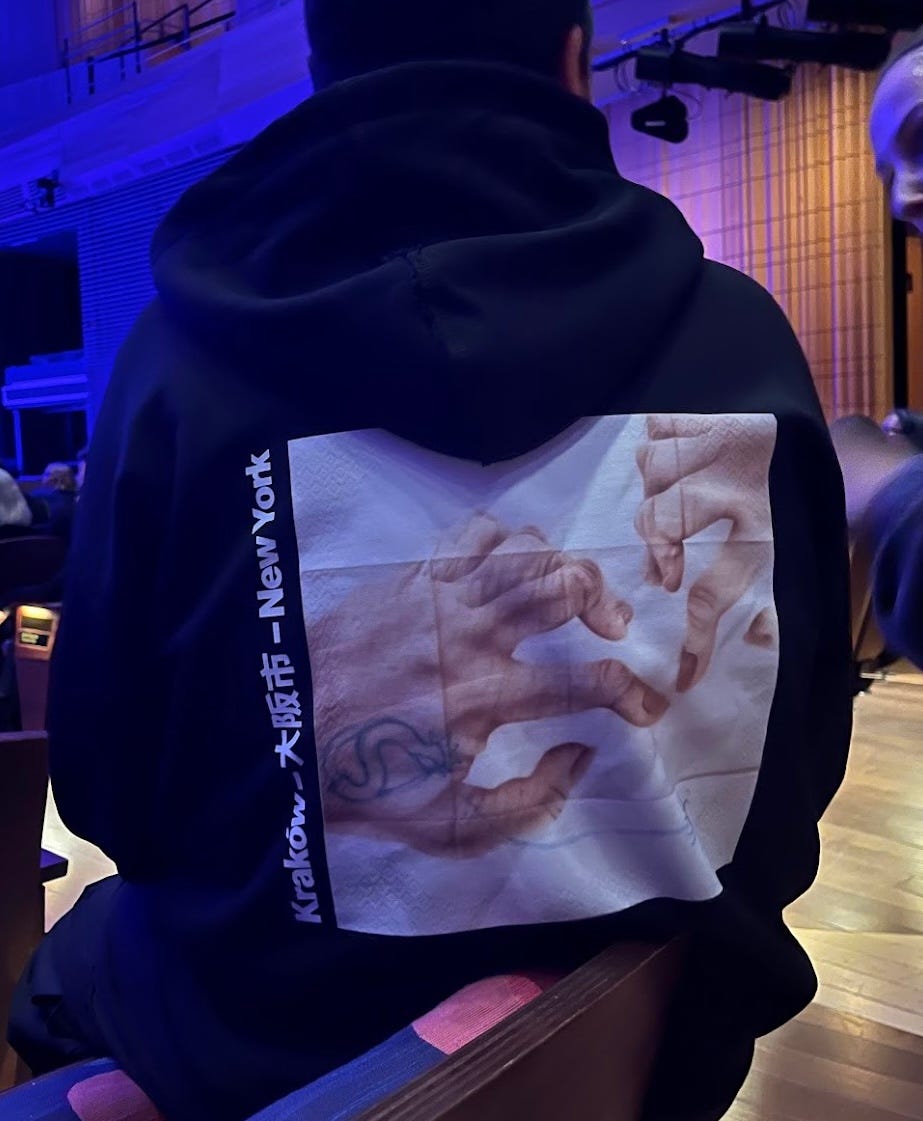
My experience of Unsound ‘s 12th New York edition at Lincoln Center was bookended by two distinct but complementary explorations of composition. As I was in Montreal, I was unable to attend any of the opening events, though word the collaboration between Adam Gołębiewski and Evischen was the clear highlight. I literally went directly to Lincoln Center with hardly a minute to spare before taking my seat for The Sinfonietta Cracovia’s rendition of Aleksandra Słyż’s Pure Voices, a fascinating amalgamation of electronic textures and strings. The middle set featured Lucrecia Dalt in a trio, presenting her anticipated new album, A Danger to Ourselves. The Sinfonietta Cracovia then returned for a program of works by Mica Levi. The opening composition was performed in near-total darkness punctuated by sudden flashes of light. The tense and unsettling atmospheres gave way to a more narrative piece, before culminating in a third act of pure, abrasive texture.
The following night at the David Geffen Hall, a different kind of legacy was being honored and reanimated. The evening opened with a modular synth and vocal duo from Heinali & Andriana-Yaroslava Saienko, presenting their 2025 album Гільдеґарда (Hildegard), a striking recontextualization of the music of the pioneering 12th century composer Hildegard von Bingen, fusing Ukrainian folk singing, modular synthesis, and ancient wisdom in order to process the effects of modern war. Heinali, one of our favorite Ukrainian artists, has been working closely with Unsound in recent years, though this may have been my favorite presentation of his work. His modular synth pulse slowly mutated into a soaring drone, a bed of electronic textures over which the barefoot Saienko delivered her melismatic vocalizations.
It was an interesting prelude for the main event, the avant-pop legendary John Cale (Velvet Underground, The Theatre of Eternal Music), who normies would soon discover via his unexpected collaboration with Charli XCX, which dropped the following week. Taking the stage with his shock of white hair, Cale moved from rocking open-tuned rhythm guitar to the piano, leading a core quartet through a set that was occasionally boosted by a 12-person choir, whose presence transformed songs like “Captain Hook.” While the Lincoln Center acoustics occasionally battled with a distorting Kurzweil organ, the raw power of the performance was undeniable.


On 2 November, I attended the opening of Chopin Residue at the Fridman Gallery downtown. I have previously mentioned Fridman in these pages when I attended their New Ears festival, but I often pop by to see what’s on, particularly as they pay special attention to sound in both their installations, screenings, and live performances. The opening day of Mariusz Szypura’s exhibition audiovisual installation featured a performance in which Szypura, on guitar, was joined by Lee Ranaldo (Sonic Youth) on guitar, John Stanier (Battles, Helmet) on drums, and Zoh Amba (Tzadik) mightily skronking their sax. As the title suggests, the Chopin Residue project reinterprets the legacy of Frédéric Chopin, the beloved composer who made his name in Paris but who was born Fryderyk Chopin in Poland. But the piano, for which Chopin is best known, is no where to be found, stripping down the maestro’s compositions to see what is left on the margins. Many NYC notables were in attendance, and I do love when an art opening goes above and beyond with the free drinks. Icelandic water and Champagne through a straw? Yes, please! The set was great as expected, and the visual installation, which featured large textured canvases and video screens, provided an interesting lens through which to recontextualize the sonic deconstruction of the album.
And finally, it wouldn’t be Unsound without an opportunity to dance the night away. Unfortunately, for me at least, it wasn’t meant to be. Unsound joined forces with Dripping and Ridgewood’s Nowadays to present the New York edition’s only club night. But when I got to the door, the Nowadays staff—who were extremely rude and unhelpful—refused to let me in after not finding me on the guest list. They didn’t even know what Unsound was, and refused to ask their manager or any present Unsound members, telling me only “that’s not my job.” So I didn’t get to see Mica Levi’s DJ set or any of the others, and I was especially sad to have missed the reworked installation version of Jim O’Rourke & Eiko Ishibashi’s Włodzimierz Kotoński!, for which I’d shown up early on the first particularly cold day of the season.
Who’s to blame? My PR contact? Unsound? Dripping? Resident Advisor? Who knows, but the entire experience left a bitter taste in my mouth, and since no one involved has done anything to make up for it (I barely even got a half-hearted “sorry”), it’s confirmed my impression that the satellite editions of Unsound—or at least the NY edition—pale in comparison to the real deal in Krakow.
I retreated to a nearby bar to warm up with a whisky and some snacks, while I tried to get some of my contacts to get back to me. While there, I was immersed in a soundtrack of ‘90s rock, including Nada Surf, Jimmy Eat World, Cake, and Weezer. It could have been worse. I’m glad I got to check out the events I did, but on balance the vibes were off. The entire festival felt like it wasn’t meant for me, and you know what, note taken. I won’t be back.


DURATIONS
Public Record, Brooklyn
I was only able to attend one concert as part of the Durations festival, but it was a doozie. The crowd at Public Records, however, really left a lot to be desired. Whenever I come to Pubic Records I get the feeling that everyone there works in finance and someone told them this is where (wanna-be) hip folks should go. The whole venue feels like it was designed by Urban Outfitters (derogatory); it’s just far too manicured to actually be cool. They do have a great sound system, though, and the programming is consistently excellent. That said, the show seemed like it might go viral for the wrong reason, as the downpour outside seemed to have coaxed a few rats into exploring the venue. I know NYC has been struggling with our subterranean co-inhabitants in recent years, but they really didn’t match the decor. One rat was clearly visible behind the stage, with the crowd training their cameras on the rat instrad of the performing. The invader scaled the wall and eventually ran out across the floor, causing a minor commotion as the staff tried to prevent too many audience members from noticing. I suspect you can find some videos out there somewhere.
Right, so the music. As soon as I arrived at the venue (admittedly a bit too stoned, and absolutely soaked after getting caught in the rain walking down from Atlantic) I was greeted with a hug by Patrick Shiroishi in the courtyard. The opening set by M. Sage was a beautiful and calming soundtrack to drying off, a blend of field recordings of bird with electronics and live clarinet. Several people were talking loudly throughout Sage’s very mellow set, and despite the performer himself giving them the stink eye and blowing his horn pointedly in their direction, they didn’t seem to get the hit. And as the offending duo eventually slunk back by the bar, another pair of miscreants quickly took their place. Shut the fuck up people! If you want to talk, don’t come to ambient shows. Or at least go outside. I really can’t comprehend the entitlement.
Patrick’s set, which drew on his acclaimed 2025 LP, began by playing voice notes of his grandmother directly into the microphone on his sax. His live set up included an Sp-404 mk2 and various effects pedals, and in addition to his sax we were also treated to some lovely singing. I can’t recall much about Fergus Jones’ set and didn’t make many notes, but I do remember that the bass rattled the building so hard I was worried that the glass panes in the atrium ceiling might come crashing down. Lyra Pramuk did a notable set in the sound room, which tended to featured more pulsing club music, though I missed most of went on there watching the sets in the atrium. In between sets, Gabriel Jermaine Vanlandingham-Dunn held it down on the turntables, playing groove heavy music, mostly hip hop, a vibe that guitarist Jeff Parker used to segue into his set with a guitar loop. Parker played a tight set drawing on his solo compositions, work with Tortoise, and also, if I recall correctly, a piece by Horace Silver. Despite getting soaked, and being in close proximity to rats and annoying finance bros, it was a nice way to spend a Sunday evening.
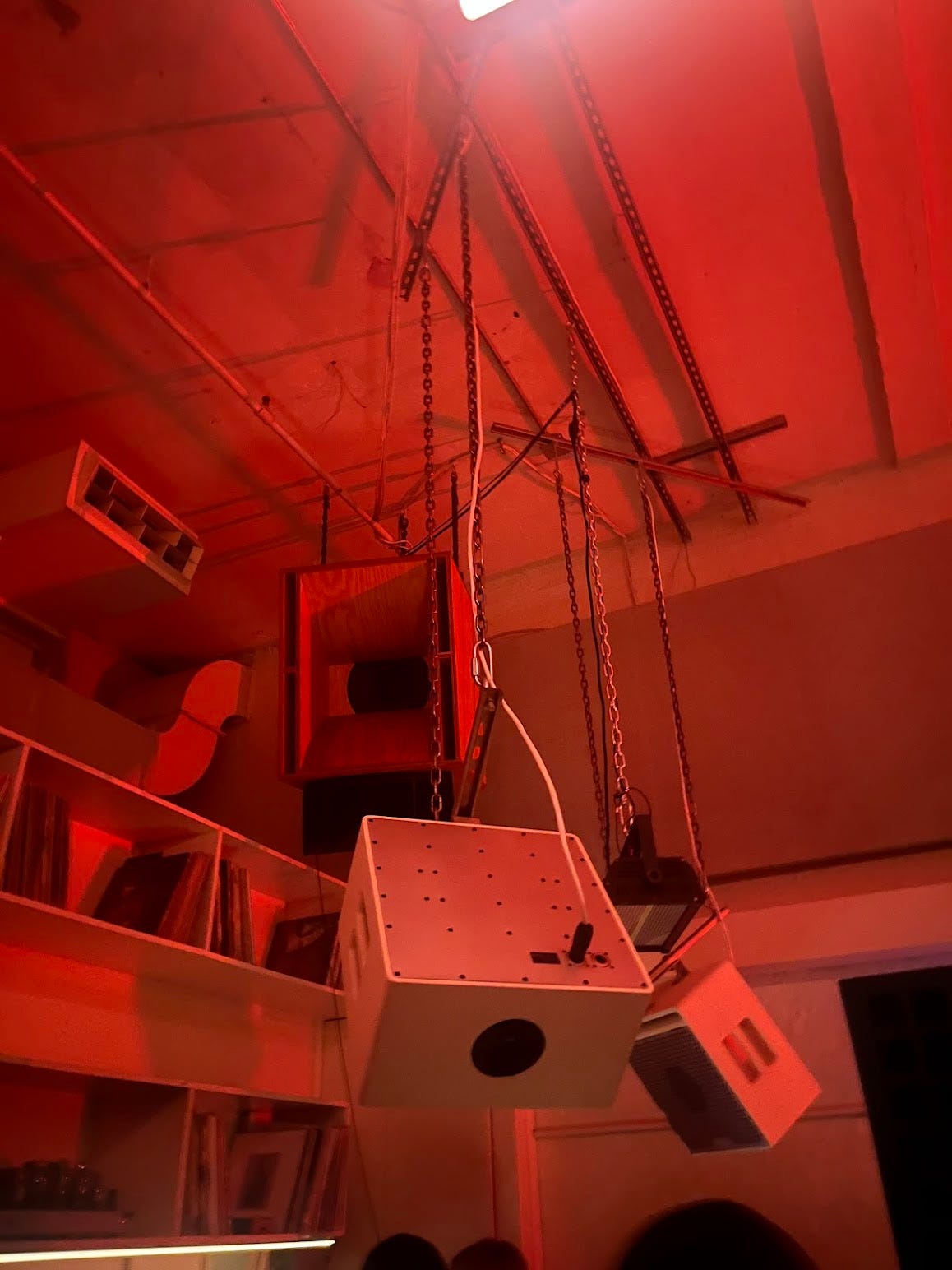
While visiting my family in New York, I also caught a great rap show in the back room of Secret Pour, a dive bar in Brooklyn. The show was birthday party for Sasco, who headlined the night in a trio with Hester Valentine and Shemar called Spare Parts. The night kicked off with Big Flowers, whose 2024 album Save the Bees (produced by Messiah Musik) was one of my favorite rap records of the year. He was backed up on the SP by CineMasai (Hearing Thing’s Dylan Green) doing his first ever beat set. Flowers hadn’t heard the beats, so it was interesting to watch him recontextualize his own rhymes over music he was unfamiliar with. Yolanda Watson’s soulful singing hit me hard, and Blackchai absolutely bodied the place. Definitely keep an eye on the “Another Rap Shows” series at Secret Pour, organized by NAHreally and Dunce. I was already back in Montreal by the 4 December show featuring ELUCID and Henry Canyons, but upcoming shows include Quelle Chris and Nappy Nina on 5 February. Seriously, you can see the cream of NYC underground rap in remarkably intimate places like Secret Pour and Young Ethels.
Back in Montreal, I caught the final showing of Jessica Moss’s Unfolding in Dolby Atmos in the basement of the Phi Center, while Theo fucking Parrish transcended space and time on the dancefloor above. (That was sold out, but I was able to walk in an absorb a few minutes of the great DJs genius.) A few other notable end of year shows included AKAI SOLO at P’tit Ours, including opening beat sets by Nicholas Craven and Mike Shabb. I mentioned this previously, but on 2 December I helped with the live stream for Radio al-Hara of the benefit Uni·e·s pour la Palestine, which included moving performances by a wide range of artists including Hawa B, Nadah El Shazly, and Radwan Ghazi Moumneh. And on 3 December, after the launch party of the For Jonathan zine—in memory of my late McGill professor Jonathan Sterne (1970-2025)—I spent a beautiful snowy evening at La Toscadura with the music of Laurie Torres and claire rousay, both presenting live versions of their most recent albums. Montreal is the best.
Lastly, over the holidays, I was in Seattle for a bit and did some digging with the homie Gabe Bogart, also former TSB and ACL contributor. Shout out to Sonic Boom and Daybreak Records. Highly recommended. Alright, thanks for Listening, and come back Wednesday for our 100th (!!!) regular edition.
Wow, didn't expect such a thorough off-week, especially with everything going on; your dedication and the OUT OF THE BOX series are truely inspiring.
Post now with added copy editing.