
Dear Listeners, Joseph here with an odd off-week newsletter dedicated to Shane Parish. The Athens, Georgia guitarist, composer, and improviser—known for his avant-rock group Ahleuchatistas and his work with Bill Orcutt—is poised to drop his interpretation of the music of Autechre on 27 February. Jeremy Bye has an early review for us, while David Murrieta Flores speaks to Parish about his work.
I’ll be back soon with another regular edition and some long-awaited interviews. Until then, Happy Listening!
Shane Parish ~ Autechre Guitar
It would appear Shane Parish likes a challenge. First of all, how to follow Repertoire, an album that saw the guitarist cover everyone from John Cage and Alice Coltrane to Aphex Twin and Charles Mingus. And second, once a theme has been decided, how to create it? In this instance, Parish has decided to cover Autechre. On an acoustic guitar. And then give the album a very pragmatic title, which may or may not be a pun. The dude heard “Corc” and decided it would work as an acoustic piece, so I’m not going to challenge his choices.
You are probably familiar with Autechre’s reputation, and that might be enough to deter you from approaching their music. They are one of the pillars of Warp Records, a duo who seem unwilling to compromise their vision to the extent that every radio session and live performance is unique, and as important as the studio records. It’s not always easy to get into, sitting somewhere between hip hop and musique concrète. I saw them late last year, and standing there in the dark – a ghostly light from laptops providing the only illumination – was a genuinely transcendental experience. It would be impossible to translate this sound into anything else. It felt like the pinnacle of what is achievable musically.
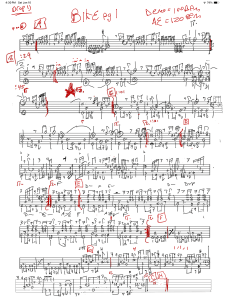
However, their earlier albums were more melodic and accessible, and that’s where Parish selects his material. Four tracks off Incunabula and three off Amber form the bulk of this album – two records that Autechre aren’t wild about now, but certainly give hints of what is to follow. It’s the duo of Sean Booth and Rob Brown finding their voice and gradually shaking off any outside influences. Through a series of EPs, the pair arrived at Tri Repetae, the starting point of the Autechre we know today. But still accessible enough for Shane Parish to grab his sheet music and pencil and notate “Clipper” and “Eutow”.
The first impression of Autechre Guitar is how Parish carefully draws out the melody lines from each of the tracks he selects. He’s not just aiming for repeated lines, such as on “Eggshell”, which has two distinct melodies – like a verse and chorus if you want to break it down to the most basic parts. He’s also sensible when it comes to editing out anything extraneous – the opening “Maetl” is a concise two minutes, and immediately recognisable. There’s quite a bit of atmospheric development and repetition removed from the original, which can only help the guitar version – as on Repertoire, Parish is a master when it comes to cutting compositions down to their catchiest components.
There comes a point about midway through the first listen when we forget we’re listening to Autechre covers. Even allowing for familiarity with the source material, this becomes a record more akin to the American Primitivism of John Fahey. It’s on “Bike” or “Nine” that this clarity occurs – Autechre Guitar becomes more Guitar than Autechre. If you wish, you can still focus on the way Shane Parish has adapted the core material, such as the shifting rhythm on “Yulquen”, or you may prefer to just let the music, such as the pastoral feel of “Slip”, float past.
On paper, this must have seemed like an impossible undertaking, but Shane Parish has exceeded expectations. He’s been faithful to the originals but has drawn elements out of the Autechre productions, resulting in pieces that are recognisable but dazzlingly fresh. If Autechre seem icily remote or inaccessible, then Parish’s work is the very opposite: warm, rural and welcoming. (Jeremy Bye)
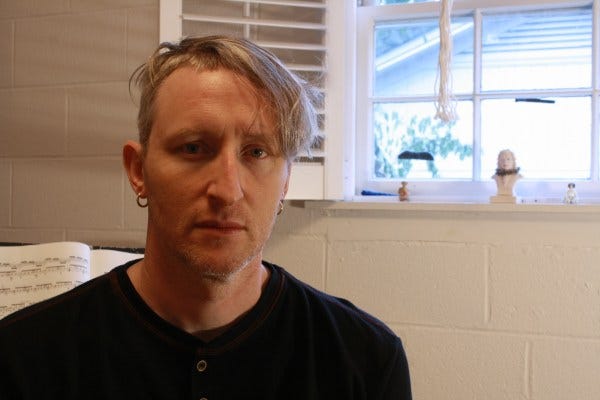
The Synthesis Machine ~ An Interview with Shane Parish
Shane Parish is a multifaceted guitarist that has crafted numerous interesting arrangements of pieces from various genres for his chosen instrument. His latest, Autechre Guitar, showcases a series of adaptations from a wide selection of early works by the UK electronic duo. We had the chance to talk with Shane over email, the result of which is the interview that you can find below. It has been edited collaboratively with the artist, prioritizing clarity and written intent.
David Murrieta Flores (ACL): Hello, Shane! Could you please talk a bit about yourself to introduce you to readers who might be unaware of your projects?
Shane Parish (SP): I play in the Bill Orcutt Guitar Quartet, along with my esteemed colleagues: Bill, Ava Mendoza and Wendy Eisenberg. I helped Bill get the live version of his Music For Four Guitars album off the ground. He hired me to transcribe it and produce a score, and to help put the band together and perform in it.
I also play in an avant-garde instrumental rock band called Ahleuchatistas, which has been active since 2002. It has gone through several personnel changes over the years, and has released nine albums. The current lineup is with Trevor Dunn on electric bass and Danny Piechocki on drums.
Most of my time is spent playing solo acoustic guitar. In 2016, I released an album of solo fingerstyle interpretations of folk and blues music called Undertaker Please Drive Slow on Tzadik Records. I love interpreting music from different canons, and have released several recordings of my interpretations, some independently and some on record labels. A few highlights are: Liverpool on Dear Life Records, Repertoire on Palilalia Records, and Solo at Cafe OTO on my own label, Red Eft Records.
ACL: To begin with, I’d like to ask you about the principles you use to figure out arrangements and covers of works that fall beyond the regular purview of the acoustic guitar repertoire. What is (or are) the ruleset(s), and what do you generally seek by applying it/them?
SP: If a song evokes a feeling in me, I generally think to myself, “what if I arrange this for solo guitar?” Creating arrangements deepens my connection to the music I love.
In trying to capture the overall atmosphere of a piece, I typically gravitate towards the melody first. I figure out what’s happening on top. Then I analyze the bottom. What’s going on in the bass? Alone together, the top and the bottom are plenty enough to create engaging counterpoint for solo guitar music. But, often, the atmosphere requires consideration of the middle, the harmonic pool the song swims in. So, I check that out to see if I need anything from the inner voices to fully convey the vibe.
My basic mantra when working up an arrangement, applying fingers to strings and frets, is “revoice, revoice, revoice.” I will trial-and-error several versions of a phrase in search of resonance, playability, and emotional conviction. A good example of this is my arrangement of “Lonely Woman” by Ornette Coleman, a song that has been covered by many people in many different ways. I arrived at my arrangement after a lot of exploration. It is in drop-D tuning and features open strings, glissandi, vibrato, harmonics, double-stops, arpeggiation, string bends…
The construction of the guitar offers virtually endless variations of how you can articulate a theme. I become enthralled when I am tarrying with a melodic fragment, searching for what I feel is its most beautiful expression on the instrument. I play it this way and that until I get that tingle of the aesthetic feeling which says “this is right.” The final result is not always the easiest path to execution. But it’s definitely not the most difficult, because if it’s too hard, I won’t play it.

ACL: Do you ever break or bend those rules?
SP: Occasionally, I work from a piano score or an orchestral score of a work and adapt it to the guitar. I did this with “Avril 14th” by Aphex Twin, “Bird’s Lament” by Moondog, and “Totem Ancestor” by John Cage.
This approach is more of a game of subtraction, rather than construction. Instead of building up my arrangement from my own transcription of the top, bottom, and middle, I have to reduce the abundance of elements in the music to the smallness of the guitar while preserving the essence of the piece.
I may have to transpose the song to a different key, or put the guitar in an alternate tuning to make it sit on the instrument in a resonant way.
ACL: When you think of your audience, what do you want them to perceive or realize from materials that might be familiar to them already in another form? What do you want for the part of the audience who might not know the “originals”?
SP: I always want my performances to be evocative in some type of way, to scratch an itch you didn’t know you had, even if the meaning is ineffable.
If someone is familiar with the source material, it is interesting to imagine at what point recognition occurs. I have had people tell me they couldn’t hear the original at all in my version, or that it took some time for the original to reveal itself. I guess it depends on the approach I take to the performance. On an album like Repertoire or Autechre Guitar, I am being very faithful to the originals. So if you know the music, it’s immediately apparent what it is. At that point, I hope that they are in their feelings about it, as opposed to viewing it as some type of novelty that a familiar piece of music was orchestrated for solo guitar. Yet I’m happy if people appreciate the guitar work too.
However, when I interpret vocal music, I let the song steer the ship, almost removing myself, and that can be very mysterious and veiled, with the shape of the original only poking through here and there. One of the reasons that I started interpreting folk music in the first place, was because I felt that there was some type of universal physiological response to the shape of these old melodies and forms. And that is why humans keep gravitating towards them. They connect us to something universal.
So, to answer the second part of your question, if a listener is not familiar with the original at all, I still hope they feel this connection to something universal. There are ratios in music that affect people’s emotions and memories in deeply impactful ways. I think about it physiologically because we’re talking about air molecules vibrating at different speeds, hitting the body over and over again throughout the course of a song. Some songs have just the right combination of all the musical elements—the ratios which constitute the shape of form, harmony, melody, rhythm, tempo, timbre, dynamics, etc.—to cause most nervous systems to vibrate in such a profoundly sympathetic way that the song sticks around and gets interpreted again and again over the course of human history, from its birth, whenever that may have been, to the present day. “Amazing Grace” comes to mind, but, there are a lot of deep cuts, more recent songs, and even contemporary tunes [I could think of].
When I interpret a folk ballad, say “She Moves Through the Fair”, but it could be any vocal tune with nice contour, it becomes an environment that I can move around in, stretching the parameters of its various coordinates, tarrying with and exulting in its more seductive moments. In this way, the map is still there, the ratios that stroke the nervous system are the terrain, but instead of playing it straight down, it is fluid.

ACL: I put “originals” in scare quotes because one of the key problems of translation work is that base texts or materials are already plural in meaning. Would you see meaning as important in the sort of translations that you do? Would form be more important?
SP: Meaning is the most important part. And by meaning, I mean feeling. It is instrumental music, after all. The meaning/feeling is no doubt saturated with history, biography, politics, narrative, context. And, while I am curious about and sincerely honor the living origins of a song, I am dealing in beauty, and attempting to elevate our current lived experience.
At the same time, I do take pleasure in analysis of form, because therein lie the codes for beauty, meaning/feeling, and epicness.
ACL: Making the guitar speak a multiplicity of (musical) languages implies reframing it as an instrument, right? What would you say is the guitar an instrument of, in this context in which it its sounds are both familiar and unfamiliar to listeners?
SP: For me, the six strings of the guitar are six individual voices. Each one has its own character and colors. When they vibrate in combination, it is like arranging across the sections of a big band—for example, something like violin meets trombone meets trumpet meets the human voice— like how Duke Ellington and Billy Strayhorn would combine instruments to produce new colors of sound. Or like car horn meets birdsong meets running water meets airplane. Each string is also a keyboard, and the frets are the black and white keys. So, the fret board is six keyboards stacked on top of each other, tuned a fourth apart. Except for strings 3 and 2, which are tuned a third apart. Very complicated. From this view, the guitar is a barrier to expression, an obstacle course that you need to physically and conceptually conquer in order to get your feelings across. But, you only need to go as far as is necessary to make your own personal statement to your own satisfaction. So, maybe you don’t do the conceptual thing. Or you don’t really push the physical thing, “no chops” ethos and all that.
For me, I want to get closer to the music I love. Interpreting, arranging, and performing is how I do it. When I share this with the world, it’s like a love letter that I’m reading aloud to the song I am playing, or a mixtape you give to a friend because you want to hip them to some shit you’re really into. I’m saying, “I dig this. I hope you dig it too!” In this way, the ends necessitate the means and pull me in deeper and deeper towards theoretical and technical goals. I’m not trying to be flashy, but I do want the music to sparkle.
ACL: There’s a quote I like by an Italian philosopher, Dominico Jervolino, that says “To speak is already to translate.” The problem is to potentiate, instead of reducing, a message that is already not in the same language you yourself might speak (a thought, an impulse). What are you potentiating – from Autechre’s work, in this case – and what might be reduced? What are you potentiating from your own language (both guitar and generally musical) through this translation, and what do you think might be reduced?
SP: On this record, it has been said that I am potentiating the strong melodic sensibility of some of Autechre’s early work. Before I began transcribing, I surveyed their discography to collect my track list. I chose compositions where I could visualize the counterpoint on the guitar in my mind. The classical guitarist Eduardo Fernández said something like, “You don’t play the guitar in the physical world. You play the guitar you have constructed in your mind.” I am a melodicist, so I gravitated towards the tuneful.
There are many layers to Autechre’s songs, but I can only to do so much with my hands on the strings. So, my renderings potentiate what my ear discerns as melodic material, sometimes bringing to the forefront elements which seem like ethereal clouds on the original recordings, like the synth pads enveloping the beat in “Clipper” or the feedback harmonics over the interlude in “Maetl” or the first few notes of the melody in section B of “Corc”. Things that were obscure or understated suddenly have primacy on solo guitar, seeming to “change” the song. Putting music with a lot of moving parts on one guitar is an act of reduction. So much gets reduced. Like Andrés Segovia said, the guitar is “an orchestra in miniature.” You have to trick the ear to fill in the blanks.
ACL: Seen as a creative process, translation also often results in evocative textual syntheses that both close the gap and open a good distance with originals: borrowed words, assimilation of meanings, expansive translator’s notes, transliterations… What would you say these syntheses are, in your own work, not only with respect to Autechre, but other arrangements and covers you’ve made across genres?
SP: At a certain point in living with a piece of music that I have “made my own”, I stop looking back. That is to say, I no longer reference the source material for information or inspiration. I just reference my own performances, while continuing to fine-tune, polish, and edit the piece. Endlessly. My repertoire is a living organism, expanding and contracting. It opens doors to new possibilities, and provides contexts for improvisation.
In 2015, a synthesis occurred within my playing generally. My musical interests—in classical guitar, country blues, jazz, rock, folkloric forms, free improv, etc—all merged into a modus operandi. I no longer felt like I was genre hopping and dabbling in different idioms. A noticeable shift took place and I felt like I was comfortable in my own voice.
When I navigate new material, I’m still operating from this stable ground that formed beneath my feet in January of 2015. It’s all very fluid, and I’m still learning every day. But, it is this synthesis machine I’m trying to describe. Learning a new piece is like data entry. And playing it is a letting go, letting the machine do its thing, come what may.

ACL: Given all we’ve talked about here, what are your favorite covers, arrangements, interpretations, etc. and why?
SP: [In terms of my own work], the Autechre Guitar project is my favorite thru-composed music I have arranged and played. It has everything: minor and suspended harmonies, timeless melodies, syncopated grooves, intricate moving parts that interlock, elegant form. It is so very patient in its development. More patient than I am. And I have learned so much about constructing a narrative arc with a handful of sequences. It is also fun to practice and play it.
Some other songs that have been mainstays in my setlist for the last few years are “Birthday” by the Sugarcubes, “I’m Going Away” by John Jacob Niles, and “She Moves Through the Fair” by Anne Briggs. These are vocal tunes that have a lot of melodic contour. They move around in a single scale, but have a big sweeping shape. They interrogate sweet spots across the range. I play them differently every time, but also the same. Saint Augustine thought that musical form was proof of god’s existence because it was invisible and eternal, just ratios floating out in space that can conjure similar elevated experiences when reified into any key signature. These songs and others are eternal like that for me. I enter a trance when I am playing them and they play me.
[As for others’ work], the first version I heard of John Cage’s “Totem Ancestor” was by the Kronos Quartet, on their album Early Music. I had nothing to compare it to, but it completely sold me on the piece in a way that I don’t think any of the prepared piano recordings possibly can. The richness of the sustain and the continuity of line you get from bowed strings [reveals] what a lyrical piece of music it actually is, whereas the prepared piano is more percussive and staccato. I still love it as a piano piece, but the Kronos Quartet version is the highest version of this composition.
I think John Coltrane’s “My Favorite Things” is a great example of an instrumentalist taking a universal song, re-contextualizing and exploding it. He pulled no punches in the ferocity of his playing, and it was still his biggest hit!
Another obvious contender for greatest re-contexulaizing and exploding of a song is Jimi Hendrix’s take on Bob Dylan’s “All Along the Watchtower”.

Bert Jansch’s version of “Blackwaterside” is mystical. It’s a folk ballad that he learned from the great balladeer Anne Briggs. He created a thru-composed finger-style guitar arrangement of the vocal melody, with all these tricky little counterpoint riffs, shifting time signatures, and yet it’s a totally smooth rendition of the tune. And then he sang the verses over it. It’s a very creative guitaristic construction using vocal line as raw materials. Jimmy Page famously stole big chunks of it in Led Zeppelin’s “Black Mountain Side”: another layer of re-interpretation.
“Katie Cruel” is an old folk ballad rendered into a sheer annihilating force by Karen Dalton. I remember the first time I heard her recording. At the time, I was on a short tour with Shannon Whitworth, a very soulful country/Americana singer from North Carolina. I briefly subbed for the bass player in her band. It was crazy that I was on this tour, because I didn’t play bass (yet) and these were serious Appalachian cats. Shannon is top-notch. And one of the guys, Barrett Smith, plays in the Steep Canyon Rangers, who back up Steve Martin. And then there’s me: I play guitar in a math rock band – what? Anyway, we’re all chatting in the van and Shannon puts on “Katie Cruel” and everyone goes silent. We were all feeling it together. Such a heavy song about rejection. And the refrain: “If I was where I would be, then I’d be where I am not, Here I am where I must be, Where I would be, I can not.” The sadness in her voice is so palpable, we were just looking at each other like “whoa”. It was a heavy first listen, the kind that you don’t get so much as an adult. The teen years are mostly when those kinds of deep impacts happen.
ACL: You’ve described very well the way in which you’ve learned these languages elsewhere, so I’d like to get a bit into this pedagogical interest. Would you say there’s something like a language lesson in the experience of listening, not only in your work, but generally in arrangements, covers, etc.?
SP: If you transcribe two pieces of music by the same artist, you can typically unlock the logic of their entire oeuvre. After that, it’s all repetition and subtle variation. So maybe this is like a Wittgensteinian language game, where a handful of symbols, or in this case, riffs and licks, are used to symbolize all the meaning a musician is trying to get across. I don’t have the strongest ear, so when I listen to music, I’m not actively unlocking the underpinnings necessarily. I’m just feeling things. But when I make a playlist of my favorite songs and analyze them, I realize that they almost all have the same basic chord progression.
Within the last five years, I have filled in some holes in my understanding of harmony, and I realized that all chord progressions are essentially the same. Reducing changes to their most basic function, for me, is a memory tool. Decoding on this level helps me internalize the map of a song. It also helps me reduce a lot of harmonic motion to a single drone, or to superimpose motion over a drone.

ACL: One of the hardest things for me about teaching is precisely transmitting a complex idea without getting students lost in the way (to speak is to translate!). Are there any parallels you find between the lessons you teach and the way you translate the work of others?
SP: It is all about eliminating layers of complexity. When I’m teaching, I try to offer information on a gradient. I try not to overwhelm with too much information about the underpinnings of a piece if the true explanation is several steps ahead of the student’s foundational understanding. Although, I often give my observations in precise language in passing, in order to plant seeds that will later grow with more secure fundamentals.
I’m always seeking to build up the student’s foundation so that they can analyze and know what is happening. Again, knowing the formula for feeling and meaning, so that when they form an opinion about a musical moment, they can internalize and globalize it and use it creatively, and eventually instinctively. With guitar, it’s possible to execute things that are way beyond one’s concept. And I am all for it. As a self taught musician, I have had to do and continue to do remedial work. We are all operating with partial knowledge. It’s all good and in the service of making the world a better place through music.
To answer the second part of your question, yes, there is a parallel in my own approach to musical translation. I have to eliminate the layers of complexity of a piece of music to be able to negotiate with the parts before I put it all together. Eliminating complex rhythms by streamlining the phrasing into a steady pulse, removing ornaments like trills and slurs, removing difficult tempos by slowing it down, reducing scale by dealing with one unit (a measure, a motif, a beat) at a time. And then I reconstruct it on the guitar.
ACL: If someone wanted to make a version of a piece you made – say, one of the Autechre tracks – but in a different artistic form, for instance, an interpretive dance, or a painting, and so on, what would your advice be? As a secondary question, what would you say would be the ideal version of a translation of your own work?
SP: My first instinct is to say that this would be some type of freely associative process where physical gestures would be responding to musical gestures. I’m not sure exactly how a formal approach would look. Possibly by zeroing in on different sides of the counterpoint, or locations in the harmonic sequence, and assigning some corollary color or motion to the line or chord.
I guess, for me, the ideal transposition to another medium would just be one that is coming from an earnest place.
ACL: Thank you so much for your time, Shane. Is there anything you’d like to tell our readers before we close up the interview?
SP: I would just like to thank people for spending time with me as I continue to play guitar, and also as I try to answer these challenging and interesting questions. I’ve been doing this for a long time and I’ve always felt that getting there is being there. So thanks for being there as I try to get there.

UPCOMING RELEASES
(complete list with Bandcamp links here)
We’re well into it now ~ the season of ice and snow. At this time of year, our emotions can head in multiple directions. Music is a constant, buoying voice that helps us to navigate the frigid terrain. We love winter, so we’re not rushing the warmer weather; even so, there are days when we’re snowed in, desperate for new music. May you find your next favorite album right here!
This Morn’ Omina ~ Insha (Cyclic Law, 23 February)
Empusae & Maris Anguis ~ Onryōtan (Cryo Chamber, 24 February)
Kinked ~ The Struggle of Making Time Habitable (Riforma, 25 February)
Amuleto ~ Becoming Forest (LAAPS, 26 February)
Brass Clouds, Fog Net & Volcanic Pinnacles ~ Day 2: Sonoluminescence (Bathysphere, 26 February)
Julia Govor ~ Riders on the Roof (JUJUKA, 26 February)
Mikalojus Konstantinas Čiurlionis, Roe Deers ~ Didysis Čiurlys (Good Skills, 26 February)
Asher Gamedze ~ A Semblance of Return (Northern Spy, 27 February)
Birtawil ~ Dua Min (27 February)
Brice Kartmann ~ Totem flotté (unjenesaisquoi, 27 February)
Caterina Barbieri & Bendik Giske ~ At Source (light-years, 27 February)
David August ~ HYMNS (99CHANTS, 27 February)
The Early ~ I Want to Be Ready (Island House, 27 February)
ESH ~ Induction Lounge (Imaginary North, 27 February)
Eventless Plot | Bruno Duplant ~ Fail Better (INNOVO EDITIONS, 27 February)
Francisco Fabris ~ DISPLACES (Bedroom Community, 27 February)
Frédéric L’Epée ~ Contre courant (Cuneiform, 27 February)
Jack Vickridge ~ Building Instruments (Flaming Pines, 27 February)
Jesse Morrison ~ Transitions (27 February)
Ken Watari ~ subtraction in spiral (Phantom Limb, 27 February)
kwes. ~ Kinds (Warp, 27 February)
Matt Orenstein ~ Desiccation (27 February)
Max Kutner ~ Rogue Lash (Orenda, 27 February)
McGregor ~ Upon Ancient Mineral (Oscilla Sound, 17 February)
Noémi Büchi ~ Exuvie (~OUS, 27 February)
Perzeptiverdampfkesselqualmtbesinnlich ~ Pussy Disco (Synaptic Cliffs, 27 February)
Pharaoh Chromium ~ Chronicles from the Arab Cold War (Discrepant, 27 February)
Robert Humber ~ into air (Redshift Music, 27 February)
Shane Parish ~ Autechre Guitar (Palilalia, 27 February)
Shape Navigator ~ Journal (Coastal Electronauts, 27 February)
Talpa & Violent Magic Orchestra ~ EXO SWAG KILLA (Transatlantic, 27 February)
Triple Blind ~ Cold Walk (27 February)
MMBTUPM ~ Meditation Music Beyond the Unsleeping Psychopathic Mind (Hidden Harmony, 28 February)
Cleared ~ Lustres (Room40, 1 March)
Mod Cog ~ Consensus Trance Induction (1 March)
Aukai ~ Chambers (3 March)
Stefan Goldmann ~ Automation Studies (Macro, 5 March)
Amalie Dahl’s Dafnie ~ Live at Moldejazz (Sonic Transmissions, 6 March)
Andrew MacKelvie’s Many Worlds ~ Many Worlds (Watch That Ends the Night, 6 March)
Bono / Burattini ~ Ora Sono Un Lago (Maple Death, 6 March)
bvdub ~ The Catastrophe Machine (Dronarivm, 6 March)
Caterina Schembri ~ a birch forest seen, imagined, and remembered (Ergodos, 6 March)
Devin Gray feat. Andrea Parkins & Frank Gratkowski ~ Hz of Gold (6 March)
Fletina ~ Terrow (6 March)
jjjacob ~ Afbrudt Evighed (Janushoved, 6 March)
Joachim Spieth ~ Vestige (Affin, 6 March)
Last Scene Alive ~ World Class Pep Talk (6 March)
The Mountain King ~ Pike Dreams (Void Key, 6 March)
OHYUNG ~ IOWA (6 March)
Quintelium ~ continuums (Somewherecold, 6 March)
Smag På Dig Selv ~ This Is Why We Lost (Stunt, 6 March)
taupe ~ waxing | waning (Minority Records, 6 March)
Teerath Majumder ~ Dust to Dust (Infrequent Seams, 6 March)
Those Who Walk Away ~ Afterlife Requiem (Constellation, 6 March)
Tomu DJ ~ antagonist (sound as language, 6 March)
Autistici ~ Familiarity Unfolded (Audiobulb, 7 March)
Bradford Reed ~ PETAL TONES (9 March)
The Lizard Point ~ In the Red Earth (Hidden Shoal, 10 March)
Wil Bolton ~ Barbican (Home Normal, 10 March)
Unknown Mobile ~ Field Work (Pacific Rhythm, 12 March)
Bentley Anderson ~ Valence (Digital Regress, 13 March)
Drum & Lace ~ Terra (Mesh, 13 March)
Laurel Halo ~ Midnight Zone (Original Soundtrack to the Film by Julian Charrière) (Awe, 13 March)
Mary Ocher ~ Weimar (Underground Institute, 13 March)
Matthieu Mazué Trio ~ Turn of Events (577 Records, 13 March)
Paperclip Minimiser ~ II (peak oil, 13 March)
Terrence Dixon ~ When Stars Remember (Tresor, 13 March)
Válek Merta Tarnovski ~ Punctum (Flaming Pines, 13 March)
Adrian de Roover ~ Chansons de Trottoir / Stoepliedjes (Edições CN, 17 March)
JC Leisure Group ~ Low Tide, Hi Grypus! (Edições CN, 17 March)
Adam O’Farrill ~ ELEPHANT (Out of Your Head, 20 March)
Ben Glas ~ “music* *?” (Room40, 20 March)
Carlos Niño & Friends ~ Bubble Bath for Giants (20 March)
Cassia Streb & Tim Feeney ~ Lampworking (kuyin, 20 March)
Colleen ~ Libres antes del final (Thrill Jockey, 20 March)
Eva Novoa ~ Solo (I) (577 Records, 20 March)
immerweiter ~ Live at Morphine Raum (Unit, 20 March)
John the Silent ~ Florida Man (Somewherecold, 20 March)
Mativetsky, Amiri, and Pagé ~ Metamorphose (Fifth House, 20 March)
more eaze ~ sentence structure in the country (Thrill Jockey, 20 March)
MT Gemini ~ Hawk Deh Near (vlek, 20 March)
odd person ~ dream rituals of the flower cult (20 March)
Pietro Bardini ~ Parallel Rooms (STRATA, 20 March)
Plankton Wat ~ The Vanishing World (Sun Cru, 20 March)
Red Largo ~ Hotel Neuf (Boudoir, 20 March)
Saba Alizadeh ~ Last Rituals (Karlrecords, 20 March)
Whitney Johnson, Lia Kohl, Macie Stewart ~ BODY SOUND (International Anthem, 20 March)
:zoviet*france: ~ The Gate Is Open (Xevarion Institute, 20 March)
HARA-KITTY!! ~ paint the dead like gods (21 March)
Water is the Sun ~ Ritual Fever (Trome/Tocco Magico, 21 March)
Stine Janvin / Morten Joh ~ Or Gare – funeral procession music from Ryfylke, Norway (Futura Resistenza, 24 March)
Blurstem ~ Fallen Fragments (We All Speak in Poems, 26 March)
Alexander IV ~ Alchemist (Feiertag, 27 March)
bod kin ~ s/t (MFZ, 27 March)
Caroline Davis ~ Fallows (Ropeadope, 27 March)
Dobrawa Czocher ~ State of Matter (FatCat/130701, 27 March)
Emil Mark ~ Mellemtid (Tonal Union, 27 March)
Nene H ~ Second Skin (UMAY, 27 March)
Sanaya Ardeshir ~ Hand of Thought (Karigar, 27 March)
Serpente ~ Visita do Fogo (Discrepant, 27 March)
Simon Berz ~ Tectonic (Karlrecords, 27 March)
Simon Hanes ~ GARGANTUA (Pyroclastic, 27 March)
Taroug ~ Chott (Denovali, 27 March)
Till Hillbrecht & Zimoun ~ Warp Slow (Room40, 27 March)
Tristan Allen ~ Osni the Flare (RVNG Intl., 27 March)
Tyler Friedman ~ METLASR (27 March)
WaSaBi Trio ~ S/T (577 Records, 27 March)
Zosha Warpeha ~ I grow accustomed to the dark (Outside Time, 27 March)
Bali Gamelan Sound ~ Topeng Semar Pegulingan (29 March)
Ancient Methods ~ Society of the Spectacle (Persephonic Sirens, 3 April)
Billy Fuller ~ Fragments (BEAK>, 3 April)
How to See Know and Fall ~ ECOLOGIES (Adhyâropa, 3 April)
Radwan Ghazi Moumneh and Frédéric D. Oberland ~ Eternal Life No End (Constellation, 3 April)
Rave at Your Fictional Borders ~ Analogue Nomadism (meakusma, 3 April)
Carl Stone & Asuna ~ Imu Plastos (Room40, 7 April)
Blue Hour ~ Selva (Blue Hour Music, 10 April)
Chessie + Contriva ~ Black Jacket (Watusi, 10 April)
El Ten Eleven ~ Nowhere Faster (Joyful Noise, 10 April)
Felicia Atkinson & Christina Vantzou ~ Reflections Vol. 3: Water Poems (RVNG Intl., 10 April)
Flore Laurentienne ~ Volume III (Secret City, 10 April)
Juha Mäki-Patola ~ Momentary Movements of Landscapes (FatCat, 10 April)
~Nois ~ What Is ~Nois (New Amsterdam, 10 April)
Tony Woollard ~ The Moon on the Istrian Riviera, Pt. 1 (Bigo & Twigetti, 10 April)
upsammy & Valentina Magaletti ~ Seismo (PAN, 10 April)
Robert R. Thurman ~ Cicadas: Broods XIX and XIII (15 April)
Annea Lockwood ~ World Rhythms (Room40, 17 April)
Domiziano Maselli ~ Garden of Kira (Torto Editions, 17 April)
Holodec ~ TRU FOLK (Phantom Limb, 17 April)
Mike Lazarev ~ Gradiscence (bigo & twigetti, 17 April)
Simon Goff ~ Sparks (Grand Chess, 17 April)
Dionée ~ Mille-feuilles (Tour de Bras, 22 April)
Ah! Kosmos & Hainbach ~ Gentle Hum (FUU, 24 April)
Celer ~ Poulaine (Room40, 24 April)
Fiona Brice ~ Think Loops (Bigo & Twigetti, 24 April)
OOIOO/Lightning Bolt ~ The Horizon Spirals/The Horizon Viral (Thrill Jockey, 24 April)
Setting ~ S/T (Thrill Jockey, 24 April)
Tacoma Park ~ Baltimore (Centripetal Force, 24 April)
Living With Tollways ~ Eponymously Titled (Signbearer, 8 May)
Momen ~ Sympathetic Resonance (TAR/MM/UOH, 8 May)
Violeta Vicci & Bruno Bavota ~ Be Human (Bigo & Twigetti, 8 May)
Christian Dillingham ~ As It Relates to Now (Shifting Paradigm, 15 May)
I keep meaning to check this out! Thanks for the reminder.